
REVIEW · ARCHITECTURE TOURS
Architectural Florence: Private Tour with a Local Expert
Florence rewards anyone who looks up. This private architectural walk links the city’s greatest façades, churches, bridges, and palaces with a local guide who can explain why they matter. I especially like the private format, which lets you set the pace, and the route’s mix of famous sights and less obvious architectural details. The main drawback is time: two hours is enough for an intelligent overview, not full visits to every major site.
The walk begins at Santo Spirito and ends near Costa San Giorgio, crossing much of central Florence on foot. You get a tailored itinerary and an independent local host, but museum, monument, and transportation tickets are not included. The guide has been praised for giving detailed explanations of Florence and its architecture, which is the key reason to consider this costly experience.
Key points at a glance
- A private two-person tour: The $786.04 price covers your group of up to two people, so this works best for couples or close companions who value personal attention.
- A broad central Florence route: You move from Santo Spirito and Santa Maria Novella to the Duomo, Signoria, Santa Croce, the Uffizi, Ponte Vecchio, Pitti Palace, and a hilltop villa.
- Architecture takes center stage: Expect Gothic churches, Renaissance domes, civic palaces, a historic bridge, and Medici-era residences rather than a general checklist of attractions.
- The guide can adjust the walk: Your host adapts the route to your interests and walking pace, with stops potentially changing in poor weather.
- Two hours means an overview: The schedule suits first-time orientation, but it does not allow for a thorough museum visit or extended interior tours.
- Mobility matters: The experience is not recommended for people with impaired mobility, and the route may involve sustained city walking.
Why this private Florence walk has appeal
Florence is compact enough to explore on foot, yet its architecture can feel like a pile of disconnected masterpieces. One square gives you a striped marble church. A few minutes later, you are looking at a giant brick dome, a medieval tower, or a bridge lined with shops.
This tour gives those sights a single thread. Instead of treating the Duomo, Uffizi, Ponte Vecchio, and Pitti Palace as unrelated photo stops, you can ask how religious power, civic pride, banking wealth, and Renaissance ambition shaped the city.
I like the private setup because you are not tied to a large group’s interests. You can ask for more detail at the Duomo, keep moving past a church you plan to visit later, or slow down when a façade catches your eye. The guide can tailor the route, though the advertised list is broad enough that you should discuss priorities at the start.
The strongest praise concerns the guide’s command of Florence and its architecture. One five-star assessment describes the guide as exceptional and particularly detailed. No guide’s name is supplied, so you should not expect to request a particular person, but the available feedback points to thoughtful interpretation rather than a simple march from one famous address to another.
The price requires a clear-eyed look. At $786.04 for up to two people, this is a premium experience. For two people, it costs $393.02 each before any admission fees. That can make sense if you want a private introduction and plan to use the advice to shape the rest of your Florence stay. It makes less sense if you mainly want quick exterior photographs or already know the city well.
More private tours in Italy:
- Private Tour: Venice Art and Architecture Walking Tour
★ 4.0 · 22 reviews - City Walk with Architect: Private walking tour of Rome
★ 5.0 · 22 reviews - Venice Art and Architecture Private Walking Tour
★ 4.5 · 11 reviews
Santo Spirito begins the route with Brunelleschi
The meeting point is Basilica di Santo Spirito in Piazza Santo Spirito. This is a smart starting place because the church offers a clean introduction to Renaissance design without the visual overload of the Duomo.
Designed by Filippo Brunelleschi, Santo Spirito is known for elegant simplicity. Its interior design gives you a chance to consider proportion, order, and restraint before reaching Florence’s more elaborate monuments. The church also sits in a lively square, giving the tour a sense of neighborhood life at the outset.
Ask your guide to explain what makes Santo Spirito Renaissance rather than Gothic. That comparison will help you read the rest of the walk. Since the experience lasts only about two hours, do not assume you will have a long interior visit. Treat this first stop as an architectural lesson and orientation point.
Santa Maria Novella brings Gothic and Renaissance together
The route then reaches Basilica di Santa Maria Novella, one of Florence’s major religious and architectural landmarks. Its façade and structure combine Gothic and Renaissance elements, making it useful for understanding how Florentine design changed over time.
The church is also associated with important art, so it sits at the meeting point of architecture and painting. You may get a concise explanation of the façade, the building’s role in the city, and the masterpieces connected with it.
If Santa Maria Novella is high on your list, confirm how much time the guide plans to spend there. Entry fees are not included, and the short schedule may favor an exterior explanation over a full exploration inside. That is not a flaw in a fast orientation tour, but it matters if you expect a museum-style visit.
The Duomo and Giotto’s Campanile define Florence’s skyline
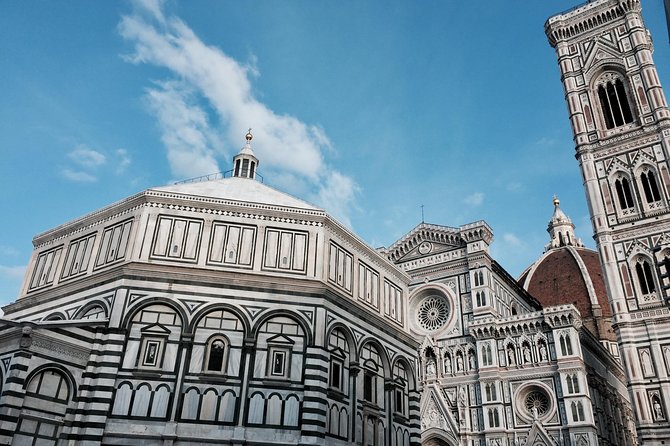
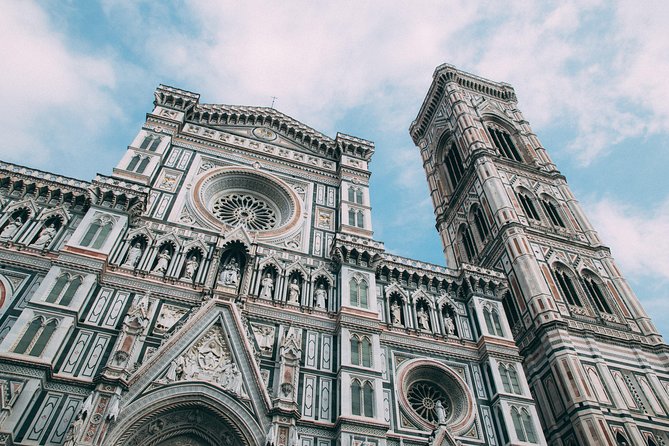
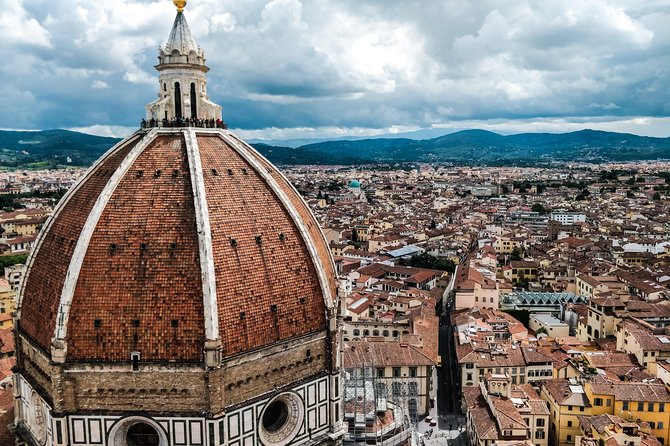
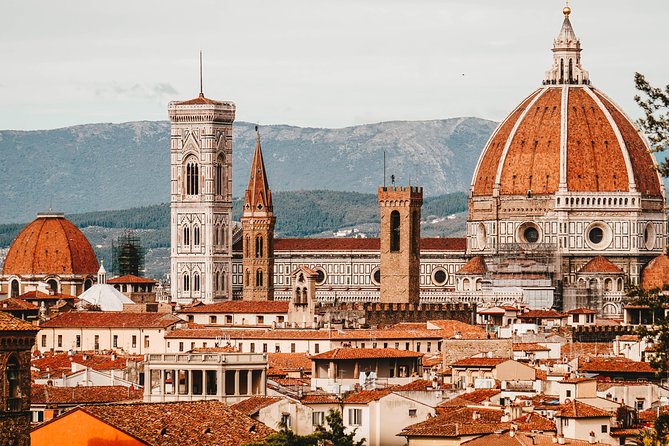
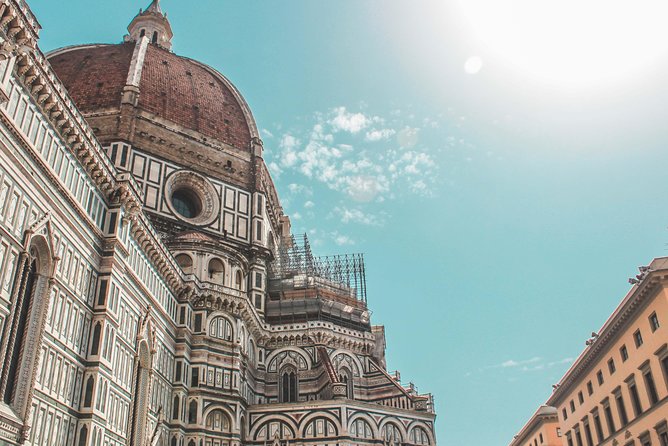
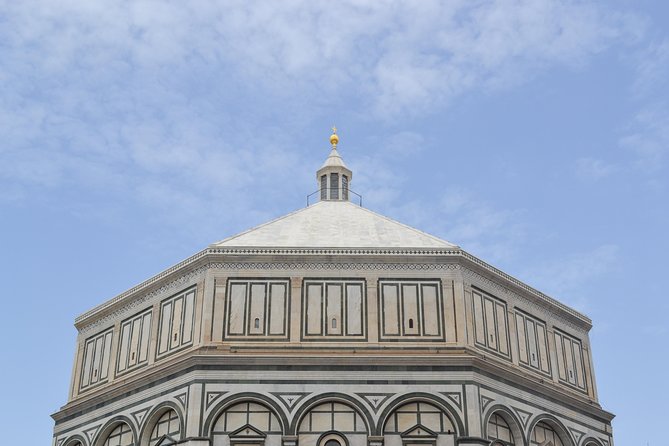
The Cathedral of Santa Maria del Fiore is the route’s biggest architectural subject. Brunelleschi’s dome dominates Florence and remains one of the clearest symbols of the city’s artistic ambition.
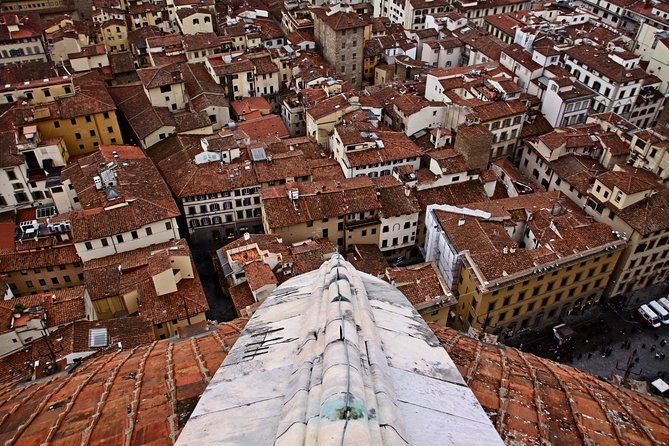
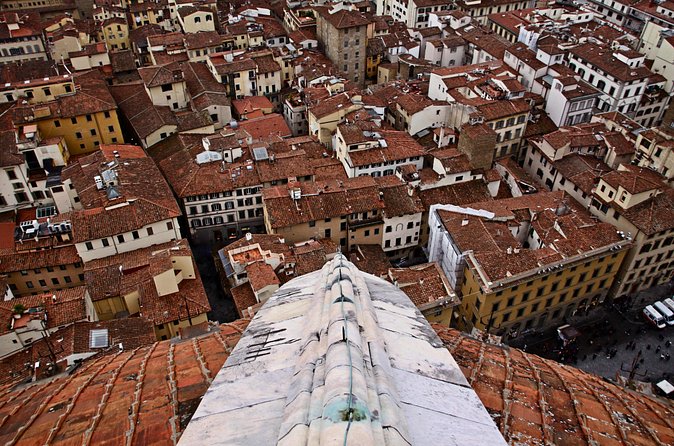
A guide can help you notice more than the dome’s size. The cathedral complex brings together several layers of Florentine design, including the cathedral, Giotto’s Campanile, and the surrounding marble decoration. The bell tower is a fine example of Florentine Gothic architecture and is known for its views over the city.
This is an important practical point: the tour does not include monument admission. If you want to climb the dome or bell tower, you will need separate entry arrangements, and the two-hour walk should not be treated as a substitute for those visits.
You will probably get the most value here by asking focused questions. Why was the dome such a technical challenge? How does the campanile differ from the cathedral? What should you notice in the marble patterns? A private guide can adjust the explanation to your level instead of giving the same speech to a large crowd.
A few more architecture tours in Italy worth a look
- Lecce: Baroque Architecture and Underground Walking Tour
★ 4.6 · 1,248 reviews - Experience Florence’s Art and Architecture on a Walking Tour
★ 5.0 · 318 reviews - Palermo: Art and Architecture Walking Tour
★ 4.7 · 136 reviews - Caprarola: Villa Farnese, masterpiece of Renaissance architecture
★ 4.5 · 28 reviews
Palazzo Vecchio explains Florence’s civic power
At Piazza della Signoria, Palazzo Vecchio shifts the story from religion to government. The medieval palace, with its crenellated tower, represents Florence’s civic authority and remains one of the square’s most commanding buildings.
Its historic rooms and art give the palace an important place in the city’s public life. Even from outside, the building’s fortified appearance tells you that Florence’s rulers wanted to project strength as well as refinement.
The square can be busy, so the guide’s value here lies in helping you separate political symbols from decorative details. You may also want to ask whether the itinerary allows time for the palace interior. Tickets are excluded, and the tour’s short duration makes an outside explanation more likely than a complete visit.
Santa Croce connects art, faith, and famous burials
Basilica di Santa Croce is the principal Franciscan church in Florence. Its Gothic structure and Renaissance elements give the guide another chance to compare different building styles, while its art and tombs connect the church to some of Italy’s best-known cultural figures.
This is one of the route’s more meaningful religious stops because the building serves several purposes at once. It is a place of worship, an art site, and a setting linked with illustrious Italians. That combination helps explain why Florence cannot be reduced to paintings and palaces alone.
Again, check your expectations. A two-hour overview can point out what deserves a later visit, but it cannot do justice to every chapel, tomb, and artwork. If Santa Croce is a priority, tell the guide early so the private itinerary can give it proper weight.
The Uffizi is more than a famous museum name
The Uffizi Gallery is one of the world’s most important art museums, but this experience presents it as an architectural stop as well as an art destination. Its historic building, near Piazza degli Uffizi, has a distinctive design that reflects Florence’s role as a center of administration, patronage, and art.
The phrase explore the Uffizi should be read carefully. Museum admission is not included, and the tour lasts about two hours while covering many locations. You may receive an introduction to the building and its setting rather than a full gallery visit.
That can still be useful. A guide can explain how the Uffizi fits into the city’s political and artistic story, then help you decide if a separate museum visit belongs in your schedule. If you want to see the collection itself, plan that as another activity and arrange entry independently.
Ponte Vecchio adds a working bridge to the route
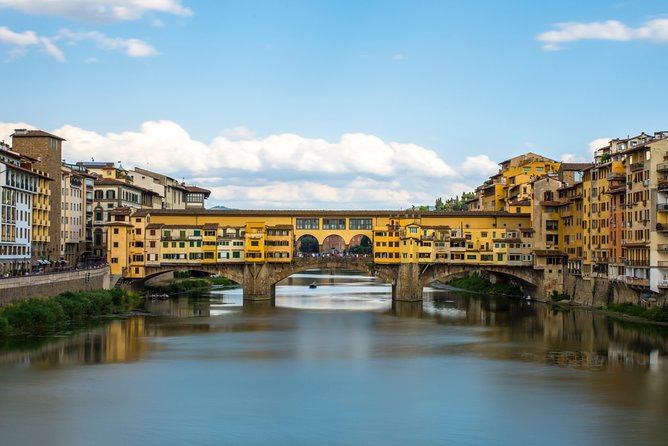
Ponte Vecchio is the most immediately recognizable bridge in Florence. It spans the Arno River and is famous for its shops built directly along the crossing.
The bridge offers a welcome change after churches, museums, and government buildings. Here, architecture meets commerce. The structure is not only something to photograph from the riverbanks. Its shops and narrow passage show how an old crossing became part of daily city life.
The bridge can be crowded, and the route may move at a steady pace. If you want time for photographs or a pause over the river, say so. A private tour gives you a better chance of adjusting the rhythm, though the guide still has several major stops to cover.
Pitti Palace shows the Medici scale of ambition
On the far side of the Arno, Pitti Palace brings the tour into the world of grand Renaissance residences. Located in Piazza de’ Pitti, the palace houses several museums and reflects the wealth and reach of the Medici family.
Its value on this route is partly visual and partly historical. After seeing churches and civic buildings, you can compare them with a residence built to express status and power. The palace also helps connect central Florence with the Oltrarno side of the river.
Admission is not included, so do not expect a complete museum visit during the walk. The guide can provide context and help you judge if the palace deserves a separate block of time. If your interest is mainly architecture, an exterior explanation may be enough. If you want the museums, plan extra time and a separate ticket.
The final villa offers a wider view of Florence
The experience ends at Costa San Giorgio, near a villa and gardens that provide views across Florence. This final setting broadens the tour from individual monuments to the relationship between architecture, gardens, and the city itself.
The villa and its gardens represent Renaissance culture in a different way from the Duomo or Palazzo Vecchio. Here, art and architecture meet cultivated nature, while the view helps you understand how Florence sits within its surrounding hills.
The endpoint is more than a convenient finish. It gives the route a visual conclusion, moving from close details on church façades and bridges to a wider view of the city. The end point is listed as Costa S. Giorgio, 2, so check the route on a map and be prepared for a walk that may include changes in elevation.
Walking, timing, and what the two hours really mean
This is a walking tour with a lot packed into a short period. The start at Santo Spirito and finish near Costa San Giorgio place the route across a substantial portion of central Florence, with several stops between them.
Most travelers can participate, but the experience is not recommended for people with impaired mobility. You should be comfortable walking through city streets and keeping up with a schedule that includes many architectural subjects. Service animals are allowed, and the route is near public transportation.
The itinerary can change with weather, interests, and walking pace. That flexibility is useful, but it also means the exact order and amount of time at each stop may vary. If you have three non-negotiable priorities, name them at the beginning.
Do not book this expecting ten full attractions in two hours. You are getting a guided framework: key exteriors, architectural context, orientation, and advice about what to revisit. The experience works best as a first or early activity during a Florence stay, when you still need help deciding where to spend your independent time.
Who gets the best value from the $786.04 price
The cost is easiest to justify for a pair who wants privacy and direct access to a local expert. Because the fee covers up to two people, couples can split the cost, though the final amount remains high compared with a shared walking tour.
I would consider booking if you:
- Care more about architecture and context than a long list of admission tickets.
- Want to shape the route around your interests.
- Prefer asking questions without a large group nearby.
- Have limited time in Florence and need a strong city orientation.
- Plan to visit several of the museums and monuments separately after the walk.
I would hesitate if you:
- Want interior access to the Duomo, Uffizi, Pitti Palace, or Santa Croce included.
- Prefer a slow, detailed visit to one or two buildings.
- Are watching your budget.
- Have difficulty with extended walking.
- Already understand Florence’s architecture and only need directions.
The price does not include personal expenses, transportation, museum tickets, or monument admission. You should treat those as additional costs, not minor footnotes.
Should you book Architectural Florence?
Book it if your main goal is to understand how Florence’s Gothic churches, Renaissance buildings, civic spaces, and Medici sites fit together. The private format, adaptable pace, and strong praise for the guide’s detailed architectural explanations give this experience real value for an architecture-minded pair.
Skip it if you want a full museum tour or a leisurely interior visit. Two hours cannot provide both broad coverage and deep exploration, especially when admission tickets are separate.
For the right pair, this is a useful first look at Florence. You get the city’s major architectural themes, a route through its most important quarters, and a local expert who can help you decide what deserves more of your time afterward.
FAQ
How long does the Architectural Florence tour last?
The tour lasts approximately two hours.
How many people can join the private tour?
The price covers a private group of up to two people.
Where does the tour begin?
It begins at Basilica di Santo Spirito, Piazza Santo Spirito, 30, 50125 Florence.
Where does the tour end?
The tour ends at Costa S. Giorgio, 2, 50125 Florence.
Are museum and monument tickets included?
No. Entry tickets for transportation, museums, and monuments are excluded.
Can the itinerary change?
Yes. The itinerary can adapt to your interests and walking pace, and stops may change depending on weather conditions.
Just added in Italy
- Vicenza: Palladian Architecture Private Walking Tour★ 3.3 · 3 reviews
- Private Personalized Architecture Tour of Rome with an Architect★ 5.0 · 5 reviews
- Architectural Milan: Private Tour with a Local Expert★ 4.5 · 2 reviews
- The Architect’s Water★ 4.5 · 11 reviews
- Rione Sanità: tour among street art, architecture, folklore★ 4.5 · 2 reviews
- Palermo Tour: Magnificent Mixture Of Architectural Styles★ 4.2 · 6 reviews
- Discover Coppedè in Rome: Liberty architecture, symbols, and jewels★ 5.0 · 2 reviews
- Borgo Parrini Gaudí-style: a walking tour in a colorful art village★ 4.8 · 9 reviews
Architecture Tours, compared.

Chicago River: 1.5-Hour Guided Architecture Cruise
Read our review →
Chicago Architecture Center River Cruise aboard First Lady
Read our review →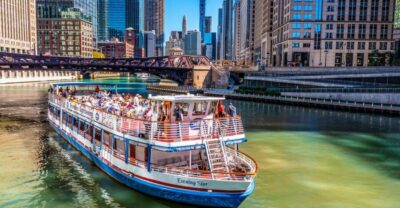
Architecture River Cruise Skip-the-Ticket Line
Read our review →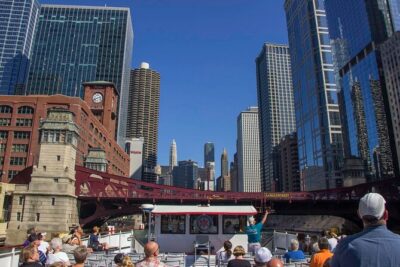
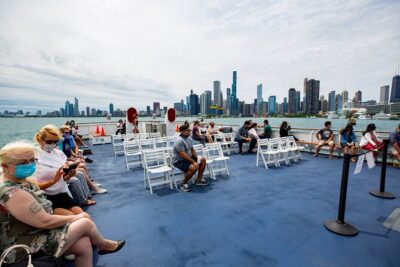
Chicago River 45-Minute Architecture Tour from Magnificent Mile
Read our review →
Browse the lists this tour appears in