
REVIEW · WALKING TOURS
Lecce: Baroque Architecture and Underground Walking Tour
Lecce rewards a slow look upward. This 90-minute walk links Baroque churches and palaces with Roman remains and the underground Jewish Museum, giving you a useful first picture of the city. I like the route because it covers the main historic center without wasting time on transport, and I like the guides’ mix of architecture, archaeology, local life, and humor.
The strongest part is the live commentary. Guides such as Max, Massimiliano, Fabrizio, Antonio, and Angela have been praised for clear explanations and easy conversation. One possible drawback is that Santa Croce Church is viewed from outside, while the underground museum can feel modest if you expect a large, dramatic excavation.
- Santa Croce exterior: Study Lecce’s famous carved Baroque facade from the square outside.
- Roman and modern Lecce together: See the Roman Column and amphitheater remains beside the busy heart of town.
- Underground Jewish Museum: Learn about Lecce’s Jewish past through the remains below street level.
- Piazza Duomo finale: See one of Italy’s most admired architectural ensembles from the outside.
- Strong guide element: The experience depends heavily on your guide, with Max and Massimiliano receiving especially warm praise.
- Good short introduction: At $29, the tour offers a focused way to get your bearings before exploring churches and museums independently.
Why this short Lecce walk works
Lecce is easy to walk around, but it is not always easy to understand. Its creamy local stone is covered with curls, saints, columns, masks, flowers, and theatrical details. Without some explanation, you may admire the surfaces without grasping how Roman, medieval, Jewish, religious, and modern stories overlap.
This tour gives you that framework in a compact 1.5-hour route. You move through the historic center with a guide who can point out details you could easily miss, then step below ground to consider an important part of Lecce’s past.
I would not choose this as a substitute for a full church visit. It is better viewed as a lively orientation walk. Afterward, you can return to the buildings that caught your eye and pay separately to enter selected churches or other sites.
The tour is offered as a shared group or private experience. The group format should suit most people who want company and a lower price. A private option makes more sense if you want to ask many questions, move at your own pace, or have a particular interest in architecture or local history.
Starting beneath Lecce at the Jewish Museum
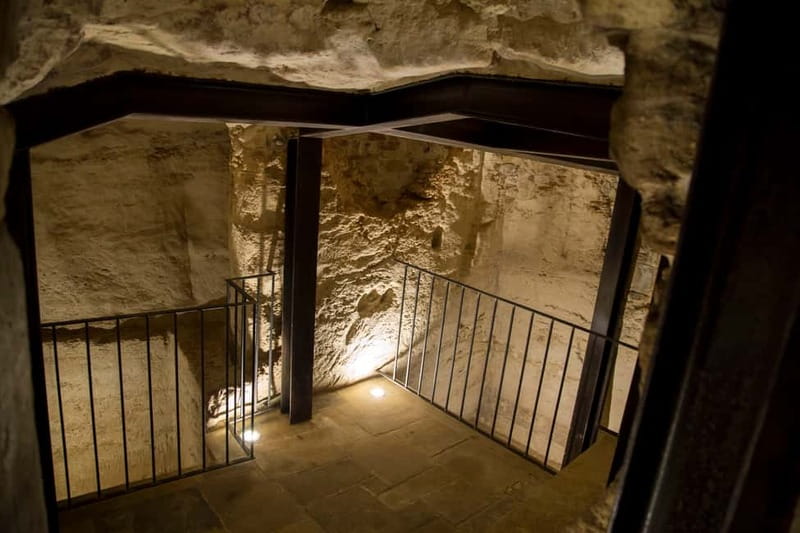
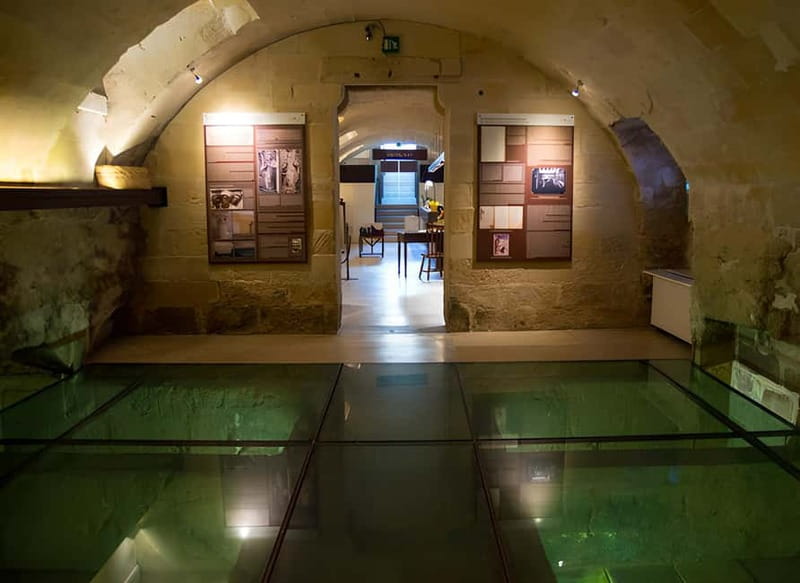
The route may begin underground at the Jewish Museum, depending on the arrangement for your tour. This is an important feature because it moves beyond the usual Baroque postcard view of Lecce.
The museum presents the town’s Jewish past through an underground setting. The space is not described as a huge archaeological complex, so keep your expectations measured. Its value comes from the story and the contrast: you begin below the polished streets and ornate facades, then spend the rest of the walk looking at the city above.
The museum also works well for visitors who are not especially interested in religious subjects. The focus is on Lecce’s history and the people who shaped the city, rather than on a narrowly devotional presentation.
Some participants have found the underground portion less impressive than the outdoor architecture. That is fair. If your main goal is grand interiors, frescoes, and carved stone, the museum may feel like the quieter part of the route. Still, it adds a layer that many quick city walks skip.
More baroque architecture tours in Italy:
- Noto: Sicilian Baroque Architecture Guided Walking Tour
★ 4.3 · 6 reviews - Martina Franca: Baroque and Rococo Architecture Walking Tour
★ 5.0 · 4 reviews - LECCE: AMONG ARCHITECTURAL TREASURES IN THE LECCE BAROQUE
★ 4.7 · 3 reviews
Santa Croce and the language of Lecce Baroque
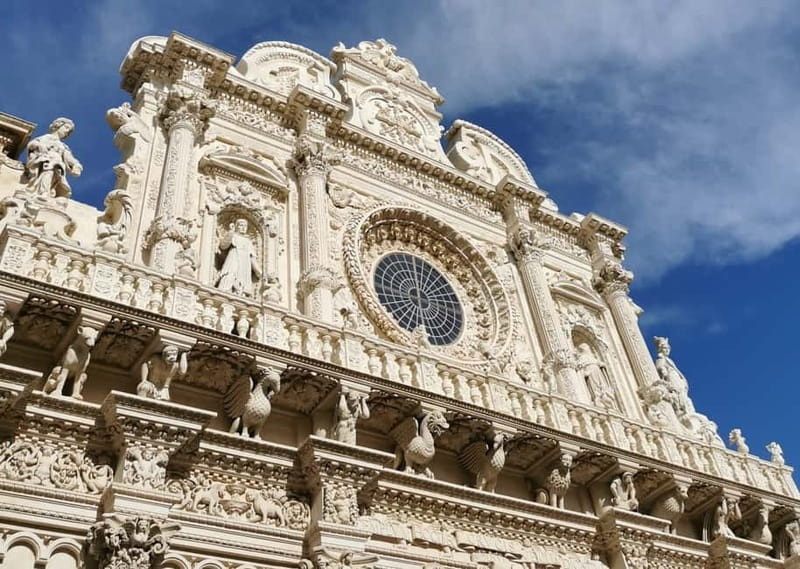
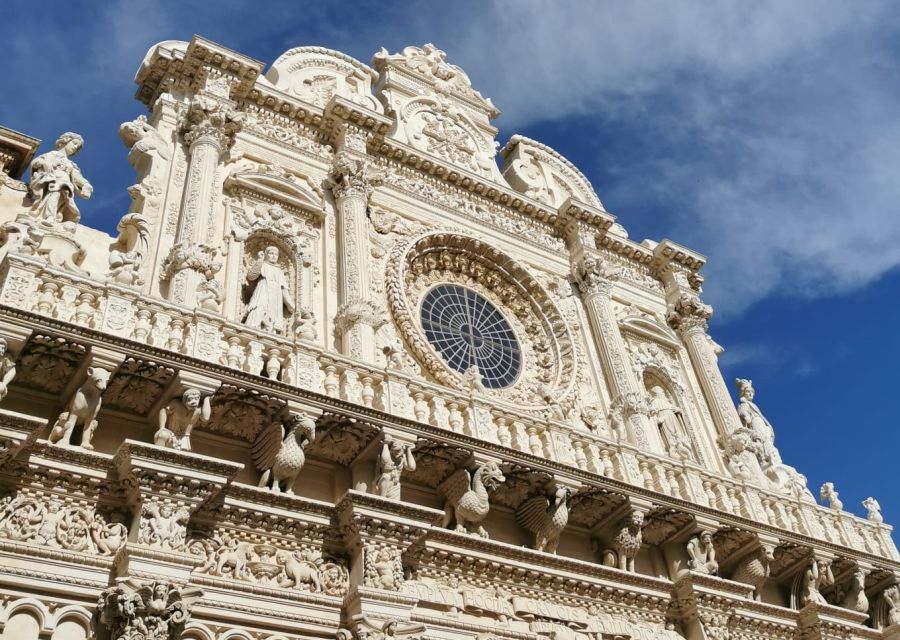
From the underground museum, the walk reaches Santa Croce Church, the most visually forceful stop on the route. The visit here is external, so you will spend your time studying the facade rather than entering the church.
That is enough to understand why Santa Croce matters. The facade is crowded with sculpted decoration and dramatic detail. Your guide can help separate the visual noise into parts, explaining what you are looking at instead of leaving you to photograph the whole thing and move on.
This is where a good guide makes a real difference. Max has been praised for combining facts with humor, while other guides have been described as passionate, patient, and clear in English. The tone can vary, but the best guides keep the group looking closely rather than simply naming the building.
If you want to see the interior, plan to return on your own. That is one of the tour’s clearest limitations. Several people have felt that entering Santa Croce or another church would have added more value, especially since the theme centers on Lecce’s Baroque architecture.
Still, the exterior stop is not a quick photo pause. It gives you a visual key for the rest of the walk. Once you see how much work went into the stone carving here, the palaces and churches along the route become easier to read.
Piazza Sant’Oronzo and Lecce’s Roman core
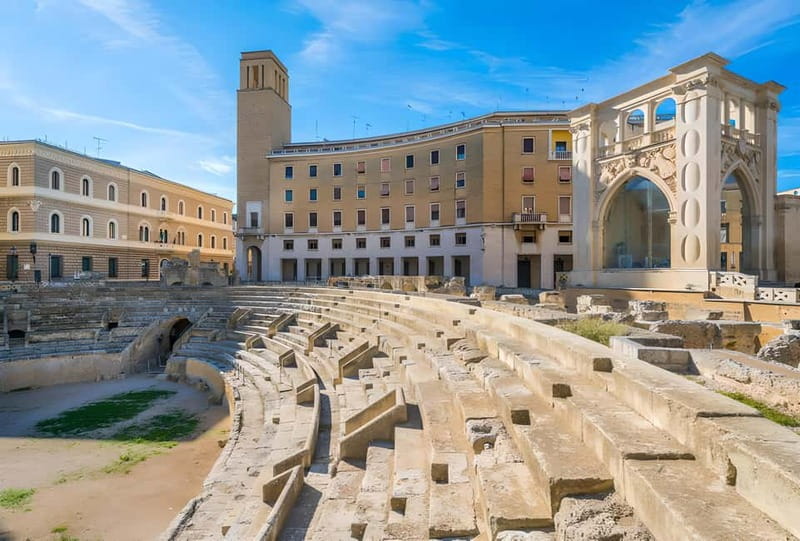
Next comes Piazza Sant’Oronzo, a central square with several periods of Lecce’s story gathered together. It was formerly a market square, and today it brings together civic buildings, Roman remains, and the daily movement of the city.
The Roman Column is one of the main points of interest. It helps connect present-day Lecce with its ancient past, and your guide explains the Roman era rather than treating the column as an isolated monument.
Nearby are the remains of a large Roman amphitheater. The excavated structure is a reminder that the modern city was built over an older one. You can look from the present street level toward the surviving ancient stone, which makes the history feel physical and immediate.
The square also includes the Old Town Hall. This is a useful stop for understanding how the center functioned as a civic and commercial space, not just a collection of churches. The tour’s strength is this movement between uses: religion, public life, trade, entertainment, and daily routines all appear along the same short route.
Restoration work has affected parts of the center, including areas around Palazzo INA and the amphitheater. That may mean some views are not fully open at the moment you visit. It also shows that Lecce’s archaeology is still being uncovered and cared for, rather than frozen as a finished museum piece.
Corso Vittorio Emanuele and the city’s elegant middle stretch
The walk continues along Corso Vittorio Emanuele, where Baroque palaces line the route. This is an enjoyable section because you see how the style extends beyond famous churches.
Look up as you walk. The most useful details are often above eye level: balconies, stone frames, decorative figures, and the way individual buildings fit into the street. A guide can point out differences that are easy to miss when you are thinking mainly about where to eat or how to reach the next square.
The recently restored Sant’Irene Church adds another architectural stop. You see it as part of the broader city story, with the guide explaining how Lecce’s religious buildings relate to the period’s design language.
This part of the route also shows why the tour is more useful than a simple list of monuments. The guide can explain how the buildings relate to one another and to the street. You are not just collecting names. You are learning how to read Lecce’s stonework.
The walk is generally described as well paced. One person noted that it finished after exactly 90 minutes, while another expected two hours and was surprised when it ended sooner. The advertised duration is 1.5 hours, so you should plan around that rather than expecting a longer city walk.
More walking tours in Italy:
- Experience Florence’s Art and Architecture on a Walking Tour
★ 5.0 · 318 reviews - Palermo: Art and Architecture Walking Tour
★ 4.7 · 136 reviews - City Walk with Architect: Private walking tour of Rome
★ 5.0 · 22 reviews - Private Tour: Venice Art and Architecture Walking Tour
★ 4.0 · 22 reviews
Piazza Duomo, Lecce’s grandest ensemble
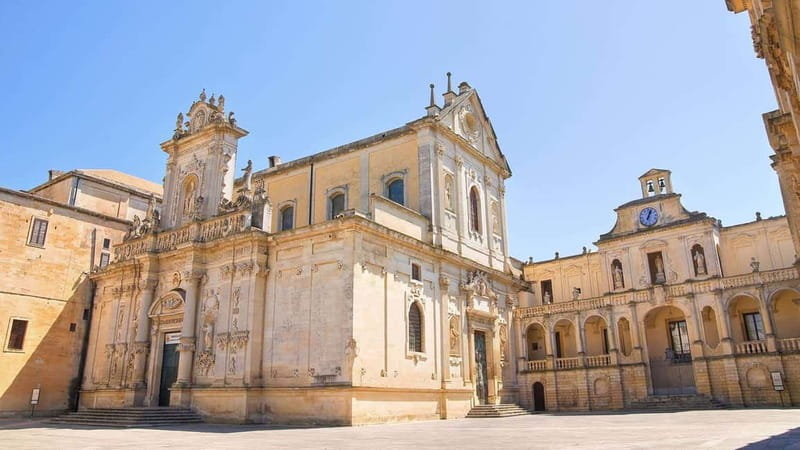
The final major outdoor stop is Piazza Duomo. It is one of the most striking spaces in Lecce because the square gathers several important buildings into one carefully composed view.
You can admire the exterior of the Archbishop’s Residence, the Seminary, the Bell Tower, and the cathedral. The arrangement gives the square a stage-like quality, with the buildings enclosing the space and directing your attention from one facade to the next.
This is another point where commentary matters. If you visit alone, you can appreciate the composition, but you may not notice why the square is considered such an important architectural group. Your guide helps you understand the relationship between the buildings and the way their decoration creates a unified scene.
The cathedral is viewed from outside on this tour. For some people, that is enough for an introduction. For others, it is the main reason to buy additional church-entry tickets afterward. One visitor specifically found it worthwhile to add tickets for churches and the tower after learning the architectural background on the walk.
That is a sensible plan. Take the tour first, note which interiors interest you, then decide where to spend extra money. You will have more context when you return.
What the guides add to the experience
The strongest praise consistently goes to the guides, not just to the route. Max is repeatedly described as engaging, funny, and well informed. Massimiliano has been appreciated for connecting Lecce’s past with life in the city today. Fabrizio, Angela, Antonio, Alex, Ilena, Mario, and other guides have also been praised for clear explanations and friendly delivery.
The exact personality will depend on who leads your group. Some guides use dry humor. Others take a more serious, academic approach. That variety is part of the experience, but the common thread is strong command of Lecce’s architecture and history.
One especially appealing detail is the range of professional backgrounds. A guide described as both an archaeologist and an architect brought a particularly useful perspective to the city’s buildings and excavations. You may also find that your guide offers practical suggestions for restaurants, gelato shops, or further sightseeing.
The commentary is not only about dates and building names. It can include anecdotes, local culture, explanations of restoration, and answers to questions. That makes the walk feel personal rather than mechanical.
On hot days, the guide may adjust where the group stops and talks. One person appreciated being kept in the shade while the guide explained each point of interest. That is a small detail, but it matters in Apulia during warm weather.
Price, timing, and overall value
At $29 per person, the tour sits in a reasonable range for a guided city walk that includes a museum admission. You are paying for the guide’s interpretation as much as for the entry ticket.
The value is strongest if you are new to Lecce and want a structured introduction in a short period. In 90 minutes, you cover Santa Croce, Piazza Sant’Oronzo, the Roman Column, the amphitheater remains, Corso Vittorio Emanuele, Sant’Irene, Piazza Duomo, and the Jewish Museum.
The value is weaker if you already know the historic center or mainly want to enter churches. The tour does not include hotel pickup, food, drinks, or interior access to Santa Croce and the other major churches described along the route.
A few tours have ended with an unexpected tasting of olive oil, wine, or local food. Treat that as a possible extra rather than a promised part of the tour, since it is not listed among the inclusions. If it happens, it can be a pleasant finish. If it does not, you have still received the stated walking tour and museum entry.
You can choose a shared or private format. The group size is described as manageable by people who have taken it, but no fixed maximum is provided. If a small group and personal attention matter greatly to you, check the option details before booking.
Flexible booking is another practical advantage. You can reserve and pay later, and cancellation is free up to 24 hours before the tour for a full refund. The walk is wheelchair accessible, and live guiding is available in English, Italian, and French.
Who should take this Lecce tour?
I would recommend it to a first-time visitor who wants history without spending half a day indoors. It is also a good fit if you enjoy architecture but do not have the background to identify Baroque details on your own.
Families with older children and teenagers may appreciate the short length and changing subject matter. Roman ruins, dramatic facades, public squares, and an underground museum give the walk enough variety to hold attention.
It suits independent visitors, too. Use it early in your stay, then return to the churches, tower, museums, or excavations that interest you most. You will have a better sense of where to spend your limited sightseeing time.
I would be more cautious if you expect a full museum visit, extensive archaeological access, or entry into several churches. The route is primarily an outdoor walking tour with one underground museum stop.
Wear comfortable shoes and be ready to look up often. The route is short, but Lecce’s stonework rewards attention, and the best details are rarely at eye level.
Should you book the Lecce Baroque and Underground Tour?
Book it if you want a focused introduction to Lecce’s Roman, Jewish, civic, and Baroque layers, especially if you can join a guide such as Max or Massimiliano. The commentary is the main reason to go, and the price is fair for the route, live guide, and museum entry.
Skip it if your priority is entering Santa Croce, the cathedral, and several other churches in one visit. In that case, use the walk only if you want the background first, then budget separately for church and tower tickets.
For most first visits, I think the tour earns its place. It is short, useful, and broad enough to make the rest of Lecce easier to understand.
FAQ
How long does the Lecce walking tour last?
The tour lasts 1.5 hours, or about 90 minutes.
How much does the tour cost?
The listed price is $29 per person.
What languages are available?
Live guiding is available in English, Italian, and French.
Is the Jewish Museum included?
Yes. The Jewish Museum entry ticket is included in the tour price.
Does the tour visit the inside of Santa Croce Church?
No. Santa Croce Church is visited from the outside.
What can I see in Piazza Sant’Oronzo?
The route includes the Old Town Hall, the Roman Column, and remains of a large Roman amphitheater.
Does the tour include Piazza Duomo?
Yes. You see the exterior of the Archbishop’s Residence, Seminary, Bell Tower, and cathedral.
Is hotel pickup included?
No. Hotel pickup and drop-off are not included.
Are food and drinks included?
No. Food and drinks are not included. Some tours may offer a tasting, but it is not listed as a standard inclusion.
Is the tour wheelchair accessible?
Yes. The activity is described as wheelchair accessible.
Can I cancel the tour for a refund?
Yes. You can cancel up to 24 hours in advance for a full refund.
Can I reserve now and pay later?
Yes. The booking option allows you to reserve your place and pay later.
Just added in Italy
- Vicenza: Palladian Architecture Private Walking Tour★ 3.3 · 3 reviews
- Private Personalized Architecture Tour of Rome with an Architect★ 5.0 · 5 reviews
- Architectural Milan: Private Tour with a Local Expert★ 4.5 · 2 reviews
- The Architect’s Water★ 4.5 · 11 reviews
- Architectural Florence: Private Tour with a Local Expert★ 5.0 · 3 reviews
- Rione Sanità: tour among street art, architecture, folklore★ 4.5 · 2 reviews
- Palermo Tour: Magnificent Mixture Of Architectural Styles★ 4.2 · 6 reviews
- Discover Coppedè in Rome: Liberty architecture, symbols, and jewels★ 5.0 · 2 reviews
Walking Tours, compared.

The Official Art Deco Walking Tour by The Miami Design Preservation League
Read our review →
Chicago in a Day: Food, History & Architecture Walking Tour
Read our review →

Ramblas, Old Town, Gothic and Gaudi Architecture Walking Tour
Read our review →
Chicago’s Secret Interiors Architectural Walking Tour
Read our review →
Historic Georgetown: History, Gossip, & Architecture Walking Tour
Read our review →Browse the lists this tour appears in