
REVIEW · ARCHITECTURE TOURS
LECCE: AMONG ARCHITECTURAL TREASURES IN THE LECCE BAROQUE
Lecce rewards a slow look. This two-hour walking tour links Roman remains, carved Baroque stone, grand palaces, and some of Salento’s most important churches in one compact route. I like the clear progression from Porta Napoli to Piazza Sant’Oronzo, and I like that guide Federica Manzi is praised for her excellent Spanish, broad knowledge, and willingness to answer questions without rushing.
The main consideration is that church entry fees are not included. The tour is also offered only in Italian or Spanish, so you will want to choose your language carefully. At $147.27 for up to five people, it makes the most sense for a small group, not for a solo visitor paying the full private-group price.
Key points at a glance
- Porta Napoli sets the historical tone: Begin at Lecce’s sixteenth-century gateway, built from the city’s famous pale stone and linked to Charles V of Habsburg.
- Piazza del Duomo is unusually enclosed: Its closed design brings the cathedral, bishop’s palace, and seminary palace into one striking Baroque composition.
- Roman Lecce shares the route with Baroque Lecce: The walk connects ancient streets and the Roman amphitheater with much later churches and palaces.
- Federica Manzi earns strong praise: Her clear Spanish, friendly manner, and ability to answer questions are major strengths.
- The price favors groups of up to five: Split five ways, the cost is reasonable for a private historical and cultural walk.
- Church admissions cost extra: You see the religious buildings from outside as part of the walk, but entry is separate.
Why Lecce’s Baroque works so well on foot
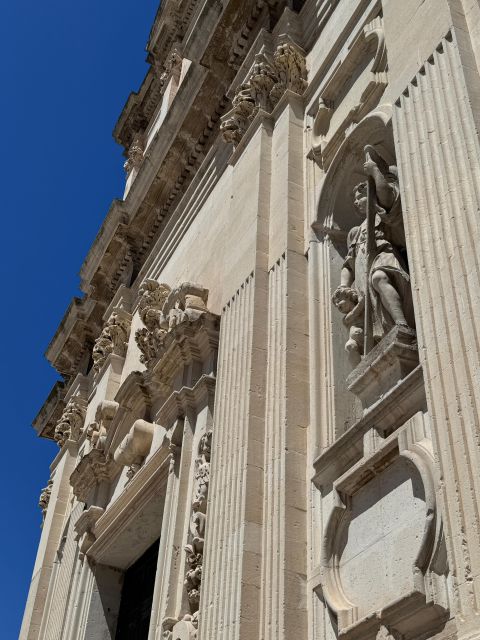
Lecce is one of those Italian cities where the stone does much of the talking. Local limestone is soft enough to carve into curling leaves, angels, columns, masks, and elaborate door surrounds. The result is a city center that can feel theatrical, yet the route is small enough to cover on foot in two hours.
I like this tour because it does not treat Lecce as a single-period city. You move from a gateway connected with the age of Charles V to Roman remains, then into the ornate religious architecture that gives Lecce its fame. That mix helps you understand the city instead of simply collecting a series of pretty façades.
The route is also practical for a first visit. It begins at Porta Napoli and finishes at Piazza Sant’Oronzo, two easy points to recognize in the historic center. You get an organized introduction without needing a full day, a bus, or a complicated plan of attack.
Still, two hours calls for sensible expectations. You will get a guided orientation and a strong look at the main monuments, but this is not a museum-heavy study of Lecce. Since church admission is not included, you should also treat the walk as an exterior-focused tour unless you choose to pay for entries separately.
More baroque architecture tours in Italy:
- Lecce: Baroque Architecture and Underground Walking Tour
★ 4.6 · 1,248 reviews - Noto: Sicilian Baroque Architecture Guided Walking Tour
★ 4.3 · 6 reviews - Martina Franca: Baroque and Rococo Architecture Walking Tour
★ 5.0 · 4 reviews
Porta Napoli, a grand entrance into Lecce
The meeting point is Porta Napoli, a sixteenth-century gateway built in Lecce stone. It was created in memory of Charles V of Habsburg, giving the tour an immediate connection to the political world that shaped the city.
A gateway is a useful place to begin because it gives the city a clear threshold. Before you head into the historic center, you see how Lecce presented itself to people arriving from outside. The pale stone also introduces one of the central themes of the walk: the local material that allowed craftsmen to turn buildings into elaborate works of art.
I would pay attention here to the contrast between the practical role of a city gate and its decorative purpose. Porta Napoli was built for movement and civic identity, not simply as a photogenic backdrop. Your guide can place it within the wider story of Lecce before the route shifts toward churches and palaces.
Because this is an outdoor starting point, arrive ready to walk. The experience is listed as wheelchair accessible, which is useful for visitors who need an accessible route, though the tour still moves through the historic center and includes several architectural stops.
Via Giuseppe Palmieri and the first Baroque details
From Porta Napoli, the route follows Via Giuseppe Palmieri. This street leads you between churches and Baroque palaces, so the architectural focus begins before the major squares appear.
That is important in Lecce. The city’s appeal is not limited to one cathedral or one famous façade. Decorative details often appear along ordinary streets, and a guide can point out how buildings relate to one another. Without that context, you might notice the stonework but miss how much of the historic center shares the same visual language.
This section should suit you if you enjoy walking through a city and learning as you go. It is less useful for someone who wants long interior visits or a fixed series of museum rooms. The pace is designed to connect several parts of the center, so you will spend much of the time moving from one architectural view to the next.
Federica Manzi’s strongest reported qualities fit this part of the tour well. She is praised for speaking Spanish impeccably, explaining Italian artistic and cultural subjects in detail, and adapting to questions. That last point matters on a street walk because your interests may shift from architecture to local customs, religious buildings, or the city’s past.
Piazza del Duomo and Lecce’s rare closed square
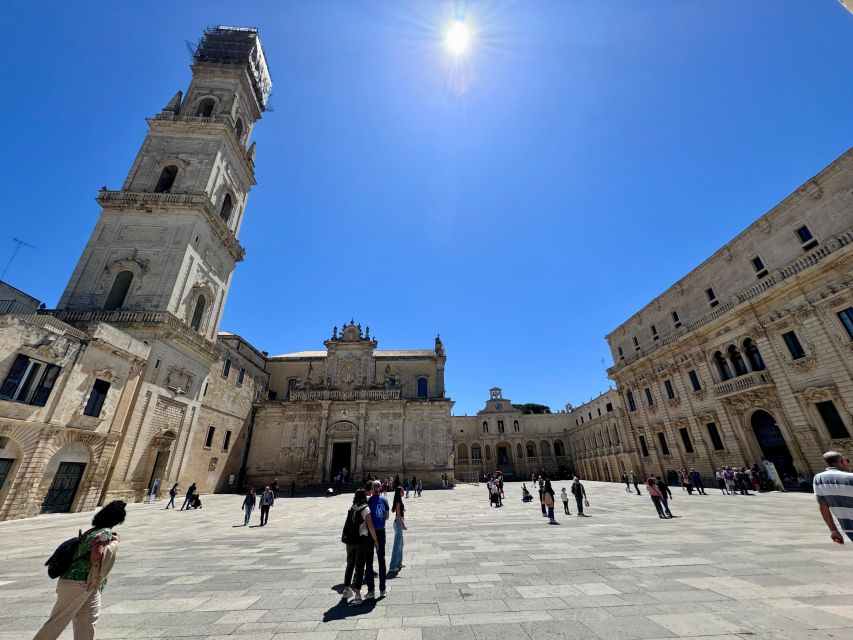
The route then reaches Piazza del Duomo, one of the most memorable spaces in Lecce. It is described as a rare example of a closed square, with the cathedral, bishop’s palace, and seminary palace gathered into a strongly defined architectural setting.
Many Italian piazzas feel open and public, with several streets feeding into them. Piazza del Duomo offers a different effect. Its enclosed arrangement makes the buildings feel like parts of one carefully composed scene. You can pause here and take in the relationship between the structures instead of looking at each one as an isolated monument.
The cathedral is the main visual anchor, but do not overlook the bishop’s palace and seminary palace. Their presence explains why the square feels complete from several angles. The point is not just that these are three important buildings. It is that their placement creates a contained urban room.
I would consider this one of the tour’s strongest stops for photographs and orientation. You can also use it to test what you have learned about Lecce stone. The ornate surfaces become easier to read after your guide has already shown you churches and palaces along Via Giuseppe Palmieri.
The practical limitation remains the same: entry to the churches is not included. You can appreciate the outside architecture during the guided route, but do not assume the two-hour walk includes a full interior visit to the cathedral or other religious buildings.
A few more architecture tours in Italy worth a look
- Experience Florence’s Art and Architecture on a Walking Tour
★ 5.0 · 318 reviews - Palermo: Art and Architecture Walking Tour
★ 4.7 · 136 reviews - Caprarola: Villa Farnese, masterpiece of Renaissance architecture
★ 4.5 · 28 reviews - Best of Bologna in one day : Food, architecture, art and history
★ 5.0 · 27 reviews
Ancient Roman streets beneath the Baroque surface
After Piazza del Duomo, the route winds through the streets of the ancient Roman city. This change of period keeps the walk from becoming a parade of Baroque façades.
Lecce’s Roman layer gives the city a different scale. Baroque architecture draws your eye upward and outward with decoration. Roman remains and street patterns remind you that the city developed over a much longer span. The value of a guide here is the connection between what you can see now and the earlier urban structure beneath it.
I like this part because it gives the tour a sense of depth without requiring a separate archaeological excursion. You remain in the historic center, but the subject changes from decorative stonework to the older city. If you already know Lecce’s Baroque churches, this section may be especially useful because it adds the missing Roman context.
The description does not promise a dedicated archaeological site visit or museum admission, so keep expectations grounded. This is a guided walk through the ancient city area, not a specialist excavation tour. You are getting a connected story rather than a long stop at one ruin.
Piazza Sant’Oronzo and the Roman amphitheater
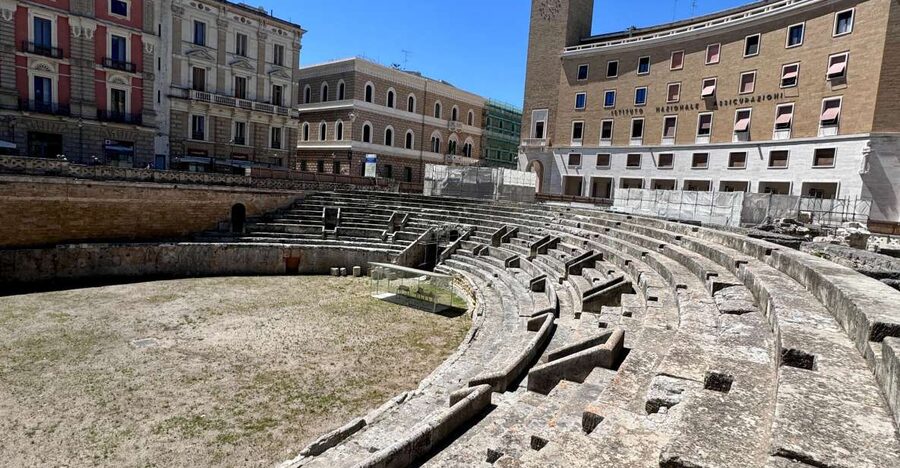
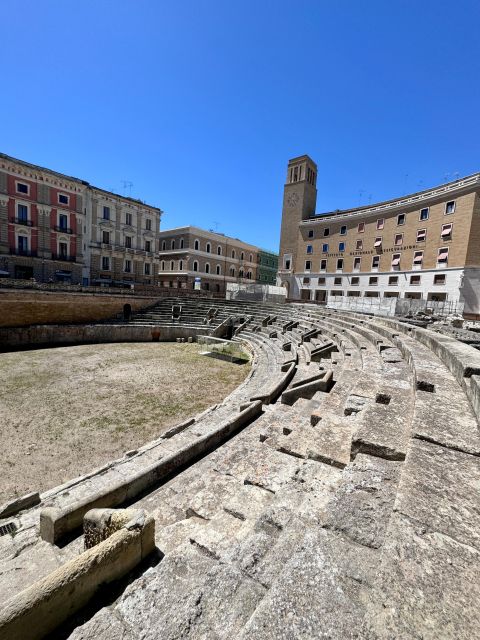
The route continues along the main street to Piazza Sant’Oronzo, the final point of the tour. This square is home to two major symbols of Lecce: the Roman amphitheater and the Roman column carrying the statue of Saint Oronzo, the city’s protector.
The pairing is a good example of Lecce’s layered identity. The amphitheater points back to Roman public life, while the column and saint connect the square to the city’s Christian tradition. A short distance can carry you across centuries, and the guide’s explanations help keep those periods from blurring together.
The Roman amphitheater is an especially useful stop because it gives you something different from the churches and palaces. Instead of carved façades, you see the remains of a large ancient structure integrated into the modern city. It is a reminder that Lecce is not only about the Baroque style that appears in guidebooks and photographs.
Ending at Piazza Sant’Oronzo is convenient. Once the tour finishes, you are already at one of the city’s central public spaces, with an obvious place to continue your own walk. The stated finish is the piazza, even though the route also includes Lecce’s evocative Baroque churches and the Basilica of Santa Croce. If you have a specific church you want to enter, ask Federica about the route and admission arrangements before the tour begins.
The churches and Basilica of Santa Croce
The final portion highlights Lecce’s Baroque churches, including the Basilica of Santa Croce, one of Salento’s best-known symbols. Its façade is the kind of architecture that rewards time: the more closely you look, the more carved details you find.
Santa Croce matters not only because it is ornate, but because it brings together the themes introduced earlier in the walk. You have seen Lecce stone, religious architecture, decorative façades, and the local Baroque style. Here those ideas reach their most famous expression.
I would not rush this stop. Even if the tour schedule is firm, listen for the explanation of the façade’s artistic and cultural role. The visual details can seem excessive at first glance. With context, they become easier to understand as a deliberate local style rather than decoration added at random.
Remember that church entry is not included. The information provided does not specify which churches are entered during the walk, so you should not count on interior access. If seeing Santa Croce inside is a priority, confirm that point before booking or plan to return independently.
What Federica Manzi adds to the walk
The guide can make or break a short city tour. Two hours is enough to create a strong first impression, but only if the explanations are clear and the pace leaves room for questions.
Federica Manzi receives particularly strong praise for her Spanish. One detailed assessment describes her as speaking Spanish impeccably and knowing Italian history, art, and culture in detail. It also highlights her pleasant manner and her ability to adapt to requests, with the group able to see Lecce without feeling rushed.
Another assessment praises her training and her ability to answer every question put to her. That is exactly the quality I would want on an architectural tour. Lecce presents plenty of opportunities to ask why a building looks the way it does, how Roman and Baroque periods meet, or what a particular church means to the city.
The available language choices are Italian and Spanish. If you need English, this is not the right booking based on the stated information. For Italian and Spanish speakers, the guide’s communication skills are a major reason to consider it.
Price, group size, and overall value
The price is $147.27 per group of up to five people. That wording matters. A full group of five pays about $29.45 per person, which is a fair price for a private two-hour cultural walk led by a live guide.
For two people, the cost is about $73.64 each. For one person, the price is much harder to justify unless a private guide is important to you. The value improves sharply as your group gets closer to five.
You are paying for a focused route through Lecce’s historic center, not for transportation, meals, or church admissions. The highlights include a gastronomic and cultural itinerary, but the supplied details do not specify food tastings or restaurant stops. I would read that phrase as a cultural walk with a local connection, not as a food tour with included samples.
The tour’s short duration is another part of its value. If you have only a morning or afternoon in Lecce, it gives you a useful framework. If you have several days, it can work as a first walk before you return to the buildings that interest you most.
Who should book this Lecce tour?
I would recommend it most strongly to a small group of up to five people who want a private introduction to Lecce’s historic center. It is also a good fit for Italian or Spanish speakers who enjoy asking questions rather than simply following a fixed script.
You will likely appreciate it if you care about:
- Baroque churches and palaces
- Roman remains in a living city center
- Short walking tours with a clear start and finish
- Cultural and historical context
- A guide who can adapt to questions
- Wheelchair-accessible tour arrangements
I would hesitate if you want extensive interior access, included admissions, a food tasting, or an English-language guide. The two-hour format is useful, but it cannot cover every church in detail.
The 4.7 rating from three recorded assessments is encouraging, though the sample is small. The praise is consistent on the points that matter most here: Federica’s Spanish, her command of the subject, her friendly approach, and her ability to answer questions.
Should you book it?
Book this tour if you want Lecce explained as a layered city, not just photographed as a Baroque backdrop. The route covers Porta Napoli, Via Giuseppe Palmieri, Piazza del Duomo, Roman streets, Piazza Sant’Oronzo, the amphitheater, the Roman column, and major churches in two hours.
I would book it for a group of three to five, especially if you speak Italian or Spanish. The cost then feels reasonable, and Federica’s praised ability to adjust the walk to your questions adds real value. If you are alone, need English, or care most about going inside churches, save the money for individual admissions and choose a format that matches those priorities.
FAQ
How long does the Lecce walking tour last?
The guided tour lasts two hours. Starting times vary, so you need to check availability for the date you want.
Where does the tour begin?
The tour begins at Porta Napoli, the sixteenth-century gateway in Lecce’s historic center.
Where does the tour finish?
The stated finish point is Piazza Sant’Oronzo.
Which languages are available?
The live guide is available in Italian and Spanish.
Are church entry fees included?
No. Entry to the churches is not included in the tour price.
Is the tour wheelchair accessible?
Yes. The activity is listed as wheelchair accessible.
Just added in Italy
- Vicenza: Palladian Architecture Private Walking Tour★ 3.3 · 3 reviews
- Private Personalized Architecture Tour of Rome with an Architect★ 5.0 · 5 reviews
- Architectural Milan: Private Tour with a Local Expert★ 4.5 · 2 reviews
- The Architect’s Water★ 4.5 · 11 reviews
- Architectural Florence: Private Tour with a Local Expert★ 5.0 · 3 reviews
- Rione Sanità: tour among street art, architecture, folklore★ 4.5 · 2 reviews
- Palermo Tour: Magnificent Mixture Of Architectural Styles★ 4.2 · 6 reviews
- Discover Coppedè in Rome: Liberty architecture, symbols, and jewels★ 5.0 · 2 reviews
Architecture Tours, compared.

Chicago River: 1.5-Hour Guided Architecture Cruise
Read our review →
Chicago Architecture Center River Cruise aboard First Lady
Read our review →
Architecture River Cruise Skip-the-Ticket Line
Read our review →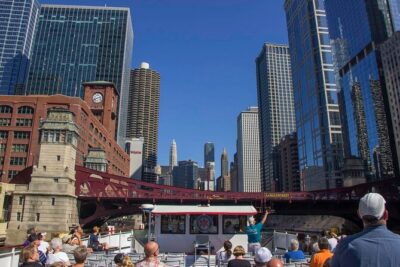
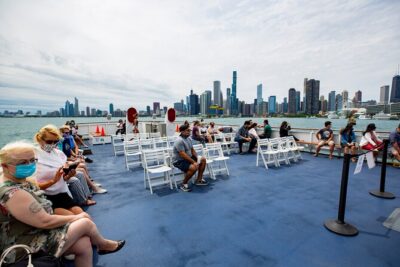
Chicago River 45-Minute Architecture Tour from Magnificent Mile
Read our review →
Browse the lists this tour appears in