
REVIEW · BERLIN ARCHITECTURE TOURS
Private walking Tour: Berlin Architecture Tour
Berlin tells its story through buildings. This private four-hour tour links grand museums, Cold War housing, modern concert halls, and rebuilt squares into one clear lesson in how politics shapes a city. I like the private format, which lets you ask for specific interests, and I like the strong mix of famous sights and less obvious architectural contrasts. The main catch is the price: at $191.87 per person, it makes the most sense for a small group that values a personal guide.
The route covers a lot of ground, from Museum Island to Kreuzberg and Friedrichshain, so you should expect a brisk outing rather than a slow study of every building. A hotel pickup and drop-off help, and you can choose to go on foot or by bike. Guides such as Sara, Thomas, Ariel, Tom, Daniel, Heiko, and Tarek Ibrahim have earned especially warm praise for clear explanations, flexibility, and strong knowledge of Berlin’s past and present.
Key points to know before booking
- Berlin’s political divide is the main theme: See how East German apartment blocks and West Berlin’s postwar modernism reflect two opposing systems.
- Ten major stops fit into about four hours: The route includes Museum Island, Gendarmenmarkt, the Philharmonie, Reichstag, Potsdamer Platz, Kreuzberg, Friedrichshain, and more.
- Your hotel is the meeting point: The guide meets you in a central Berlin hotel lobby and returns you to your hotel at the end.
- The private format gives you room to shape the tour: Ask for extra focus on architecture, design, urban planning, politics, or particular sights.
- The route can be done on foot or by bike: That choice matters because the itinerary stretches across several central districts.
- This is best for people who want context, not just photographs: The buildings become easier to understand when you know why they were built and what they replaced.
Why Berlin works so well as an architecture classroom
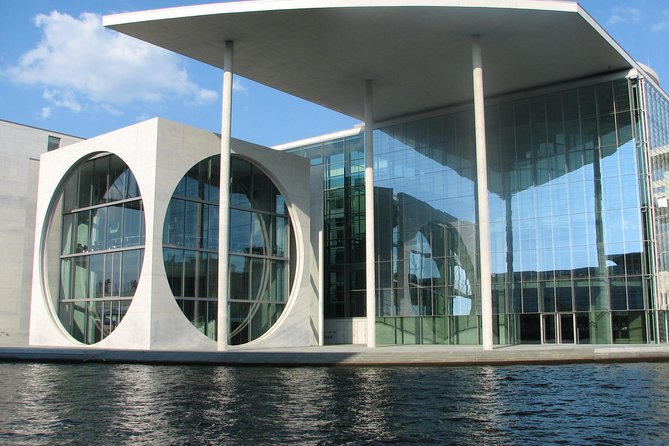
Berlin is not one polished architectural showpiece. It is more useful than that. Its streets reveal imperial ambition, wartime damage, Communist planning, Cold War separation, reunification, and fresh construction all in one day.
That makes this tour a good choice if you want to understand the city rather than simply collect postcard views. Your guide connects building design with the decisions behind it. East Berlin’s broad socialist apartment blocks tell one story, while West Berlin’s bold cultural buildings tell another.
The private setting is important here. Architecture tours can become dry if you are forced through a fixed script. This experience lets you ask why a building looks the way it does, how the Berlin Wall changed the area, or which sites deserve more of your time later.
The tour begins with a central hotel lobby meeting and ends with hotel drop-off. That is convenient, especially if Berlin is new to you. It also gives you a useful orientation early in your stay. One group used the tour at the start of its visit and found that the geographic, political, and artistic overview helped them decide where to spend the rest of their time.
More walking tours in Germany:
- Düsseldorf: Guided City Architecture Walking Tour
★ 4.6 · 61 reviews - Potsdam: Guided Walking Tour of UNESCO Site and Architecture
★ 4.7 · 49 reviews - Lübeck: Private Historical and Architectural Walking Tour
★ 4.5 · 6 reviews
Museum Island: four museums and several centuries of design
Museum Island is a strong opening because it places several major buildings close together. You spend about 20 minutes here, mainly taking in the exteriors and hearing how the group of museums developed.
The Altes Museum is the classical star, with its broad portico and orderly columns. The Pergamon Museum has a more monumental presence, while the Bode Museum adds a graceful dome and curved Baroque forms. The Neues Museum brings a different lesson: its restored structure combines surviving historical fabric with newer design after severe wartime damage.
You can photograph the buildings from different angles, including views toward the Spree. The short visit will not allow time inside the museums, and admission is not included as part of the tour. That is not a flaw if your goal is architecture, but you should plan a separate museum visit if you want to see the collections.
The Berliner Dom is also included nearby as another major architectural stop. Its huge dome, symmetrical facade, stone decoration, and ornate interior represent a grander Baroque and Renaissance Revival style. The tour allows about 15 minutes there, so expect an exterior-focused explanation rather than a full cathedral visit.
Gendarmenmarkt: Berlin’s most complete square
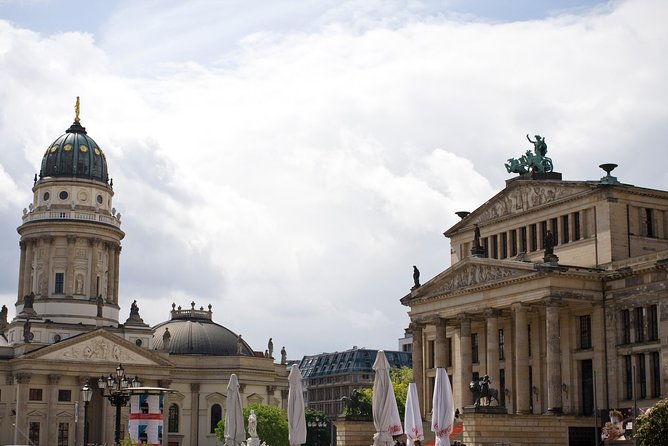
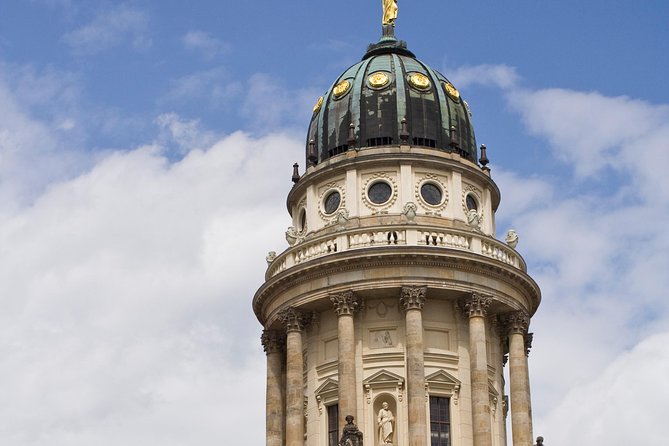
Gendarmenmarkt takes about 15 minutes and gives you one of the clearest examples of a planned architectural ensemble in central Berlin. The French Cathedral and German Cathedral face one another across the square, with Schinkel’s Konzerthaus between them.
The three buildings are not simply separate sights. Their relationship is the point. Your guide can explain how the matching domes frame the concert hall and create a balanced civic space. Friedrich Schiller’s statue anchors the center.
This is a fine photography stop, especially when the light warms the facades. The limited time means you will probably hear the essential story, take photographs, and move on. If the square is a priority for you, tell the guide early. A private tour gives you at least some say in how long you spend here.
The Philharmonie and Kulturforum: a bold West Berlin answer
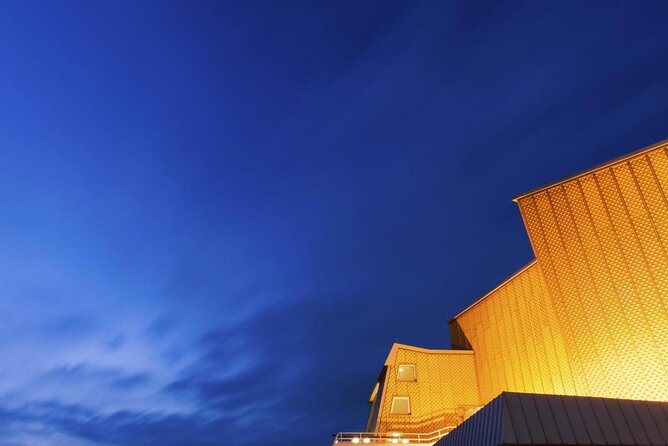
The Berliner Philharmonie is one of the tour’s most rewarding stops for modern design. You have about 15 minutes to see its tent-like form, uneven roofline, and unusual exterior. It does not resemble a traditional concert hall, and that is exactly why it matters.
The building sits within the Kulturforum, a group of cultural institutions developed in the 1950s and 1960s on the West Berlin side of the divided city. Many cultural collections and institutions had ended up behind the Wall, so West Berlin created a new cultural center of its own.
The Philharmonie’s concert hall was designed around a central performance area, helping the audience feel closer to the musicians. You may not enter the hall during this tour, but the guide’s explanation helps you read the exterior as a political and artistic statement.
This is also the place to pose for photographs. If you care about architectural images, ask the guide to allow a moment for the building rather than treating it as a quick passing view.
More private tours in Germany:
- Private Taxi Tour City East & West History and Architecture 3-4h
★ 5.0 · 42 reviews - Lübeck: Architecture and Local Craft Private Guided Tour
★ 4.0 · 6 reviews - Architectural Berlin: Private Tour with a Local Expert
★ 4.0 · 3 reviews - Private Munich Tour for History Buffs with Architectural Gems and WWII sites
★ 5.0 · 3 reviews
Potsdamer Platz and the Reichstag: rebuilding after division
The Reichstag receives about 10 minutes, making it one of the briefest stops. Its original 19th-century facade represents imperial Germany, while Norman Foster’s glass dome points toward a newer idea of open government after reunification.
The contrast between the solid stone building and the transparent dome is easy to grasp, even if you know little about architecture. The dome also offers views across Berlin, but this tour does not promise a dome visit. Treat this as an exterior and design discussion unless your guide tells you otherwise.
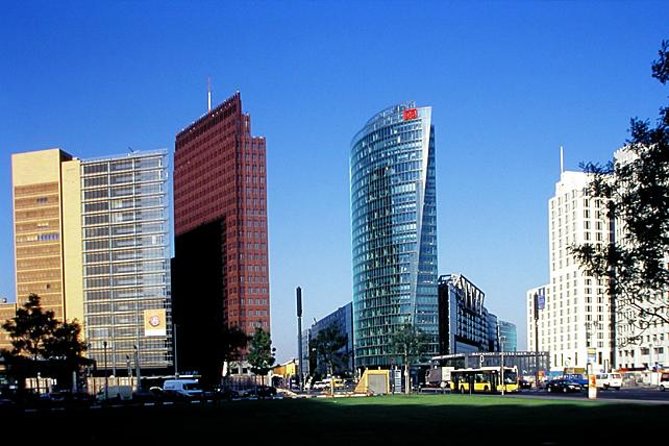
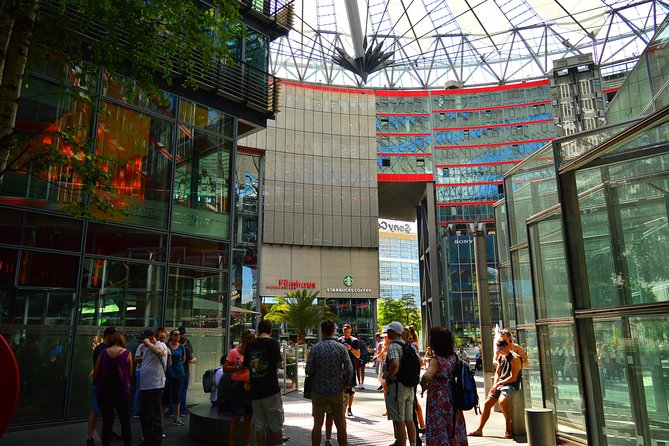
Potsdamer Platz gets around 20 minutes. Before World War II, it was a busy central junction. After wartime destruction and Cold War division, the area became associated with emptiness and the Berlin Wall. Today, glass towers, offices, public spaces, and the Sony Center create a sharp picture of the city’s post-reunification rebuilding.
The Sony Center’s broad glass roof and the DB Tower’s sleek facade offer very different ideas about modern city design. The Panoramapunkt is another nearby feature, though the tour information does not include admission or a visit to its viewing platform.
I like this part of the route because it avoids presenting modern Berlin as random new construction. Your guide can show how the area went from a divided void to a new commercial center. Some people may find the architecture here less intimate than the older quarters, but that tension is part of the story.
Kreuzberg and Friedrichshain: old apartment blocks, new life
Kreuzberg receives about 30 minutes and gives the tour a more local, lived-in feel. Here you see 19th-century Altbau buildings with decorated facades, tall windows, and high ceilings alongside converted industrial spaces and newer construction.
The neighborhood’s architecture reflects its earlier countercultural reputation and its changing role in Berlin. The Oberbaum Bridge is a major visual highlight. Its red brick towers and Gothic-inspired arches connect Kreuzberg with Friedrichshain across the Spree.
Friedrichshain also receives 30 minutes. This former East Berlin district combines prewar apartment buildings, socialist-era structures, and recent development. The restored Altbau facades help you see how older housing has been adapted for apartments, cafes, and shops.
The East Side Gallery adds a direct link to the Berlin Wall. The open-air gallery occupies a remaining section of wall covered with colorful murals by artists from different countries. The stop is not only about paintings. It shows how a barrier built to divide people became a public place for art and memory.
These two districts are valuable because they move you away from monumental government buildings. You get a closer look at how Berliners live, reuse old buildings, and respond to political change in ordinary streets.
Friedrichstrasse and Pariser Platz: grand plans and careful reconstruction
Friedrichstrasse is described as one of central Berlin’s major shopping and cultural streets. It mixes memories of the Golden Twenties with post-reunification construction, including offices, cafes, boutiques, restaurants, department stores, and Galeries Lafayette.
The architectural lesson is the tension between tradition and urban renewal. You can see decorated historic-looking facades beside newer commercial buildings. The street is useful for discussing how Berlin tried to recover a central-city identity after decades of division.
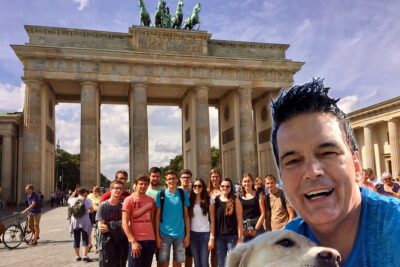
Pariser Platz receives about 20 minutes and brings together some of the city’s most recognizable symbols. The Brandenburg Gate is the focus, with its neoclassical columns and carefully controlled proportions. Around it, the Hotel Adlon, French Embassy, American Embassy, Academy of Arts, and DZ Bank building show several approaches to rebuilding a historic square.
Frank Gehry’s DZ Bank building adds a sculptural modern touch, while the nearby embassies and hotels fit more closely with the square’s classical character. The result is not a single style. It is a debate about how much a rebuilt Berlin should imitate the past.
That makes Pariser Platz a good place to ask your guide about urban rules and reconstruction. The square looks orderly, but its buildings express different ideas about memory, diplomacy, commerce, and modern design.
Hackescher Höfe: art nouveau in a working courtyard complex
The Hackescher Markt stop takes about 20 minutes, with Hackescher Höfe as the architectural prize. Built in 1906 by August Endell, the connected courtyards are known for art nouveau details, colorful ceramic tiles, decorative ironwork, and patterned brick.
The courtyards were designed to combine practical urban functions with visual appeal. Each has its own character, so this is a pleasant place to slow down and look closely at details rather than only photographing a big facade.
The stop can feel more intimate than the grand squares earlier in the tour. Shops and cafes occupy parts of the complex, but the architectural details remain the reason to come. Your guide can help you notice the curves, tile patterns, and changes from one courtyard to the next.
Four hours, ten stops, and a fast pace
The published stop times add up to roughly three hours. Once you include movement between districts, hotel pickup, explanations, and photo breaks, the four-hour schedule is full.
That is the chief practical consideration. You will see a broad cross-section of Berlin, but you will not have long at each site. The itinerary works best as a guided overview. It is less suitable if you want to enter several museums, inspect every facade, or spend an hour at one square.
The tour can be done on foot or by bike. Walking gives you more time to notice street details and makes the city’s changes easier to feel, but the route covers a wide area. A bike may make the distance more manageable, though the supplied information does not specify bike rental arrangements.
Ask at the start to adjust the route around your interests. The guide can tailor the experience, and past groups have requested more attention to architecture, history, and design. Sara, who is herself an architect, was praised for combining design knowledge with Berlin’s story. Thomas was especially appreciated for explaining what architects were trying to achieve. Ariel was noted for clear communication and flexibility, while Heiko provided a useful first-day orientation. Tom, Daniel, and Tarek Ibrahim also received strong praise for their explanations and personal approach.
Is $191.87 per person good value?
The price is high for a four-hour city tour. It becomes easier to justify when you divide the cost among a small private group and consider what is included: a professional guide, hotel pickup, hotel drop-off, and a route shaped around your interests.
You are paying for interpretation, not entry tickets. Food, drinks, and museum admissions are not included. If you only want to see the exteriors, take photographs, and get a basic city overview, a cheaper group walk may suit you better.
I would consider this good value for architecture students, designers, photographers, families with mixed interests, and first-time visitors who want a strong orientation. It is also useful for a small group that wants to ask questions without slowing down strangers.
The strongest value comes from the guide. A flexible and well-informed person can turn a long list of buildings into a coherent story. The praise for friendliness, clarity, and adjustment to personal needs suggests that guide quality is the key part of the purchase. If a particular guide matters to you, ask if that person is available before booking. The information specifically names Sara, Thomas, Ariel, Tom, Daniel, Heiko, and Tarek Ibrahim, but availability is not guaranteed.
Who should book this Berlin architecture tour?
Book it if you want to connect architecture with Berlin’s political past. The route gives you imperial monuments, restored museum buildings, East German housing, West Berlin modernism, post-Wall reconstruction, and neighborhood architecture in one outing.
It is also a smart first-day activity. You get a city orientation that can help you choose later museum visits, neighborhoods, and viewpoints.
Skip it if you want a slow museum tour, a specialist lecture on only one architect, or a low-cost group experience. The schedule is ambitious, and the fee is difficult to justify for solo visitors who are mainly interested in quick photographs.
Free cancellation is available up to 24 hours before the start time. Service animals are allowed, public transportation is nearby, and most participants can take part. Pickup is offered, and group discounts may be available.
FAQ
How long does the Berlin architecture tour last?
The tour lasts approximately four hours, including the guided route between its main stops.
Is the tour private?
Yes. Only your group participates, so you can discuss specific interests with the guide and request adjustments where possible.
Where does the tour begin?
The guide meets you in the lobby of a central Berlin hotel.
Does the tour include hotel drop-off?
Yes. Hotel pickup and drop-off are included.
Can I take the tour by bike?
Yes. The experience can be done on foot or by bike.
Is the tour offered in English?
Yes. English is the listed tour language.
Are museum or landmark admission tickets included?
The listed inclusions cover the professional guide and hotel pickup and drop-off. Food, drinks, and admission costs are not included.
Which places are included on the route?
The route includes Museum Island, Gendarmenmarkt, the Berliner Philharmonie, the Reichstag, Potsdamer Platz, the Berliner Dom, Kreuzberg, Friedrichshain, Pariser Platz, and Hackescher Markt.
How much does the tour cost?
The listed price is $191.87 per person. Group discounts may be available.
Can I cancel for a full refund?
Yes, if you cancel at least 24 hours before the experience begins. Cancellations made less than 24 hours before the start time are not refunded.
Is the tour suitable for most people?
The information says most travelers can participate, and the tour is near public transportation. Service animals are allowed. Expect a substantial amount of walking if you choose the walking option.
Should I request a particular guide?
You can ask about guide availability. Sara, Thomas, Ariel, Tom, Daniel, Heiko, and Tarek Ibrahim are among the guides praised for strong explanations, flexibility, and friendly service, but a specific guide cannot be guaranteed.
Just added in Germany
- Hidden Architectural Gems of Munich (Max. 16 guests)★ 5.0 · 2 reviews
- Munich Your Way: Private Tour with Architect & Guide★ 5.0 · 2 reviews
- Architectural Frankfurt: Private Tour with a Local Expert★ 5.0 · 2 reviews
- Architectural Berlin: Private Tour with a Local Expert★ 4.0 · 3 reviews
- Private Taxi Tour of City East History and Architecture 2-3h★ 5.0 · 2 reviews
- Berlin Architecture/River Spree Full Day Photography Tour★ 5.0 · 2 reviews
- Lübeck: Private Historical and Architectural Walking Tour★ 4.5 · 6 reviews
- Lübeck: Architecture and Local Craft Private Guided Tour★ 4.0 · 6 reviews
Berlin Architecture Tours, compared.
Private Taxi Tour City East & West History and Architecture 3-4h
Read our review →
Karl-Marx-Allee Tour: Life and Architecture in East Berlin
Read our review →
Karl-Marx-Allee Tour of Life and Architecture in GDR
Read our review →
Guided Architectural Walking Tour of Hansaviertel
Read our review →
Berlin Architecture/River Spree Full Day Photography Tour
Read our review →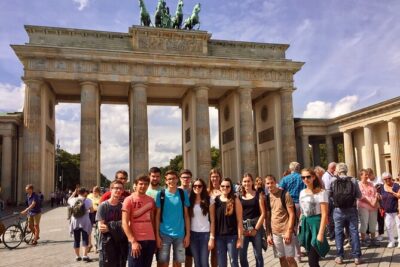
Private Taxi Tour of City East History and Architecture 2-3h
Read our review →Browse the lists this tour appears in