
REVIEW · BERLIN ARCHITECTURE TOURS
Berlin: Karl-Marx-Allee Tour of Life and Architecture in GDR
Karl-Marx-Allee was built to make a political point. This two-hour walking tour shows how East Germany used grand housing blocks, shops, and public spaces to sell an image of socialist success. I like the clear link between architecture and Cold War politics, and I like that the tour does not stop at pretty facades. It also explains the 1953 workers’ uprising and the quieter story of Stasi surveillance.
At $29 per person, the tour offers solid value for anyone curious about Berlin beyond the Wall and Brandenburg Gate. The main consideration is pace: you will be outside and on foot for most of the experience, and the subject matter suits older children and adults better than families with young kids. Children under 10 are not permitted.
Key points about the Karl-Marx-Allee tour
- Meet at Frankfurter Tor: Find the guide by the southern tower, on the corner of Warschauer Straße and Karl-Marx-Allee, with an orange umbrella.
- Follow East Berlin’s grandest avenue: See the huge housing blocks created as the young GDR’s most ambitious rebuilding project.
- Connect buildings to politics: Learn how socialist classicism replaced earlier modernist ideas about city life.
- Understand the June 1953 uprising: The street’s construction helped trigger a revolt that threatened the new government.
- Look beyond the polished image: Hear about wiretaps, attic listening posts, and the Stasi’s system of control.
- End at Strausberger Platz: The tour covers roughly 1.5 hours of guided walking and finishes at U Strausberger Platz.
Why Karl-Marx-Allee tells Berlin’s Cold War story so well
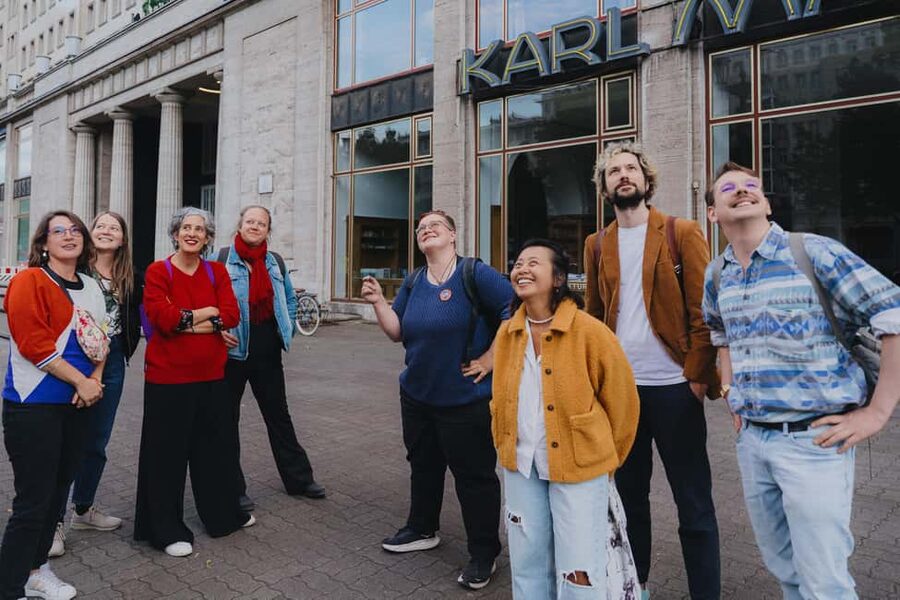
Berlin can make history feel abstract. Karl-Marx-Allee gives it a physical scale. Walk between the broad avenue and the towering blocks, and you can see how architecture was asked to serve the state.
The avenue began as Stalinallee, a name that reflected East Germany’s loyalty to the Soviet model. It was later renamed Karl-Marx-Allee, but the older name still matters because it points to the street’s original political purpose. This was not just a housing project. It was meant to display a new society.
The scale does much of the teaching. The buildings are imposing, with long rows of apartments and a formal style often called socialist classicism. You are meant to feel small beside them. That effect was intentional. The street needed to express order, strength, and national recovery after the destruction of World War II.
I like that the tour treats the buildings as more than decorative backdrops. You learn why this design was selected, what it replaced, and how the avenue fit into East Germany’s wider reconstruction program. That gives the walk a useful frame before the political stories become more complicated.
A few more architecture tours in Germany worth a look
- Munich 3-Hour Segway Tour: Nazi Munich & Royal Architecture
★ 4.9 · 194 reviews - Düsseldorf: Guided City Architecture Walking Tour
★ 4.6 · 61 reviews - Hidden Architectural Gems of Munich (Max. 16 guests)
★ 4.9 · 52 reviews
Meeting at Frankfurter Tor and finding your guide
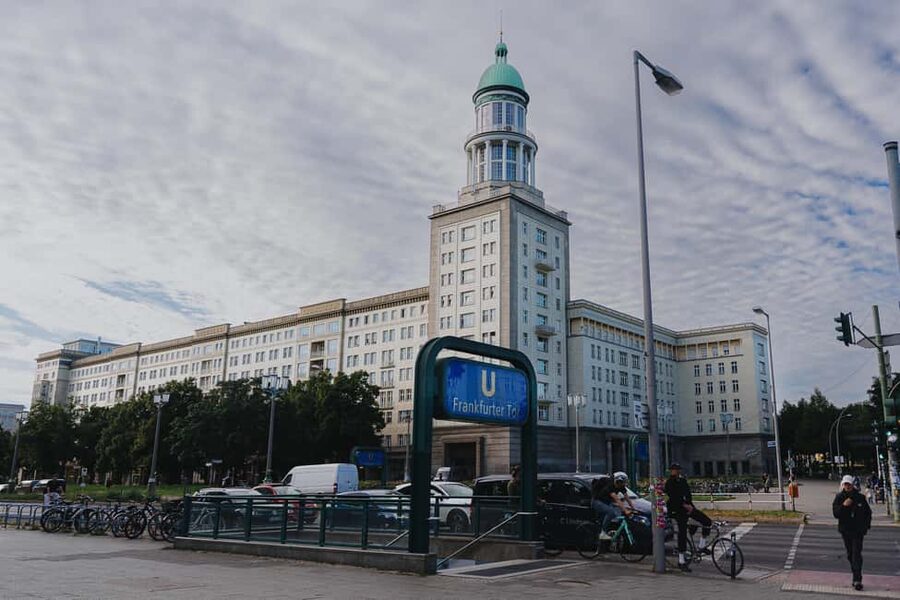
The tour begins outside U Frankfurter Tor, beside the southern tower at the corner of Warschauer Straße and Karl-Marx-Allee. Look for a guide holding an orange umbrella. That detail matters in a busy city, especially if you are arriving by underground and have not yet found your bearings.
Frankfurter Tor is a fitting start because its towers help define the grand entrance to the avenue. From here, the tour moves along Karl-Marx-Allee toward U Strausberger Platz. The route is easy to understand, but comfortable shoes are still important. You will be walking outdoors for much of the two-hour experience.
The guided portion is listed as 1.5 hours, within a total duration of two hours. That leaves room for meeting, gathering the group, and moving between points of interest. I would avoid scheduling a tight museum booking immediately afterward. Berlin weather can also affect the experience, since the route is outside rather than inside a single attraction.
The tour is offered in English and German. It is wheelchair accessible, which is useful for anyone who needs a route with that accommodation. Since group size is not specified, do not book this expecting a private walk.
Socialist classicism on Berlin’s biggest rebuilding project
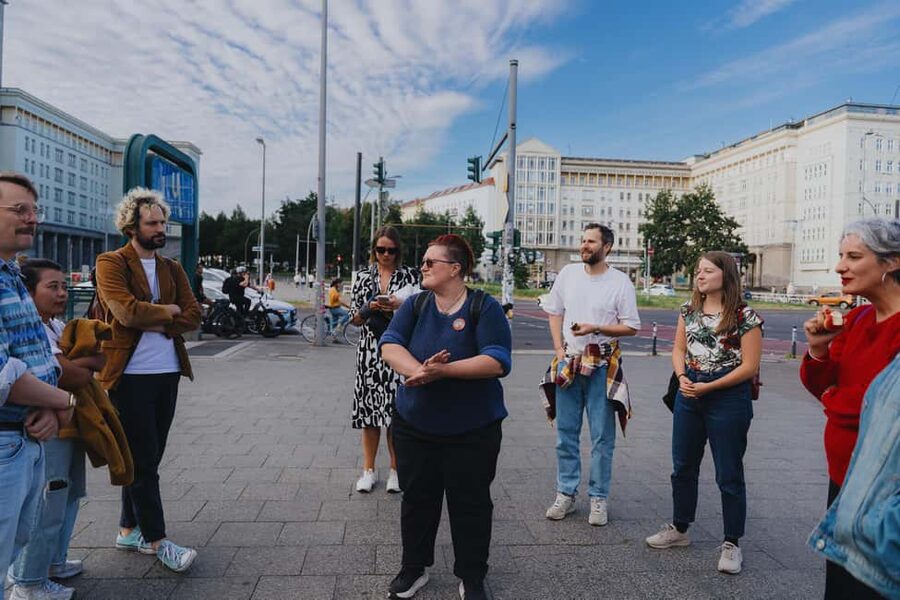
The central sight is the long sequence of apartment blocks created during East Germany’s early reconstruction. The buildings were part of the national rebuilding program after the war, and thousands of volunteers worked day and night to bring the avenue out of the ruins.
That labor story gives the architecture a human side. The street was not built by a distant government alone. It was also presented as a collective achievement, with ordinary workers helping create the new capital of a socialist state.
The design was carefully chosen. Rather than leaving the avenue in the modernist style that had shaped some earlier postwar projects, the East German regime favored a more monumental look. Socialist classicism used size, symmetry, and formal decoration to present a confident public face.
The contrast is one of the tour’s most useful ideas. The modernist buildings from the immediate postwar years reflected utopian urban planning, with different ideas about open space and daily life. Later, those buildings were partly hidden from passersby by fast-growing poplar trees. The new regime wanted people to focus on its own vision, not on an earlier architectural direction.
You do not need a strong interest in architecture to follow this section. The guide connects design choices to power, ideology, and everyday living. That makes the buildings easier to read. Instead of seeing only large blocks, you begin to ask why they look this way and who they were intended to impress.
The ideal socialist life, with cafes and full shops
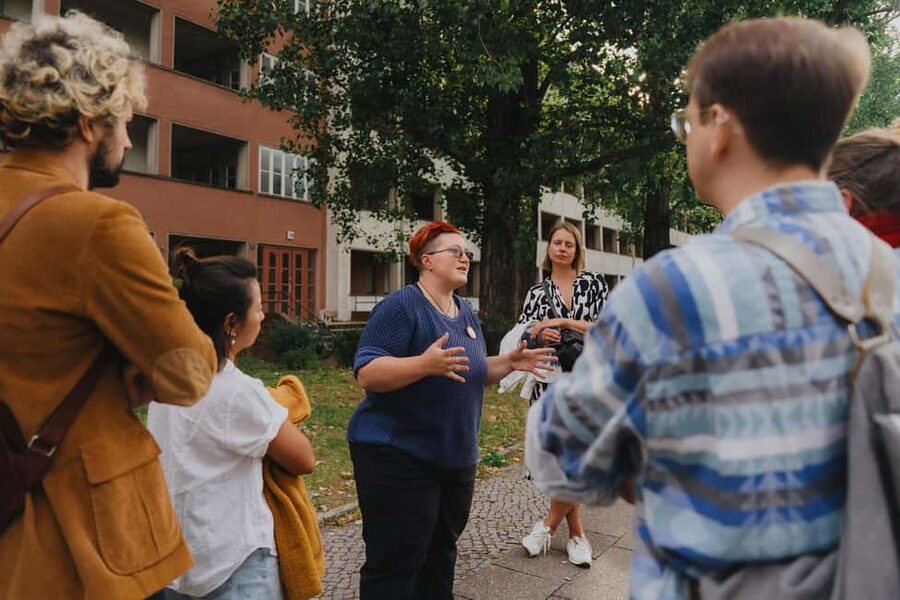
Karl-Marx-Allee was designed to offer more than apartments. It included cafes, restaurants, and well-stocked shops, creating a picture of comfort and abundance in East Berlin.
That detail helps explain the street’s importance. The government needed a showcase for socialism, and the avenue supplied one. People could see modern housing and public amenities in one carefully planned setting. It was meant to show that the new state could provide a good life.
The guide also helps separate the public image from private reality. A well-supplied shop or elegant cafe could project confidence, but it did not erase political control. The street’s polished appearance was part of the message.
This is where the tour moves beyond architecture. You are not simply learning that a cafe once stood here. You are considering how ordinary routines, shopping, housing, and leisure were used to support a national story.
I especially like this balance. A lesser walking tour might treat Karl-Marx-Allee as a parade of monumental buildings. This experience asks you to look at the avenue as both a real neighborhood and a stage set for the state.
Same city, a different building to stand in front of:
- Potsdam: Guided Walking Tour of UNESCO Site and Architecture
★ 4.7 · 49 reviews - Private Taxi Tour City East & West History and Architecture 3-4h
★ 5.0 · 42 reviews - Stuttgart city library – an architectural tour
★ 4.4 · 27 reviews - Karl-Marx-Allee Tour: Life and Architecture in East Berlin
★ 5.0 · 19 reviews
The 1953 uprising and the cost of rebuilding

The most dramatic political chapter concerns the workers’ uprising of June 1953. The rebuilding program depended on hard work, but the conditions imposed on workers helped produce anger. Disgruntled workers began a mass protest that spread and threatened the survival of the young East German government.
This is a crucial part of the tour because it complicates the official image of worker-led socialism. The state claimed to represent workers, yet worker demands helped expose the gap between that claim and daily conditions.
You will hear how the street’s construction was tied to the crisis. The avenue was supposed to prove that the new country was strong and united. Instead, its building program became connected to one of the most serious challenges the government faced.
The tour does not need to turn the uprising into a dry list of dates. Its strength is the physical setting. You are standing in the place where the state tried to project confidence, while nearby workers were questioning its demands and authority.
If you enjoy political history, this will likely be the strongest section. If you prefer a light sightseeing walk, it may feel weightier than expected. That is not a flaw, but it is worth knowing before you book.
Stasi surveillance behind the perfect facade
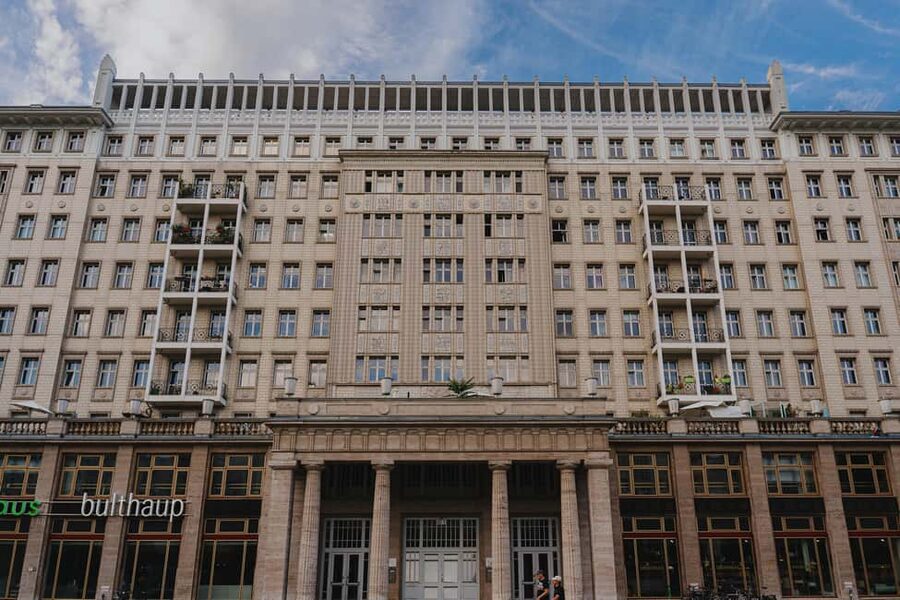
Karl-Marx-Allee also reveals the split between public life and private fear. The avenue was meant to look orderly and prosperous, but the East German secret police monitored people through wiretaps and listening stations.
The surveillance equipment was designed to remain unseen. Wiretaps in apartments and listening posts in attics did not belong in the official picture of happy socialist living. Their very concealment tells you how the system worked: public confidence on the outside, suspicion and control behind closed doors.
This part of the tour connects well with the film The Lives of Others. You will also see filming locations associated with The Queen’s Gambit. The film references add a useful visual link for anyone who knows those productions, though the tour is not presented as a film-only walk.
I like that the Stasi discussion is tied to actual spaces rather than treated as a separate lecture. A grand apartment block can represent state pride from the street, while the same building may have held private conversations under surveillance. That tension gives the avenue its strongest human interest.
The tour does not promise access to hidden interiors or original surveillance equipment. Instead, the guide explains how the system operated and why it was kept out of sight. You should come expecting interpretation from the street, not a museum visit.
From neglected boulevard to a contested neighborhood

After the Berlin Wall fell, Karl-Marx-Allee lost its former role as a stage for socialist parades. For a time, the avenue looked like an awkward leftover from a vanished state. Its large blocks seemed dated, and parts of the area fell into disrepair.
Berlin changed again as housing costs rose. Real estate interest returned to the avenue, turning old socialist housing into a focus of attention in a city facing a housing shortage. The same buildings that once represented state power became part of a new argument about who can afford to live in central Berlin.
That modern connection makes the tour feel current rather than locked in the past. Local protests against gentrification and rising living costs now take place along a street once used for socialist pageantry. The political language has changed, but the avenue remains a place where ideas about housing and public life are argued out.
For you, this section offers a useful reminder that architecture does not stay fixed in meaning. A building can shift from symbol of socialism to neglected curiosity, then to valuable urban property. The stone remains, but the debate around it changes.
Guide style and what the reviews reveal

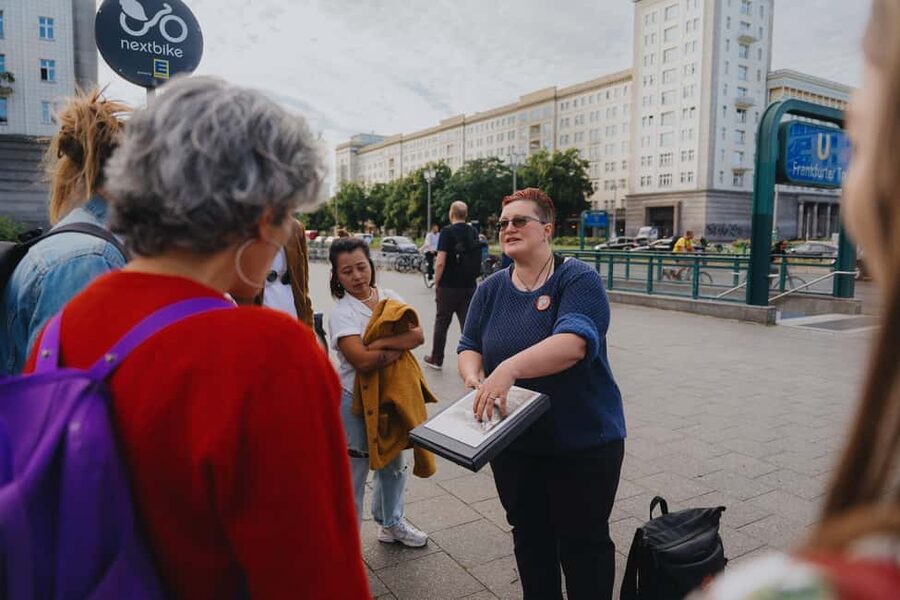
The clearest praise for this experience concerns the guides’ storytelling. One German-language review describes Martina as responsive to curious questions rather than simply delivering a fixed script. That is an important quality for a tour about complicated political history.
Another review calls the walk intimate and informative, with a guide who held attention as a storyteller. A third describes the explanations as lively and well thought out. Taken together, these comments point to the tour’s strongest feature: the delivery seems designed for conversation and interpretation, not just fact recitation.
I would value that approach here. Karl-Marx-Allee can look repetitive if you do not know what to notice. A guide who responds to questions can help you connect a building detail, a political event, and a modern housing issue without losing the thread.
The rating is 5 out of 5 from nine reviews, so the sample is small. That makes the praise encouraging but not a guarantee of the exact same guide or group dynamic on every departure. Martina is specifically praised in one review, but guide assignments can vary.
Is $29 a fair price?

At $29 per person, this is a reasonable price for a two-hour guided history walk in Berlin. You are paying for a live guide, not admission to a major museum or a long list of included attractions. The value rests on the quality of explanation.
I think the price works best if you want context you would not get from walking Karl-Marx-Allee alone. The avenue is free to see, but its scale does not explain itself. Without guidance, you might notice the monumental blocks and miss the modernist phase, the 1953 uprising, the Stasi story, and the present housing dispute.
It is also a practical choice for a first visit if you want to understand East Berlin before visiting other Cold War sites. The walk gives you a framework that can make later museums and memorials easier to place.
The value is weaker if you only want architectural photography or a fast overview. At 1.5 hours of guided walking, the tour asks you to listen closely and think about the political meaning of ordinary buildings. That is its purpose, not a drawback, but it should match your interests.
You can reserve now and pay later, and cancellation is free up to 24 hours before the tour for a full refund. Those terms make it easier to fit the walk into a changing Berlin schedule.
Who should book this walk?
I would recommend it to adults interested in the Cold War, urban planning, German reunification, or the daily life of East Berlin. It also suits anyone who has seen The Lives of Others and wants to connect film locations with the real city.
Architecture fans will get plenty to study, but you do not need to know architectural terms beforehand. The guide explains the change from postwar modernism to socialist classicism in plain language.
The tour is less suitable for young children. Anyone under 10 cannot join, and the political material may be too serious for children who are only looking for sights and activity. Teenagers with an interest in history may find the uprising and surveillance sections especially useful.
Bring comfortable shoes and plan for an outdoor walk. The tour is wheelchair accessible, but the information provided does not describe the exact route surface or restroom arrangements, so you may want to confirm those details if they matter to your planning.
Should you book the Karl-Marx-Allee tour?
Book it if you want Berlin’s Cold War story told through real streets rather than only through museums. The combination of monumental housing, the 1953 uprising, Stasi surveillance, film locations, and today’s housing protests gives you more than a basic architecture walk.
The strongest reason to choose it is the storytelling. The praise for Martina’s responsiveness and the guides’ lively explanations suggests that curious questions are welcome. That matters on a subject where the best lessons often come from connecting the official story with what was happening behind it.
Skip it if you want a short photo stop, a relaxed cafe stroll, or a tour aimed at young children. For $29, though, it is a fair buy for a focused, two-hour look at one of Berlin’s most politically loaded avenues.
FAQ
Where does the Karl-Marx-Allee tour begin?
It begins outside U Frankfurter Tor, by the southern tower on the corner of Warschauer Straße and Karl-Marx-Allee. Look for the guide holding an orange umbrella.
Where does the tour finish?
The tour finishes at U Strausberger Platz.
How long does the tour last?
The total experience lasts two hours. The guided walking portion along Karl-Marx-Allee lasts about 1.5 hours.
Which languages are available?
The tour is offered in English and German.
Is the tour wheelchair accessible?
Yes, the activity is listed as wheelchair accessible.
Can children join the tour?
Children under 10 are not permitted to participate.
Just added in Germany
- Hidden Architectural Gems of Munich (Max. 16 guests)★ 5.0 · 2 reviews
- Munich Your Way: Private Tour with Architect & Guide★ 5.0 · 2 reviews
- Architectural Frankfurt: Private Tour with a Local Expert★ 5.0 · 2 reviews
- Architectural Berlin: Private Tour with a Local Expert★ 4.0 · 3 reviews
- Private Taxi Tour of City East History and Architecture 2-3h★ 5.0 · 2 reviews
- Berlin Architecture/River Spree Full Day Photography Tour★ 5.0 · 2 reviews
- Lübeck: Private Historical and Architectural Walking Tour★ 4.5 · 6 reviews
- Lübeck: Architecture and Local Craft Private Guided Tour★ 4.0 · 6 reviews
Berlin Architecture Tours, compared.
Private Taxi Tour City East & West History and Architecture 3-4h
Read our review →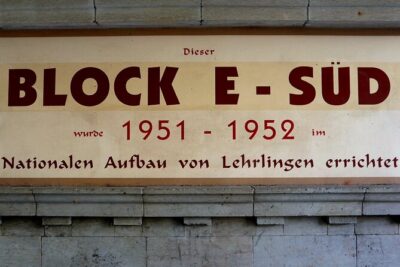
Karl-Marx-Allee Tour: Life and Architecture in East Berlin
Read our review →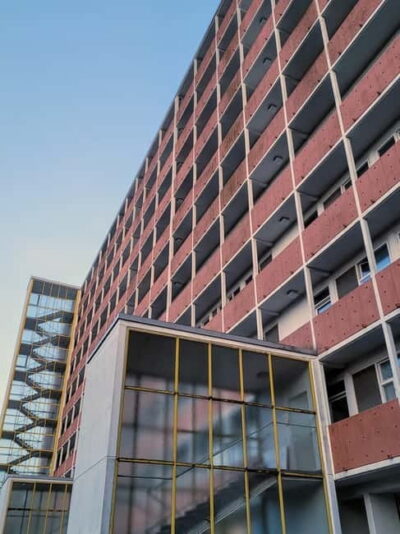
Guided Architectural Walking Tour of Hansaviertel
Read our review →
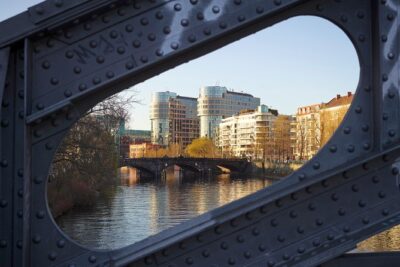
Berlin Architecture/River Spree Full Day Photography Tour
Read our review →
Private Taxi Tour of City East History and Architecture 2-3h
Read our review →Browse the lists this tour appears in