
REVIEW · BAUHAUS AND BRUTALIST ARCHITECTURE TOURS
Architecture of New Belgrade – Brutalism Decoded
New Belgrade rewards a closer look. I love the Genex Tower stop, where concrete, bridges, and twin towers tell a bold story of Yugoslav ambition. I also like the personal touch of a private guide, including guide Xenia, whose tour style brings everyday life into the discussion. The main drawback is timing: one recent account found the experience shorter than the advertised two and a half hours.
This is not a standard Belgrade sightseeing walk. You move between several sites by vehicle, beginning at the Museum of Contemporary Art and ending at Sava Center. The tour costs $86.42 per person, so it makes the most sense for anyone who wants architecture explained rather than simply photographed.
You should also know that the Museum of Contemporary Art entrance is not included. Most of the experience takes place outdoors or in publicly accessible areas, and the private format means you can ask questions without sharing the guide’s attention with a large group.
Key points about Architecture of New Belgrade
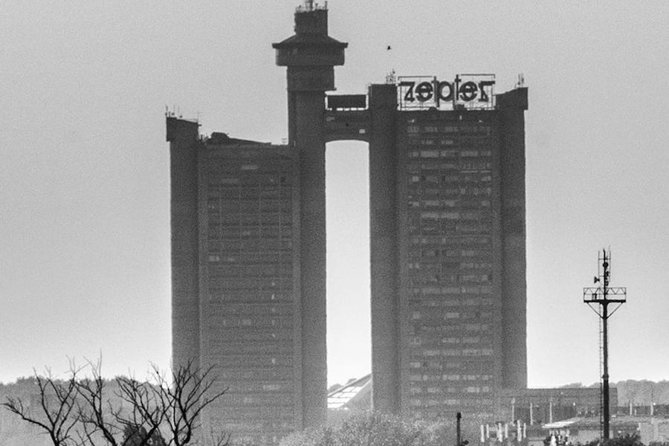
- Genex Tower gets a close-up visit: See the Western City Gate, a 30-floor landmark built around 40 years ago and once described as the Balkans’ first smart building.
- The route covers five important buildings: The Museum of Contemporary Art, the Government Building viewed from the vehicle, Genex Tower, Sava Center, and Primary School Laza Kostić.
- Yugoslav politics shape the story: The Park of Friendship introduces the Non-Aligned Movement and its 120 member countries.
- Private guiding changes the pace: Only your group takes part, making it easier to ask about design, politics, and daily life.
- Block 23 shows architecture as a complete neighborhood: Apartments, a school, kindergarten, sports courts, and a small shopping center were planned together.
- The tour finishes at Sava Center: That makes the route practical if you plan to continue exploring New Belgrade from there.
Why New Belgrade needs a guided explanation
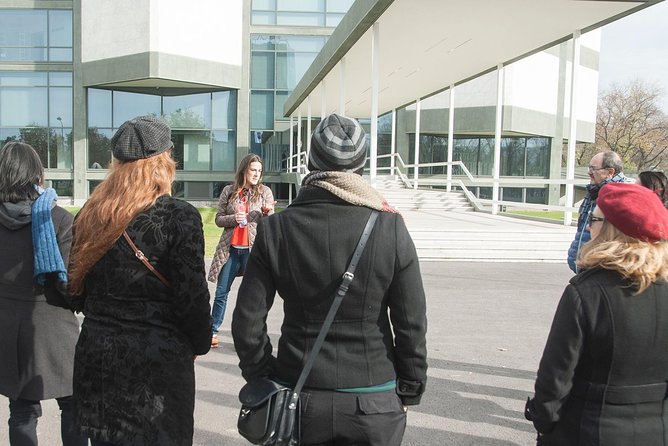
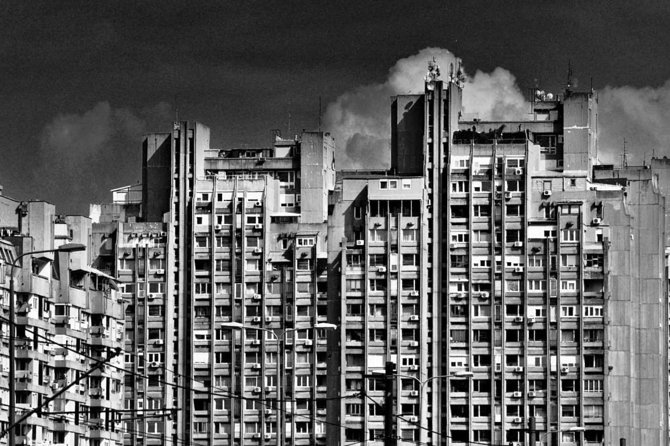
New Belgrade can look confusing at first. Wide roads, enormous apartment blocks, open spaces, and isolated concrete structures do not present their stories in an obvious order. Without context, you may see a lot of concrete and wonder what all the fuss is about.
A good guide helps you read the city as a political and social project. New Belgrade was shaped during Yugoslavia’s period of independence from Stalin and later became a major expression of the country’s own modernist ambitions. The buildings were not designed as old-fashioned monuments. They were meant to show that a socialist state could create advanced public spaces, housing, cultural buildings, and offices on a grand scale.
That is why this tour works best for you if you like architecture with a story attached. The guide explains not only the shapes and materials, but also how people used these places and how life changed during the 1960s, 1970s, 1980s, and difficult 1990s.
The private format is important here. You are not simply being marched from one photo stop to another. You can ask why a building looks the way it does, how it served its original purpose, or what happened to the area after Yugoslavia changed. The strongest praise for this experience centers on that human side of the tour.
More Bauhaus and brutalist tours in the world:
- London: Brutalist Architecture & History Walking Tour
★ 4.8 · 42 reviews - Le Corbusier’s Chandigarh : A Complete Architecture Tour
★ 4.7 · 25 reviews - Secret Split: Socialist Architecture & brutalism – Urban Utopia
★ 5.0 · 17 reviews
Starting at the Museum of Contemporary Art
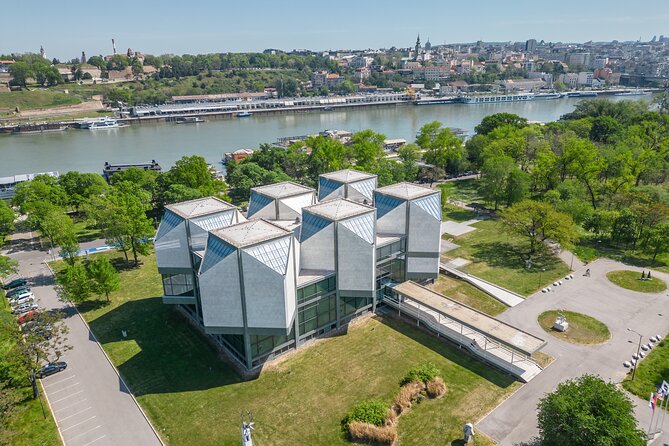
The meeting point is in front of the Museum of Contemporary Art at Ušće, at Ušće 10. It is an easy place to identify, and the arrangement avoids a vague street-corner meeting in an unfamiliar part of the city.
The museum itself provides an excellent introduction to New Belgrade’s modernist style. Its 1960s volumes are low, geometric, and carefully composed. The marble facades are especially useful for correcting a common assumption about socialist buildings. Socialist architecture was not always plain, cheap, or gray. Here, precious marble was used to create a building with a polished civic presence.
You spend about 20 minutes at this stop. The museum admission is not included, so the tour is primarily an exterior architecture visit rather than an art museum outing. If you want to see the collections inside, plan that as a separate activity and check the museum’s opening arrangements independently.
I like beginning here because the museum gives you a visual vocabulary for the rest of the route. Once you have looked at its shapes and materials, the later buildings become easier to compare. You start noticing how different architects handled concrete, scale, public space, and movement through a building.
The Park of Friendship and Yugoslavia’s independent path
The next stop is the Park of Friendship, or Park Prijateljstva. You spend about 15 minutes here, and admission is free.
The park is tied to the Non-Aligned Movement, which brought together 120 countries. It was founded in Belgrade in 1961, when heads of state planted trees as symbols of peace. That detail gives the park more weight than its open lawns might suggest at first glance.
This is one of the tour’s most useful history stops because it links New Belgrade’s architecture to foreign policy. The city was not simply copying Soviet planning. Yugoslavia took a different political path after breaking with Stalin, and Belgrade presented itself as a meeting place between major power blocs and newly independent countries.
The park also slows the pace after the large forms of the museum. You are looking at an open public space rather than a building, but the same ideas remain: civic purpose, international ambition, and a belief that urban design could express political values.
The stop is brief, so do not expect a long garden walk. Its value comes from the explanation and the connection to the wider story of Yugoslavia.
Seeing the Government Building from the vehicle
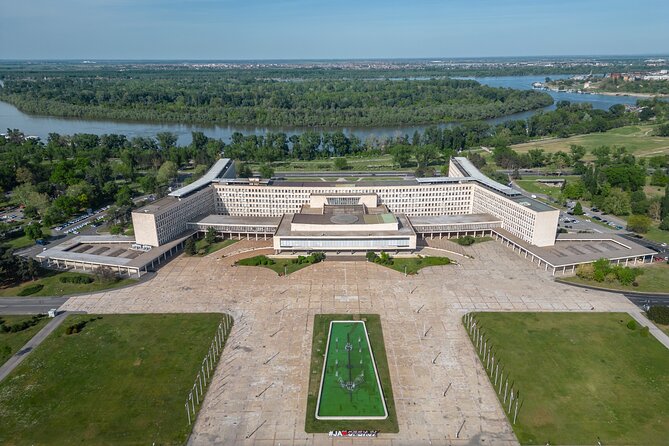
The route continues past the huge Government Building. This is a drive-by rather than a full stop, so you should not expect time for a detailed walk around it or an extended photo session.
Even from the vehicle, the building helps explain an earlier stage of Yugoslav politics. Construction began before the country’s break with Stalin, and the building experienced that political change while it was still going up. That makes it a useful physical record of a state adjusting its direction.
This short portion of the route is a reminder that the tour is not only about famous architectural objects. It also uses the spaces between them to explain changing ideas about power, identity, and public life. You will get more from it if you listen for the political shift rather than treating it as another large government structure.
A few more architecture tours in the world worth a look
- Chicago Architecture River Cruise
★ 5.0 · 15,756 reviews - Chicago River 90-Minute Architecture Tour
★ 4.5 · 9,629 reviews - Chicago River: 1.5-Hour Guided Architecture Cruise
★ 4.8 · 8,046 reviews - Chicago Architecture Center River Cruise aboard First Lady
★ 5.0 · 5,536 reviews
Genex Tower, New Belgrade’s great visual landmark
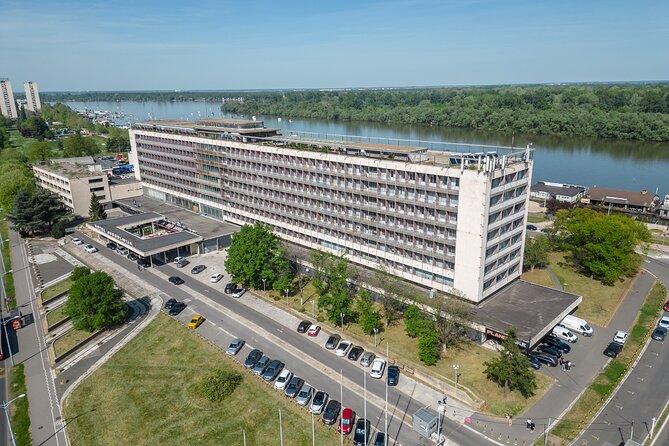
The stop at Narodnih heroja 45 brings you close to Genex Tower, also called the Western City Gate of Belgrade. You spend about 20 minutes here, and there is no admission charge.
Genex Tower is the tour’s strongest photo stop. Its 30-floor structure is made of two tall elements linked by a bridge, creating a dramatic gateway effect. The design is forceful without being decorative in the usual sense. It uses height, repetition, concrete, and separation to create a building that is immediately memorable.
The tower was built around 40 years ago and became known internationally as an example of brutalist architecture. It was also described as the first smart building in the Balkans, an important point when you consider how advanced its original ambitions were.
You will likely spend much of this stop looking upward and trying to understand the building’s scale. That is where a guide adds real value. A photograph can show the twin towers, but it cannot explain why the structure was placed there, how it functioned, or why it became such a strong symbol of New Belgrade.
The stop is outside, free, and relatively short. You should not expect a tour of the interior or a climb to the top based on the information provided. The reward is the close view and the explanation of its design.
Sava Center and a working piece of late Yugoslav modernism
The final major building stop is Sava Center on Milentija Popovića 9. It was built at the end of the 1970s in record time and was the first building of its kind in this part of Europe.
Sava Center was created as a huge congress center, and it remains in use. That matters. You are not looking only at a preserved relic. You are seeing a building that still performs the public role it was designed for.
The tour gives you about 15 minutes here. The focus includes the interior solutions, some of which still feel fresh after four decades. The design is not just about a large outer shell. It also involves how people enter, move through, gather, and use a congress complex.
Because the tour ends here, Sava Center is also a practical final point. You can continue with your own plans in New Belgrade rather than being returned to the starting location. The stated end point is Sava Center, and the route is near public transportation.
The short time can be a limitation if you want a detailed architectural study. Still, it gives you a useful introduction and lets you see why the building remains important. If Sava Center is the part of the tour that interests you most, you may want to return later with more time.
Block 23 and the everyday life of concrete expressionism
The final stop listed on the route is Primary School Laza Kostić, inside Block 23. This section is especially valuable because it moves beyond landmark buildings and shows how New Belgrade was planned for ordinary daily life.
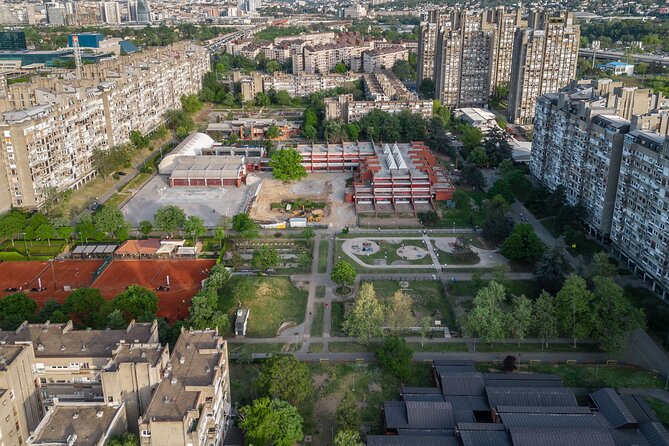
Block 23 is described as the most representative public housing project on the route. Its design follows the style of concrete expressionism, but the key idea is not only the appearance of the apartment buildings. The block was planned as a complete neighborhood.
You see how housing was placed alongside a school, kindergarten, sports courts, and a small shopping center. In theory, residents could find many basic needs close to home. That makes Block 23 a useful counterpoint to Genex Tower and Sava Center, which were built to project commercial, political, or cultural ambition.
This is also where the guide’s personal stories matter most. You hear about life in the blocks during their golden decades of the 1960s, 1970s, and 1980s, followed by the much harder experience of the 1990s. Those details help you picture the buildings as homes, not just as examples in an architecture textbook.
The stop lasts about 15 minutes. You should expect a close look at the school and the surrounding block, not a full tour of private residential interiors. The experience is strongest if you want to understand how urban planning affected real routines: getting children to school, reaching shops, finding sports space, and living among large shared structures.
What $86.42 means for value
At $86.42 per person, this is not a budget sightseeing ride. The price is easier to justify for a small group because the tour is private. You are paying for a focused explanation, transportation between sites, and the ability to shape the conversation around your own interests.
The value depends heavily on your curiosity. If you only want quick views of Genex Tower and Sava Center, you could see major exteriors independently. The guide becomes worth the money when you want the politics, design choices, and personal stories connected in one route.
The experience also covers several parts of New Belgrade in about two and a half hours. Walking between all the stops would be impractical, so the vehicle-based format saves time and effort. The stated schedule adds up to roughly the advertised duration, but one account describes the actual experience as under two hours. I would treat the timing as approximate and avoid booking another fixed activity immediately afterward.
A private tour is also useful if your group has mixed interests. One person can ask about building technology, another about Yugoslav politics, and another about daily life in the housing blocks. That flexibility is hard to get on a large group outing.
Who will enjoy this tour most
I would recommend it to you if you:
- Like modern architecture, brutalism, or urban planning
- Want to see a part of Belgrade outside the usual old-town route
- Prefer a private guide to a large group
- Enjoy political and social history tied to physical places
- Want to understand how housing and public services were planned together
- Have already seen central Belgrade and want a different side of the city
You may want to skip it if your main goal is historic churches, old streets, museums, or traditional Serbian architecture. This is a tour of concrete, marble, broad public spaces, and 20th-century political ideas. It asks you to look carefully at buildings that many people would otherwise pass without a second thought.
The 2.5-hour schedule also involves several stops with only 15 or 20 minutes at each. That keeps the route moving, but it may feel rushed if you prefer long photo sessions or detailed interior visits.
Practical details before you book
You meet at the Museum of Contemporary Art in Ušće and finish at Sava Center, not back at the starting point. Both locations are near public transportation, which makes the route practical for building into a wider day in Belgrade.
The tour is offered in English and uses a mobile ticket. Confirmation arrives at booking, and most people can take part. It is a private activity, so only your group participates.
The Museum of Contemporary Art admission is not included. The Park of Friendship, Genex Tower stop, Sava Center stop, and Primary School Laza Kostić stop are listed without admission charges.
Free cancellation is available if you cancel at least 24 hours before the local start time. Cancellations or changes made inside that window are not refunded or accepted.
Should you book Architecture of New Belgrade?
Book this tour if you want Belgrade explained through its 20th-century buildings rather than its best-known old monuments. The strongest parts are the close view of Genex Tower, the political context at the Park of Friendship, and the personal stories connected to Block 23.
The price is fair for a private experience if architecture and city history are high on your list. I would confirm the expected timing with Walking Belgrade before booking, especially if you have another appointment afterward. For a short, focused look at New Belgrade’s ambitious concrete city, this is a worthwhile choice.
FAQ
Where does the tour begin?
The tour begins in front of the Museum of Contemporary Art at Ušće 10 in Belgrade, Serbia.
Where does the tour end?
The tour ends at Sava Center, Milentija Popovića 9, Belgrade 11000.
How long does the experience last?
The advertised duration is approximately two hours and 30 minutes.
What language is the tour offered in?
The tour is offered in English.
Is this a private tour?
Yes. Only your group participates in the activity.
Is the Museum of Contemporary Art admission included?
No. Admission to the Museum of Contemporary Art is not included.
How many buildings will the tour visit?
The route includes five buildings: the Museum of Contemporary Art, the Government Building viewed while driving past, Genex Tower, Sava Center, and Primary School Laza Kostić.
Is admission charged at the other stops?
The Park of Friendship, Genex Tower stop, Sava Center stop, and Primary School Laza Kostić stop are listed with free admission.
Can most people participate?
Yes. The experience states that most people can participate and that it is near public transportation.
What is the cancellation policy?
You can cancel at least 24 hours before the local start time for a full refund. Cancellations or changes made less than 24 hours before the start are not refunded or accepted.
Just added in the world
- Wilmington History and Architecture Tour★ 4.8 · 18 reviews
- New Orleans : Garden District Architecture Walking tour★ 4.8 · 5 reviews
- Washington DC: Dupont Circle & Embassy Row Architecture Tour★ 5.0 · 6 reviews
- Washington, DC: Georgetown Architecture Walking Tour★ 5.0 · 8 reviews
- Vicenza: Palladian Architecture Private Walking Tour★ 3.3 · 3 reviews
- Walk & Discover KL’s Architectural and Heritage Gems★ 5.0 · 7 reviews
- Unveiling Brno: History, Culture & Architectural Delights★ 5.0 · 2 reviews
- Private Colonial Williamsburg Architectural Tour★ 5.0 · 5 reviews
Bauhaus and Brutalist Architecture Tours, compared.
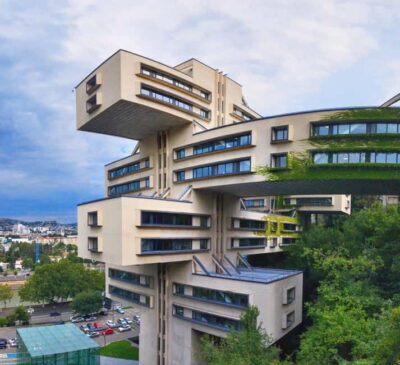
Brutalist Tbilisi: Urban exploration and untold stories
Read our review →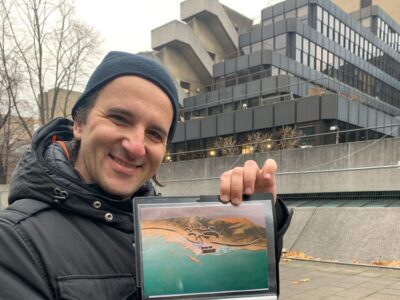
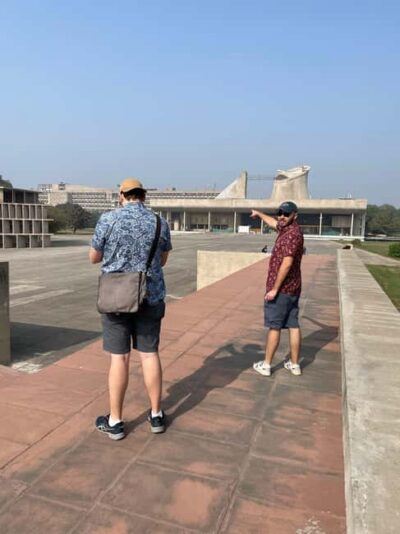
Le Corbusier’s Chandigarh : A Complete Architecture Tour
Read our review →
Secret Split: Socialist Architecture & brutalism – Urban Utopia
Read our review →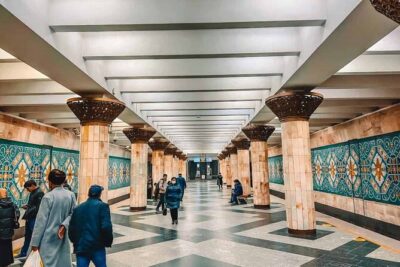
Tashkent Soviet Architecture (Modernism) and Subway station tour.
Read our review →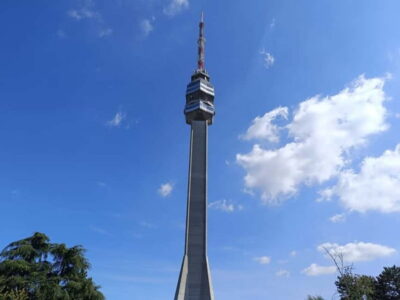
Belgrade: Space architecture tour – brutalist architecture
Read our review →
Bishkek : USSR History, Soviet Architects ,Statues & Mosaics
Read our review →
Brutal Tbilisi — Night Edition: Dark Side of Soviet Architecture
Read our review →Browse the lists this tour appears in