
REVIEW · BAUHAUS AND BRUTALIST ARCHITECTURE TOURS
Bishkek : USSR History , Soviet Architects , Statues & Mosaics
Bishkek tells its story in concrete. This three to four-hour city tour links Soviet buildings, public art, monuments, parks, and Kyrgyz national symbols into one useful introduction to the capital. I like the clear focus on architecture and political history, and I like that the route also explains Kyrgyz identity through the flag, Manas, and nomadic traditions.
The price is $49 per person, which feels fair if you want a guide to explain what you are seeing rather than simply point out buildings. The main consideration is pace: there are many stops, some lasting only five minutes, and the experience does not include food, drinks, insurance, or an air-conditioned vehicle.
Key points before you book
- Soviet design is the main subject: See Socialist Modernism, Stalin-era architecture, public mosaics, statues, theaters, and government buildings.
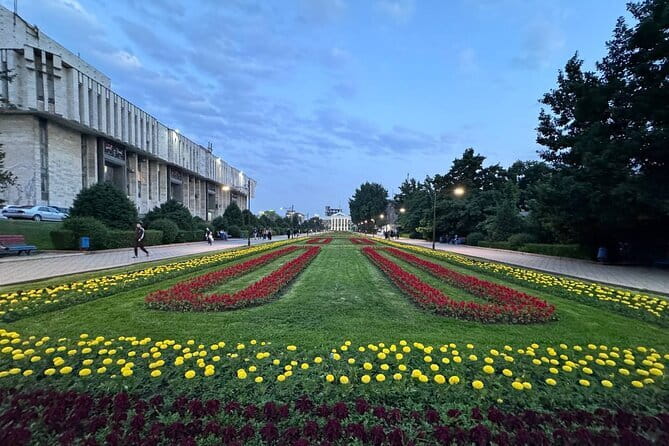
- The route covers major central sights: Stops include Ala-Too Square, Victory Square, Panfilov Park, the opera house, Philharmonic Hall, and City Hall.
- Kyrgyz culture gets its place: The flag, Manas statue, museum, and nomadic traditions keep the tour from becoming only a Soviet architecture lesson.
- The walk lasts about three to four hours: Expect a city tour with short stops, explanations, and time to look around.
- Guide quality matters here: Anna and Alex are named as guides praised for clear explanations, friendly service, and patience.
- The group can reach 25 people: That keeps the price reasonable, though a large group may make questions and photographs less personal.
Why Bishkek’s Soviet past is worth seeing
Bishkek changed sharply during the Russian imperial and Soviet periods. The city was reshaped with broad public spaces, formal government buildings, parks, memorials, apartment blocks, and public art. Under communism, it was renamed Frunze after Bolshevik figure Mikhail Frunze, and it kept that name for more than 60 years.
This tour gives you a way to read those changes. Instead of treating a square or theater as a backdrop for photographs, your guide explains what the building was meant to communicate. Soviet civic design often used scale, symmetry, heroic figures, and murals showing work, education, industry, and unity. Once you understand that visual language, Bishkek’s center becomes easier to read.
I also like the balance between Soviet material and Kyrgyz culture. The route includes Lenin and Marx, but it also includes Manas, the national flag, and the traditions of a people whose identity reaches far beyond the Soviet period. That balance matters. You get political history without reducing Kyrgyzstan to its former place in the USSR.
The walk begins at the Paramount Kyrgyz Republic Flag on Chuy Avenue and returns to the same meeting point. Since the experience includes time walking through parks and around monuments, wear comfortable shoes and allow room in your schedule for a steady city stroll.
More Bauhaus and brutalist tours in the world:
- London: Brutalist Architecture & History Walking Tour
★ 4.8 · 42 reviews - Le Corbusier’s Chandigarh : A Complete Architecture Tour
★ 4.7 · 25 reviews - Architecture of New Belgrade – Brutalism Decoded
★ 4.5 · 24 reviews
Ala-Too Square and the national flag
Ala-Too Square is the logical opening. It is the center of Bishkek and brings several themes together: Soviet planning, national independence, public ceremony, and changing monuments.
You can expect to see major Soviet-era buildings around the square, along with statues connected to the city’s earlier political identity. The guide also explains which statues were removed after 1991. That detail gives the square a useful sense of change. Public monuments are not permanent history books. Governments move them, replace them, or give them new meaning.
The nearby flag stop adds a different layer. You learn about the purpose of the Kyrgyz flag, including the meaning of its design and colors, along with the nomadic traditions tied to Kyrgyz identity. This is a short stop, but it helps you understand why national symbols matter in a place that has passed through imperial and Soviet rule.
Do not expect a long museum-style talk at these opening points. The listed timing is about 10 minutes at Ala-Too Square and about five minutes at the flag. The value comes from the connections between the stops, not from lengthy time at one monument.
The museum and the Manas statue
The museum stop focuses on Kyrgyz cultural heritage, with thousands of objects ranging from antiquity to the end of the 20th century. The supplied schedule does not give the museum’s name or a separate admission detail, so you should treat it as a brief cultural stop within the route rather than assume you will have a long independent museum visit.
That distinction matters. If you want to study exhibits at length, you may need a separate visit. On this tour, the museum gives you context for the people and traditions that existed before, during, and after Soviet rule.
The Manas statue provides a strong contrast to Soviet monuments. Manas is a famous Kyrgyz hero, and the guide explains his life and importance to the nation. The stop is scheduled for about five minutes, so expect an introduction rather than a full lecture on the epic.
I like this part of the route because it keeps the story grounded in Kyrgyz culture. You are not simply moving from one Soviet building to the next. You are also seeing the figures and symbols that help define the country on its own terms.
Ala-Too Cinema and public art
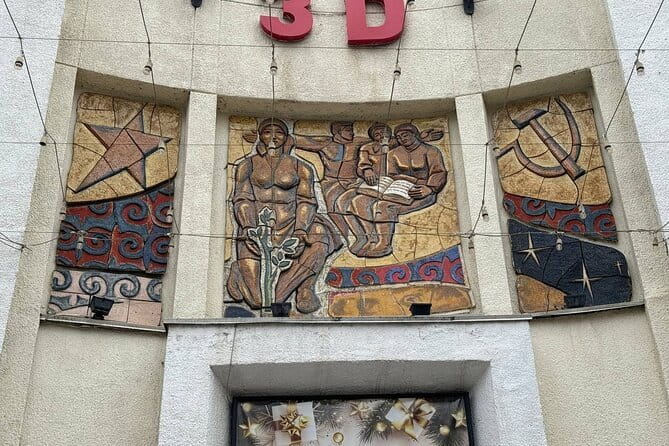
Ala-Too Cinema dates from the early 1960s and is described as the oldest movie theater in Kyrgyzstan. The building’s main appeal on this tour is its mosaic work.
Mosaics are one of the best reasons to take a guided architecture walk in Bishkek. They are easy to pass without understanding their purpose, especially when they sit on a working building rather than a famous monument. Soviet public art often brought political ideas into daily life, and the image could be seen by anyone passing the building.
You get about 10 minutes here. That should be enough to inspect the exterior and hear why the mosaic matters, though it is not enough for a detailed study of every panel. Bring a phone or camera, but listen first. The guide’s explanation is what turns a colorful wall into a historical document.
More history tours in the world:
- Chicago in a Day: Food, History & Architecture Walking Tour
★ 5.0 · 1,153 reviews - Charleston’s Best Highlights: History, Culture & Architecture
★ 5.0 · 422 reviews - Palm Springs Modernism Architecture & History Bike Tour
★ 5.0 · 359 reviews - Charleston: History and Architecture Guided Walking Tour
★ 4.8 · 349 reviews
Fine arts, opera, and the Soviet cultural project
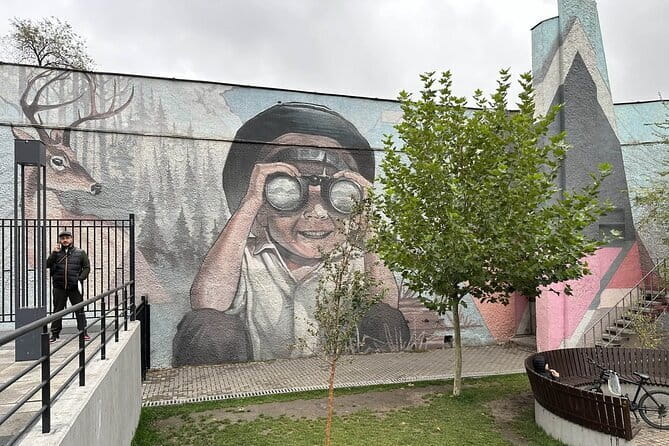
The Gapar Aitiev National Museum of Fine Arts is presented as one of Bishkek’s distinctive buildings. You learn about artworks brought by well-known Russian artists, as well as the institution’s role in the city’s art life.
The listed stop is only about five minutes, so the focus is the building and its place in Bishkek rather than an extended gallery visit. If you want to see the collection inside, plan another visit. The tour’s strength is the broad picture: how Soviet institutions brought art, theater, music, and formal culture into public life.
The Maldybaev Opera and Ballet Theater opened in 1937 as a musical drama theater. Its history reflects the Soviet effort to create permanent cultural institutions across the union. A theater was not only for entertainment. It also helped present a shared public culture through music, drama, and ballet.
Again, the timing is short, about five minutes. You will likely hear the building’s origin and role, then continue. This is useful for first-time orientation, but not a replacement for attending a performance or taking an interior tour.
Victory Square and the memory of war
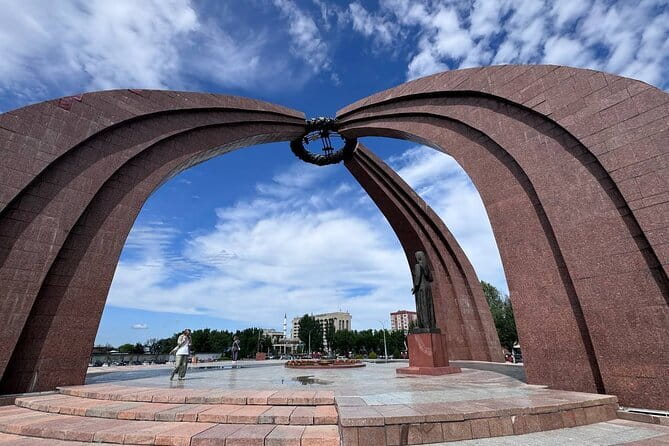
Victory Square commemorates victory over Nazi Germany. It was created in 1985, marking the 40th anniversary of the end of the war.
This memorial is one of the more emotionally serious points on the route. Soviet war memory shaped public spaces across the former USSR, and Victory Square connects Bishkek to that wider story. The design and setting are meant for remembrance, not just decoration.
You get around 10 minutes here. That gives you enough time to understand the memorial’s purpose and look closely at its form. Ask your guide how the memorial fits into Kyrgyzstan’s own wartime experience if time allows. The supplied information confirms the square’s dedication and date, but not the full details of the interpretation offered on the day.
Library, Marx, Engels, and Lenin
The National Library of the Kyrgyz Republic was founded in 1934 and serves as the country’s legal deposit and copyright agency. Its collection contains six million documents in 89 languages.
That number gives the building more weight than its exterior alone might suggest. A national library represents education, state administration, language, and access to ideas. Its Soviet-era foundation also shows how institutions built during that period continued into independent Kyrgyzstan.
The Marx and Engels monument brings the tour back to communist political thought. The guide explains the connection to The Communist Manifesto, written jointly by Karl Marx and Friedrich Engels between December 1847 and January 1848, and first published on February 21, 1848.
The Lenin statue offers another useful example of changing public memory. It was erected in 1984 for the 60th anniversary of the Kyrgyz Soviet Socialist Republic. After communism ended in 1991, Lenin statues were generally removed, though Bishkek retained this one in a different setting. The stop lets you consider how a city decides what to preserve, move, or reinterpret.
Each of these stops lasts about five minutes. The quick pace works well if you want a broad introduction, but you should not expect a full political theory lesson. You will get the essential context and can note places to revisit.
Panfilov Park and the city’s green spaces
Panfilov Park is near Old Square and Manas Square. It is named for Ivan Panfilov, a Hero of the Soviet Union and chairman of the Military Committee of the Kirghiz SSR.
The park adds breathing room to a route filled with monuments and formal buildings. Soviet city planning placed real value on parks and open spaces, and Bishkek’s greenery remains part of its urban character.
This is also a good place to notice how memorial space and ordinary city life can share the same setting. The park is a memorial site, but it is also a public place. The tour does not promise rides, attractions, or extended free time, so think of this as a guided look at the park’s historical role.
The textile-factory mosaic and working women
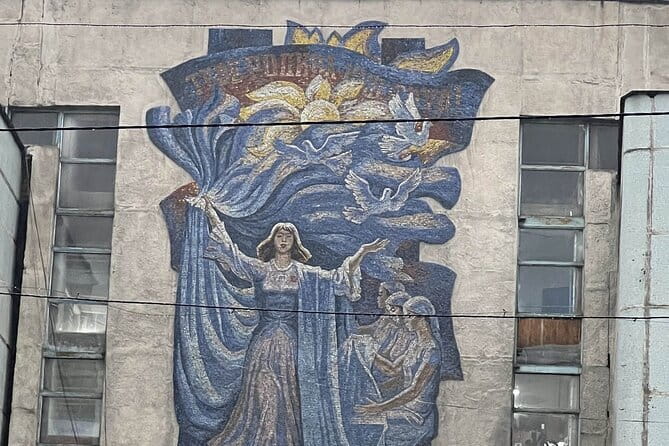
One of the most specific stops is the mosaic titled Our Work to You, Motherland on a textile factory. It celebrates the power of working women and the labor that helped make the Soviet nation strong.
This is exactly the kind of sight a visitor can miss without local guidance. A factory wall may look plain or dated at first glance, yet the mosaic carries a clear message about labor, gender, industry, and state pride. It also adds a social angle to a route otherwise dominated by leaders, memorials, and official buildings.
The stop lasts about five minutes. Use that time to look at the figures, gestures, and overall composition. The guide’s explanation should help you understand how public art presented work as a civic duty and a source of national strength.
Philharmonic Hall and Stalin-era City Hall
The Toktogul Satylganov Philharmonic Hall grew from a Philharmonic Society founded in 1936. For many years, the society had no dedicated concert hall and used other venues. That detail shows how cultural life developed gradually rather than appearing fully formed.
The hall gives you another look at the Soviet desire to organize music as a public institution. You will hear about its beginnings and its place in Bishkek’s cultural life, with about 10 minutes for the stop.
The final listed sight is Bishkek City Hall, described as the mayor’s building and an example of Stalin-era architecture. This style is usually easy to recognize through its formal scale and official appearance. The building makes a fitting end because it brings the route back to power, administration, and the physical design of the state.
The tour then returns to the original meeting point. The stated schedule leaves some time for the round route, sightseeing, and exploration, so the exact finish may depend on walking speed, questions, and the group.
What $49 gets you
At $49, the price is reasonable for a three to four-hour guided introduction, especially if you want explanations at many separate sites. You are paying for a route that connects architecture, public art, national identity, and political change. The guide’s role is important because several of the most interesting features are exterior mosaics or monuments that would be easy to misunderstand alone.
The strongest value comes from the number of themes covered. You see Soviet civic buildings, cultural institutions, war memorials, communist symbols, Kyrgyz heroes, and a textile-factory mosaic. You also receive suggestions for other worthwhile places in Kyrgyzstan and recommendations for local food spots.
The price does not include food or drinks, insurance, or an air-conditioned vehicle. The information provided also does not list hotel pickup. You meet at the Paramount Kyrgyz Republic Flag on Chuy Avenue and return there, so plan your own way to and from that point.
Group discounts are available, and the maximum group size is 25. A smaller group would likely make it easier to ask questions and take photographs, but the stated maximum keeps the cost within reach for many visitors.
Guide quality and practical fit
Guide quality can make or break a history walk. Anna received especially strong praise for patiently explaining the key sights, the country’s geography, and the history behind the parks and statues. One reported outing with her lasted about three and a half hours.
Alex was also praised for a friendly manner and clear explanations of the city’s buildings, monuments, and mosaics. If you can request a guide, asking for Anna or Alex is a sensible tip, though guide assignments cannot be guaranteed from the information provided.
This experience suits you best if you enjoy walking, public architecture, history, and close attention to details that are easy to miss. It is also useful early in a Bishkek visit because it gives you a map of the central city and points you toward places worth returning to.
It may be less suitable if you want long interior visits, a relaxed café break, or a transport-based sightseeing trip. The route has many short stops, and the air-conditioned vehicle is not included. Check the weather and dress for several hours outside.
Should you book this Bishkek tour?
Book it if you want a focused introduction to Bishkek’s Soviet past with enough Kyrgyz culture to keep the story balanced. The combination of Ala-Too Square, mosaics, Victory Square, Lenin, Manas, the opera house, and City Hall gives you a useful first look at how the capital was shaped.
Skip it if you prefer to explore slowly inside museums or spend a long time at one monument. For $49, the tour offers good value through interpretation and route planning, not through admission-heavy attractions. If you book, start with comfortable shoes, bring water, and request Anna or Alex if possible.
FAQ
How long does the experience last?
The tour lasts approximately three to four hours. One guide-led outing with Anna lasted about three and a half hours.
How much does the tour cost?
The listed price is $49 per person. Group discounts are available.
Where does the tour start?
It starts at the Paramount Kyrgyz Republic Flag on Chuy Avenue in Bishkek.
Where does the tour end?
The experience ends back at the meeting point.
Is transportation included?
No air-conditioned vehicle is included. The route is described through walking between parks, statues, buildings, and public spaces.
What is the maximum group size?
The maximum group size is 25 people.
Are meals or drinks included?
No. Food and beverages are not included.
Are entrance fees included?
All fees and taxes are included. Most listed stops are exterior sights with free admission, while the supplied information does not give separate admission details for the museum stop.
Can most people participate?
Yes. The provided information says most people can participate.
Can I cancel for a full refund?
Yes, if you cancel at least 24 hours before the experience start time. Cancellations made less than 24 hours before the start time are not refunded, and changes within that period are not accepted.
Just added in the world
- Wilmington History and Architecture Tour★ 4.8 · 18 reviews
- New Orleans : Garden District Architecture Walking tour★ 4.8 · 5 reviews
- Washington DC: Dupont Circle & Embassy Row Architecture Tour★ 5.0 · 6 reviews
- Washington, DC: Georgetown Architecture Walking Tour★ 5.0 · 8 reviews
- Vicenza: Palladian Architecture Private Walking Tour★ 3.3 · 3 reviews
- Walk & Discover KL’s Architectural and Heritage Gems★ 5.0 · 7 reviews
- Private Colonial Williamsburg Architectural Tour★ 5.0 · 5 reviews
- Unveiling Brno: History, Culture & Architectural Delights★ 5.0 · 2 reviews
Bauhaus and Brutalist Architecture Tours, compared.
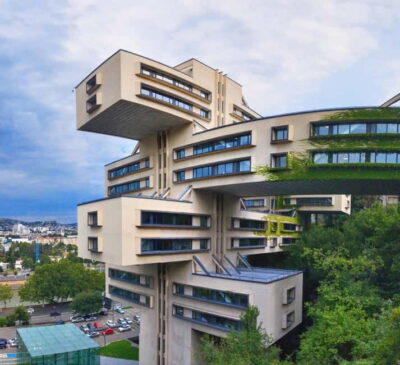
Brutalist Tbilisi: Urban exploration and untold stories
Read our review →
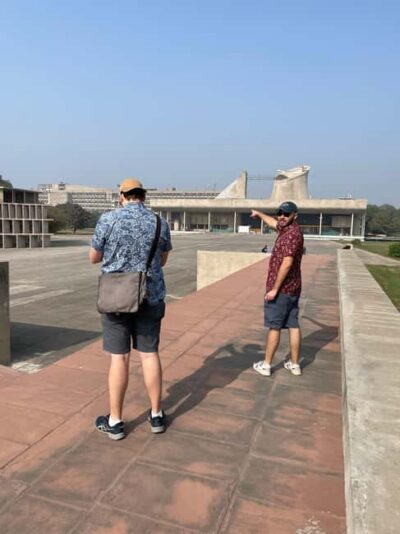
Le Corbusier’s Chandigarh : A Complete Architecture Tour
Read our review →
Architecture of New Belgrade – Brutalism Decoded
Read our review →
Secret Split: Socialist Architecture & brutalism – Urban Utopia
Read our review →
Tashkent Soviet Architecture (Modernism) and Subway station tour.
Read our review →
Belgrade: Space architecture tour – brutalist architecture
Read our review →
Bishkek : USSR History, Soviet Architects ,Statues & Mosaics
Read our review →Browse the lists this tour appears in