
REVIEW · COPENHAGEN ARCHITECTURE TOURS
Copenhagen Architecture and Sustainability Tour with local Guide
Copenhagen’s best stories are often built into its streets. This three-hour bicycle tour links modern buildings, harbor bridges, reclaimed nature, stormwater parks, and community spaces in one well-planned ride. I like the way it gets you beyond the usual central sights, and I especially like the small group, capped at 15 people, which makes following a guide through city traffic far easier.
I also like that the tour treats sustainability as a practical subject rather than a slogan. You see shared housing, bike infrastructure, clean-water projects, adaptive parks, and reused buildings. The main drawback is the pace: you cover about 11 kilometers between stops, so you need a moderate level of fitness and some comfort cycling in an urban setting. Busy harbor areas can also feel crowded, especially in summer.
Key points to know before booking
- About 11 kilometers of city cycling: The ride covers much more ground than a walking tour, with most of the time spent moving between stops.
- Small groups capped at 15: This is a useful size for staying close to the guide and asking questions.
- Architecture meets daily life: You see student housing, concert halls, parks, food markets, community centers, and bridges, not just landmark buildings.
- A strong focus on practical sustainability: Shared facilities, harbor swimming, cycling routes, stormwater control, and urban nature all have a place in the story.
- Bikes are included: Helmets are free upon request, while baskets, phone holders, child seats, and upgraded bikes cost extra.
- Good guides add real value: Guides including Jörn and Julia have been praised for making Copenhagen’s recent city development clear, interesting, and easy to follow.
Why this three-hour ride is different
Many Copenhagen tours stay close to the old center and cover royal buildings, canals, and postcard streets. This one takes a wider view. It shows how Copenhagen has changed from a working port and industrial city into a place where cycling, public access, shared space, and environmental planning shape daily life.
That makes the tour a good choice for a first or second day in the city. You get your bearings quickly, but you also see places you may not think to visit on your own. The route includes the harbor, Islands Brygge, Amager Fælled, the Meatpacking District, Nørrebro-adjacent parkland, and several newer urban projects.
The guide is important here. These stops make more sense when someone explains why a bridge was built for bicycles, why a former church became a community center, or how a park now helps manage heavy rain. The strongest guide feedback specifically names Jörn and Julia, both praised for being friendly, clear, and good at explaining recent urban development.
You will spend about 10 minutes at many stops, with shorter visits at Lille Langebro and Folkehuset Absalon. The remaining time is cycling. This is not a stop-and-stare tour with long interior visits. It is a moving lesson in how the city works.
A few more architecture tours in the world worth a look
- Chicago River: 1.5-Hour Guided Architecture Cruise
★ 4.8 · 8,046 reviews - Charleston: History and Architecture Guided Walking Tour
★ 4.8 · 349 reviews - Vienna: Spanish Riding School Guided Architectural Tour
★ 4.8 · 333 reviews
Starting at Blox and Lille Langebro
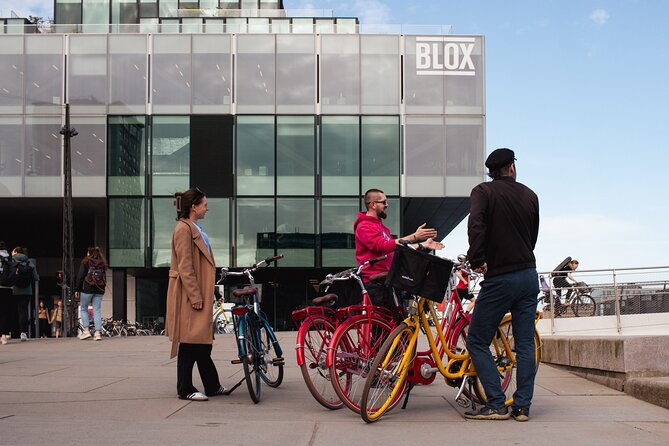
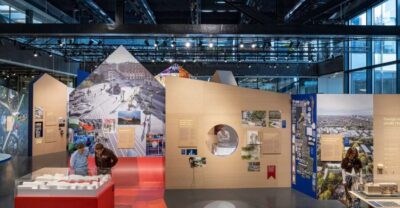
The ride begins at Blox, a mixed-use building developed with both technical and social sustainability in mind. The Danish Architecture Center, known as DAC, is the building’s most prominent renter and presents exhibitions about Copenhagen architecture.
The stop is brief, around 10 minutes, and admission to the tour stop is free. If you want to explore DAC in detail, check what exhibition is currently on before booking or plan a separate visit. The tour gives you the building’s role in the city, but it is not designed as a full museum visit.
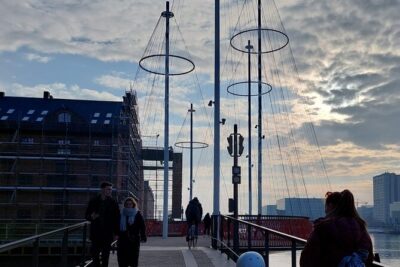
From Blox, you reach Lille Langebro, a newer harbor crossing for pedestrians and cyclists. The bridge is part of Copenhagen’s larger effort to turn the old merchant and naval harbor into a place for recreation and public life.
This is one of the tour’s clearest examples of design serving ordinary needs. You are not just looking at a bridge. You are seeing how a city can reconnect areas on opposite sides of the water without giving every new connection to cars.
One practical warning: the harbor area can be crowded, particularly during the summer season. If you dislike riding through busy public spaces, this may be one of the more demanding parts of the route.
Islands Brygge and the city’s changing harbor
At Havnebadet Islands Brygge, you see the harbor bath that opened in 2003. Its importance is larger than its modest 10-minute stop suggests. The bath marked a major change in how Copenhagen related to its water.
For years, working harbors were mainly places for ships, storage, and industry. A public swimming facility signals a different idea: the harbor can also be part of everyday leisure. The stop helps you understand Copenhagen’s shift toward public waterfront space.
You may find this especially useful if you are interested in city planning rather than just architecture. The key point is not a single building. It is the decision to make the water accessible to people.
The cycling between stops gives you time to see how these projects fit together. You are moving through the city instead of viewing isolated sites from a tour bus. That wider context is one of the tour’s best features.
Tietgen Residence Hall and social sustainability
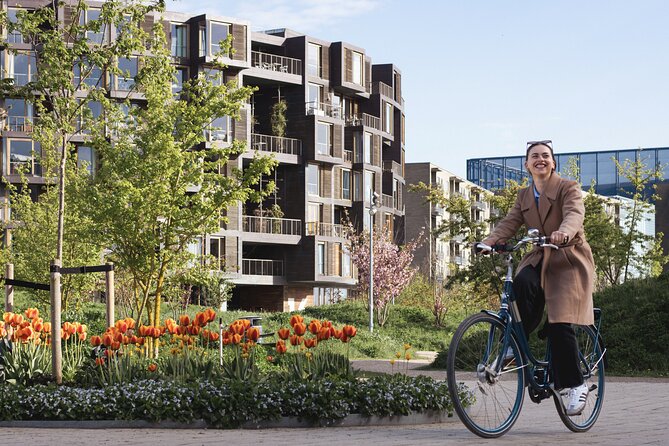
The Tietgen Residence Hall offers a more personal example of sustainable design. The building houses about 400 people and is designed to balance individual privacy with shared life.
Rooms are small and include a washroom. Kitchens, living rooms, and other facilities are shared by some or all residents. The idea is not simply to save space. Shared areas are meant to support contact, cooperation, and personal development.
This stop makes the tour’s use of the word sustainability broader. You are not limited to solar panels, recycled materials, or energy systems. You also look at how buildings can support community and reduce the need for every resident to have a complete private set of facilities.
The stop lasts about 10 minutes, so expect an explanation from the outside rather than a detailed interior tour. Still, it is a useful contrast with the large public buildings elsewhere on the route.
Same city, a different building to stand in front of:
- Chicago Architecture River Cruise
★ 5.0 · 15,756 reviews - Chicago River 90-Minute Architecture Tour
★ 4.5 · 9,629 reviews - Chicago Architecture Center River Cruise aboard First Lady
★ 5.0 · 5,536 reviews - Chicago: Architecture River Cruise Skip-the-Ticket Line
★ 4.8 · 4,325 reviews
DR Koncerthuset and Amager Fælled
DR Koncerthuset brings culture into the route. The building includes an 1,800-seat concert hall, home to the Royal Symphony Orchestra, along with smaller stages and recording studios.
A short stop here shows how a large cultural building fits into the city’s modern development. You will not be attending a concert as part of this activity, but the building gives the route some variety after the residential and infrastructure stops.
Next comes Amager Fælled, a rare area of relatively untouched nature within Copenhagen. Its past is less polished. The area was used by the military as a training ground and shooting range from the 1700s to the 1950s, then became a garbage dump. Copenhageners have even joked about Amager as lorteøen, or shit island.
Today, Amager Fælled presents a very different picture. Much of it sits on artificially reclaimed land, yet it has become an important open area in the city. That contradiction is worth hearing about. Urban nature is not always ancient or untouched. Sometimes it develops from damaged, altered, or discarded ground.
The 15-minute stop is among the longer visits on the tour. It gives you a break from buildings and bridges, though the ride still keeps moving at a steady pace.
Cykelslangen and Copenhagen’s bicycle logic
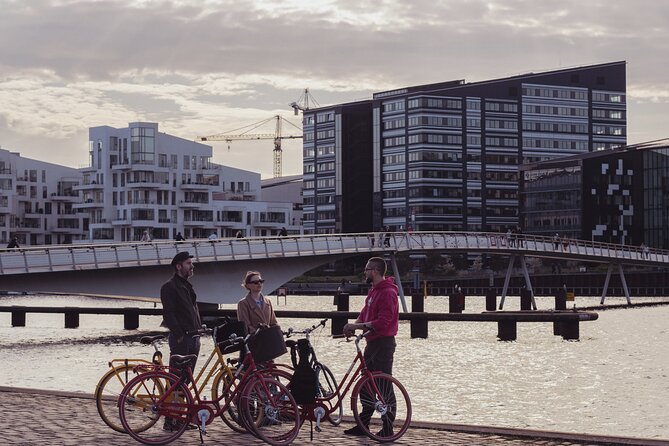
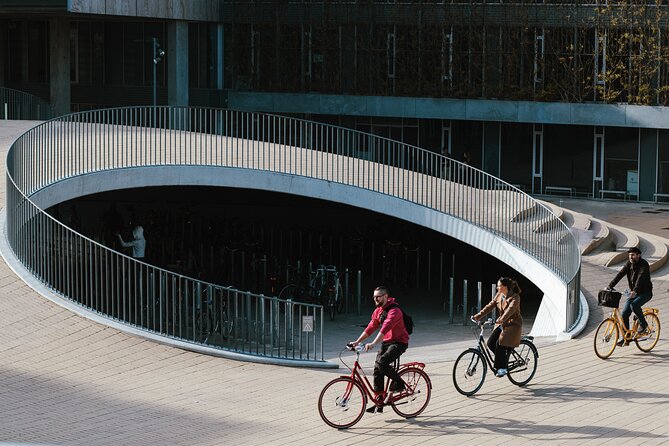
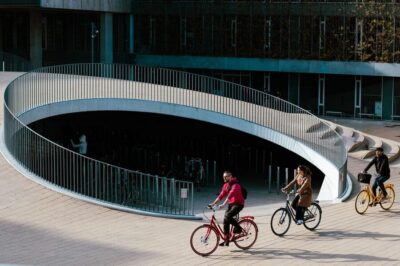
Cykelslangen, or the Bicycle Snake, is one of the route’s most practical stops. Along with Bryggebroen, it was among the first new harbor crossings built exclusively for cyclists.
You can understand the point best while riding. A bicycle bridge is not merely a decorative structure or a tourist photo stop. It can create a direct route that keeps cyclists separate from heavy traffic and helps cycling function as everyday transport.
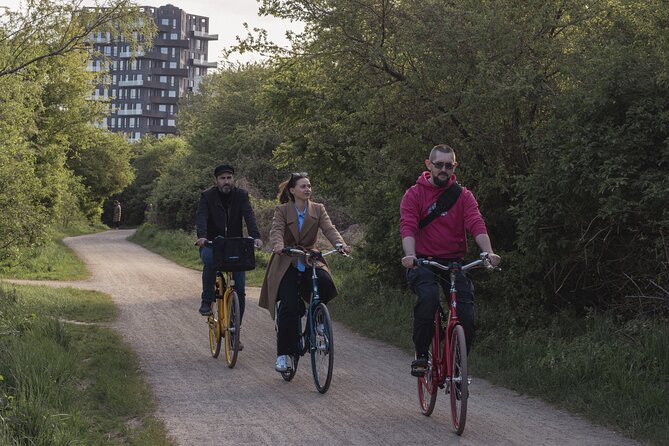
The tour is well suited to people who want to understand why Copenhagen is so easy to explore by bike. You are not only told that the city is bicycle-friendly. You use the infrastructure yourself, with a guide nearby.
That said, you should be comfortable starting, stopping, and riding in an urban environment. The tour does not describe itself as a beginner cycling lesson. The guide helps with the route, but you remain responsible for handling the bike.
Enghave Park and stormwater planning
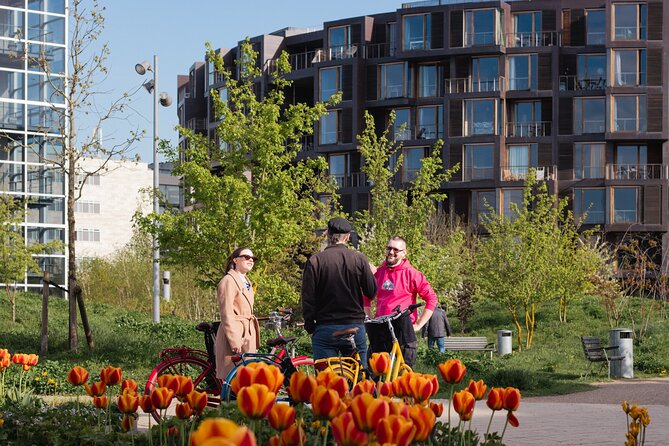
Enghave Park was created in the late 1920s on the site of former allotment gardens. Its original design followed a neoclassical plan, with a bandstand, playground, sports fields, hills, and paths.
Between 2017 and 2019, the park was completely redesigned. Its new role includes helping Copenhagen manage torrential rain. This is a fine example of infrastructure that still functions as a pleasant public space.
You see how a familiar park can serve several purposes at once. People can play sports, meet friends, walk, and spend time outdoors, while the park also helps control stormwater during severe weather.
The stop lasts about 10 minutes. It is one of the clearest places to connect public design with a current city problem. You do not need a technical background to understand the basic idea: good urban planning can make necessary systems useful and attractive.
Absalon and the Meatpacking District
Folkehuset Absalon occupies a former church that was converted into a privately run community center. The short stop gives you another example of reuse, this time on a neighborhood scale.
The building’s importance comes from its new social purpose. Instead of treating an old structure as something to preserve behind glass, the city has a place where people can gather and use the building in a new way.
The Meatpacking District, or Kødbyen, offers a different kind of reuse and urban history. The city planned the district to create cleaner and healthier conditions for the meat trade as Copenhagen grew. It expanded through several stages, and its buildings show the development of industrial architecture across the 19th and 20th centuries.
The district is useful for understanding that architecture is often shaped by public health and practical business needs. It was not created as an entertainment quarter. Its current identity grew from an older working district.
You spend about 10 minutes here. The tour does not promise extended time inside restaurants, bars, or galleries, so plan a separate visit if you want to explore Kødbyen at length.
Israel’s Square and Ørstedsparken
Israels Plads, next to Torvehallerne, is now a popular meeting point for Copenhagen’s food scene. Its earlier story is just as interesting. A farmers market occupied the area from the end of the old walled city’s strict building rules in the 1890s until the 1950s. Later, the space became a huge parking lot.
That change tells you a lot about shifting city priorities. A market serves people on foot and supports local trade. A parking lot serves cars. Returning the area to public use reflects a different idea of what central urban space should do.
The final major stop is Ørstedsparken, an early example of adaptive reuse. The area once formed part of Copenhagen’s defenses outside the city walls. After the walls were demolished, it became a park while retaining sections of the former moat as a lake.
The hills and crooked paths give the park a different feel from the formal spaces earlier in the tour. At about 10 minutes, you get enough time to understand the transformation without lingering for a full park visit.
Bikes, extras, timing, and value
The tour costs $72.57 per person and includes bicycle use, a local guide, and helmets upon request. Children’s bikes in different sizes are available, but you should contact the provider about availability before booking.
The base price offers good value if you want a broad introduction to Copenhagen’s modern architecture and environmental planning. A private guide or separate bike rental plus several paid activities could cost more, while a standard walking tour would cover less ground.
The main extra charges are easy to avoid if you need only a standard bike. Phone holders and baskets cost 49 DKK each. An e-bike costs 249 DKK, a child seat costs 119 DKK, a cargo or tandem bike costs 449 DKK, and an e-cargo bike costs 649 DKK. These upgrades must be reserved in advance where required.
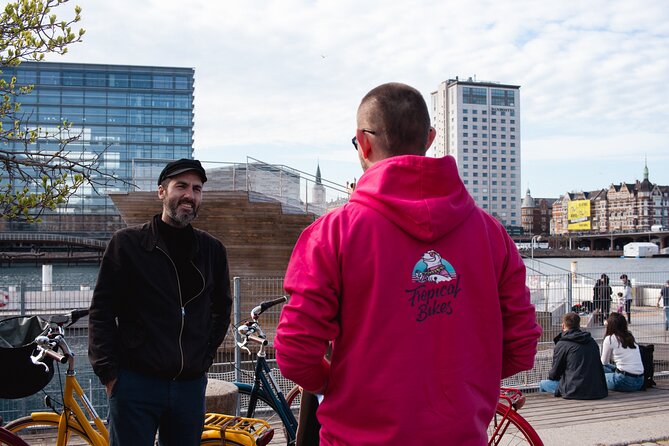
The meeting point is Tropical Bikes at Vester Voldgade 2. Toilets are available at the store, and the tour returns there at the end. Public transportation is nearby.
The schedule is approximate, and the tour requires good weather. If poor weather or an insufficient number of bookings causes cancellation, you can choose another date or receive a full refund. Otherwise, cancellation is free up to 24 hours before the start time. The activity is usually booked about 35 days ahead, so early planning makes sense during busy periods.
Who should book this Copenhagen bike tour?
I would choose this tour if you want to see how Copenhagen is planned, not just photograph its famous buildings. It suits first-time visitors who want a broad introduction, repeat visitors looking for newer areas, architecture fans, urban planning students, and anyone curious about cycling and public space.
It also works well for a short stay because three hours covers a lot. You see the harbor, modern housing, cultural buildings, reclaimed nature, industrial architecture, markets, parks, and community spaces in one outing.
I would hesitate if you want long interior visits, a relaxed sightseeing pace, or a tour focused on royal Copenhagen. The route includes about 11 kilometers of cycling and requires moderate fitness. Crowded harbor areas may also test anyone who is nervous around urban bike traffic.
Should you book it?
Book it if you want a practical, wide-ranging look at Copenhagen’s recent development and feel comfortable riding a bicycle for three hours. The strongest reasons are the small group, the thoughtful route, the included bike, and guides such as Jörn and Julia, who have been praised for making city development clear and engaging.
Skip it if your priority is famous historic sights, indoor attractions, or a slow walking tour. For the right cyclist, though, this is a useful way to see the city as Copenhageners experience it: by bike, across bridges, through parks, and among buildings designed for daily life.
FAQ
How long does the Copenhagen Architecture and Sustainability Tour last?
The tour lasts approximately three hours, including cycling between the stops.
How far do you cycle?
You cycle roughly 11 kilometers between the stops.
What is the maximum group size?
The group is limited to a maximum of 15 people.
Is bicycle use included?
Yes. Bicycle use is included in the tour price.
Are helmets provided?
Free bicycle helmets are available upon request.
Are children’s bikes available?
Children’s bikes in different sizes are available. You should contact the provider to confirm availability.
Where does the tour start and finish?
The tour starts at Tropical Bikes, Vester Voldgade 2, 1552 København, Denmark, and ends back at the same meeting point.
What happens if the weather is poor?
The tour requires good weather. If it is canceled because of poor weather, you will be offered another date or a full refund.
Just added in the world
- Wilmington History and Architecture Tour★ 4.8 · 18 reviews
- New Orleans : Garden District Architecture Walking tour★ 4.8 · 5 reviews
- Washington DC: Dupont Circle & Embassy Row Architecture Tour★ 5.0 · 6 reviews
- Washington, DC: Georgetown Architecture Walking Tour★ 5.0 · 8 reviews
- Vicenza: Palladian Architecture Private Walking Tour★ 3.3 · 3 reviews
- Walk & Discover KL’s Architectural and Heritage Gems★ 5.0 · 7 reviews
- Private Colonial Williamsburg Architectural Tour★ 5.0 · 5 reviews
- Unveiling Brno: History, Culture & Architectural Delights★ 5.0 · 2 reviews
Copenhagen Architecture Tours, compared.
Copenhagen City, Old Town, Nyhavn, Architecture Walking Tour
Read our review →
Copenhagen City, Old Town, Nyhavn, Architecture Walking Tour
Read our review →Browse the lists this tour appears in