
REVIEW · LOS ANGELES ARCHITECTURE TOURS
The History and Architecture of Downtown Los Angeles
Los Angeles rewards walking below the movie set. This three-hour tour shows you the city’s older, stranger, more human side, from Angels Flight and Victorian Bunker Hill to the Bradbury Building, Little Tokyo, and Grand Central Market. I especially like the mix of major landmarks and small local details, including a mochi sample at the 1903 Fugetsu-Do.
I also like the compact route and small group size, capped at 15 people. Guide Chris receives high marks for clear explanations, humor, patience, and a talent for making architecture feel connected to daily life. The main limitation is scope: the route does not include Olvera Street, so the Mexican and Spanish roots of Los Angeles receive less attention than the city’s Japanese, civic, theater, and financial history.
Key points to know before booking
- Angels Flight is part of the tour: Your first stop includes a ride on the historic funicular, with the fare covered.
- The route links four different DTLA districts: You walk through Bunker Hill, the Civic Center, Little Tokyo, and the Historic Core.
- Fugetsu-Do adds a genuine local taste: The family business has operated since 1903, and you sample its mochi.
- Architecture gets equal billing with history: The program covers Frank Gehry, the Bradbury Building, historic banks, movie palaces, and early Los Angeles.
- Chris is a major part of the experience: He is praised for his local knowledge, easy manner, humor, and willingness to answer questions.
- The route finishes at Grand Central Market: You end where you began, which makes parking and post-tour plans simpler.
Why this Downtown LA walk is worth your time
Downtown Los Angeles can feel scattered if you explore it without a plan. One block gives you a glass tower, the next reveals an old theater, a Japanese sweet shop, or a former bank with a grand marble lobby. This tour gives those pieces a clear order.
At $39.20 per person, the price is fair for a three-hour guided walk with a ride on Angels Flight and a mochi sample included. You are not paying for a long list of admission tickets, since most stops are viewed from outside and the museums mentioned are free. You are paying for the route, the stories, the local context, and the chance to ask questions as you go.
The group limit of 15 matters. Downtown streets can be noisy, and a giant group would make it hard to hear or gather around a building. A smaller group also gives Chris room to adjust the pace, answer questions, and spend more time on an interest that catches your eye.
The tour is offered in English and uses a mobile ticket. It begins at 341 South Hill Street and returns to that same meeting point. That closed loop is practical if you parked nearby or want to continue exploring from a known location.
More history tours in the USA:
- Chicago in a Day: Food, History & Architecture Walking Tour
★ 5.0 · 1,153 reviews - Charleston’s Best Highlights: History, Culture & Architecture
★ 5.0 · 422 reviews - Palm Springs Modernism Architecture & History Bike Tour
★ 5.0 · 359 reviews
Angels Flight and the vanished homes of Bunker Hill
The tour opens with Angels Flight Railway, often described as the shortest train ride in the world. The ride itself is brief, but the story around it gives you an immediate lesson in how Los Angeles changed.
Angels Flight once served the Victorian community on Bunker Hill. The hill was home to residences that later disappeared as Downtown changed and commercial development took over. From the funicular, Chris explains what happened to those homes and how the modern financial district grew around their former setting.
I like this opening because it makes urban change easy to see. Instead of starting with a list of dates, you begin with a physical connection between old residential Los Angeles and the office towers that replaced it.
The railway ride is included in the tour price. It is a small attraction, not a major theme-park experience, so keep your expectations in proportion. Its value comes from the story and the setting, not the length of the ride.
Bunker Hill’s modern art and bold buildings
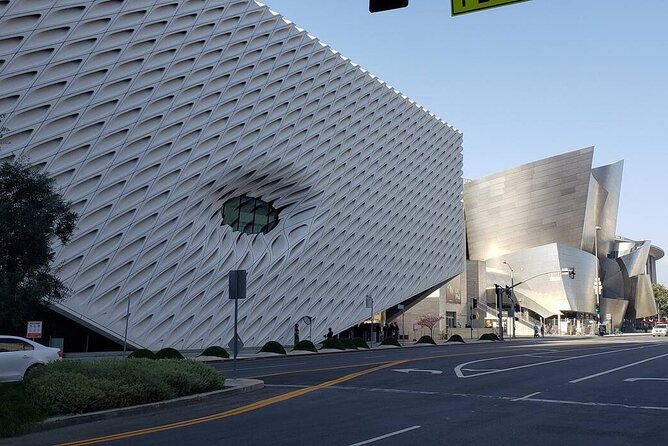
From Angels Flight, the route takes in Bunker Hill’s modern architecture. You see the Museum of Contemporary Art and The Broad, two free art museums with very different identities.
At the Museum of Contemporary Art, the discussion includes the architect behind the building and his early professional struggles. The stop is listed as brief, about five minutes, so you should expect an exterior explanation rather than time to tour the galleries.
The Broad gets similar treatment. You learn the correct pronunciation of its name and hear about the museum’s Pop Art collection, its striking design, and plans for ambitious additions. Again, the point is architectural and cultural context, not a full museum visit.
This is useful if you want to return later. You get enough background to decide which building or collection deserves more of your own time. If you hoped to enter both museums during the walk, plan on coming back separately. The schedule is too tight for a proper gallery visit.
Walt Disney Concert Hall and the civic heart of Los Angeles
The Walt Disney Concert Hall is one of the tour’s visual high points. Frank Gehry’s sweeping metal forms make it easy to understand why the building attracts so much attention, but the story behind its creation adds more than a photo stop.
Chris explains Gehry’s role as a major architect and discusses the long process behind the concert hall. The scheduled stop lasts about 15 minutes, enough time for the building’s design and history without turning the walk into a full architectural lecture.
You then continue toward City Hall through Grand Park. Here the subject shifts from private buildings and cultural institutions to public power. The route explores how Los Angeles grew from a town of only 44 people into a city of millions.
That change gives the tour a useful rhythm. You are not just looking at attractive buildings. You are tracing the forces that shaped the city: population growth, money, government, immigration, transportation, and changing ideas about what Downtown should be.
The Civic Center portion is especially helpful if you know Los Angeles mainly through Hollywood images. It shows the city as a working capital with political and civic functions, not only as a backdrop for films.
A few more architecture tours in the USA worth a look
- Chicago Architecture River Cruise
★ 5.0 · 15,756 reviews - Chicago River 90-Minute Architecture Tour
★ 4.5 · 9,629 reviews - Chicago River: 1.5-Hour Guided Architecture Cruise
★ 4.8 · 8,046 reviews - Chicago Architecture Center River Cruise aboard First Lady
★ 5.0 · 5,536 reviews
Little Tokyo and the story behind Fugetsu-Do
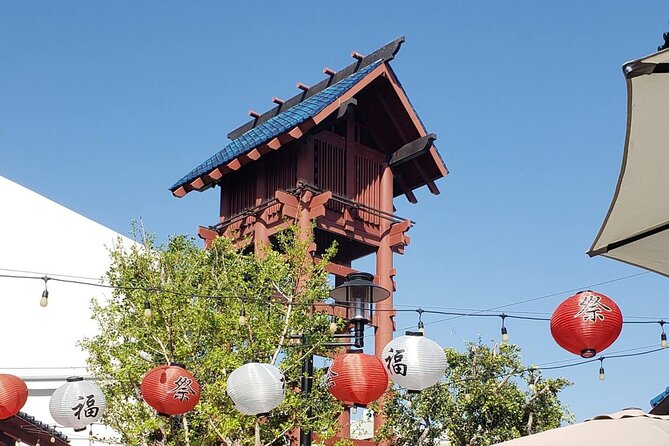
Little Tokyo receives about 30 minutes, making it one of the most substantial sections of the route. The walk points out historic markers, older businesses, restaurants, and the continuing influence of Japanese communities on California and Los Angeles.
This is one of my favorite parts of the route because it gives you time to connect buildings with people. You are not simply passing through a commercial district. You are learning how Japanese immigration and family businesses helped shape this part of the city.
The food stop at Fugetsu-Do brings that history down to a memorable, edible detail. The Kito family opened the business in 1903 and kept it going through two world wars, the Great Depression, and more than 120 years of change. The tour includes a sample of the shop’s mochi.
The snack is modest, but the setting makes it meaningful. A small taste at a long-running family business can tell you more about continuity in Los Angeles than another quick view of a skyscraper.
Little Tokyo is also where the tour differs from many general Downtown routes. The route gives Japanese history a central place instead of treating the district as a quick lunch stop. If that subject interests you, this part alone adds real value.
Vibiana, Broadway, and the old entertainment district
The next stretch moves into older Los Angeles, beginning with Vibiana. The building dates from 1876 and is the oldest structure along the route. At the time it was built, nearly one-fifth of Los Angeles’s entire population could fit inside it.
That comparison makes early Los Angeles feel surprisingly small. Modern Downtown has millions of people nearby, but this building belongs to a period when the city was still a modest settlement with a much smaller civic and religious center.
The route then reaches the Million Dollar Theater on Broadway. Downtown Los Angeles has one of the largest remaining collections of historic movie palaces in the United States. These theaters once hosted major premieres, including films connected with Hollywood figures such as Charlie Chaplin.
The Million Dollar is one of the grandest surviving examples. The stop is short, around five minutes, so you will hear the main story and see the building rather than settle in for a full theater tour.
Broadway rewards close attention. Look up as you walk. The facades, signs, and decorative details make more sense once you know that this was a major entertainment district, not simply an old street with a few handsome buildings.
The Bradbury Building and Spring Street’s financial past
The Bradbury Building is given about 10 minutes, which is appropriate for one of Downtown’s most unusual landmarks. Built in 1893, it has an extraordinary story and an interior that has appeared in films and television.
The tour explains what makes the building important rather than leaving you with only a quick photo opportunity. Its design feels unlike the formal banks and office towers nearby, which helps show the variety of late nineteenth-century Los Angeles architecture.
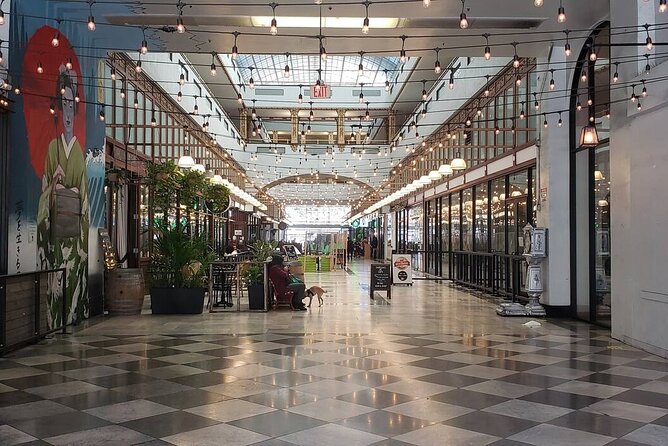
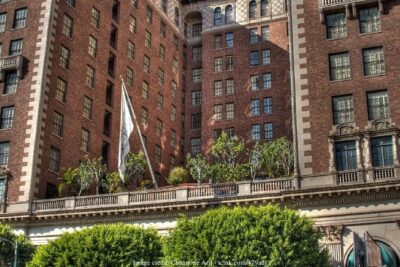
After the Bradbury, the route follows Spring Street through the old bank district. This section works like an architectural timeline. You see iron, steel, Beaux Arts design, and Art Deco forms appear as the street moves through different periods of prosperity and construction.
The area was once called the Wall Street of the West. That phrase helps explain the confidence behind the buildings. Los Angeles was growing quickly, and its financial institutions wanted structures that looked permanent, wealthy, and important.
I find this kind of comparison more useful than viewing each building alone. You can watch materials and styles change from block to block. The buildings become evidence of economic history, not just attractive backdrops.
The Last Bookstore and Grand Central Market
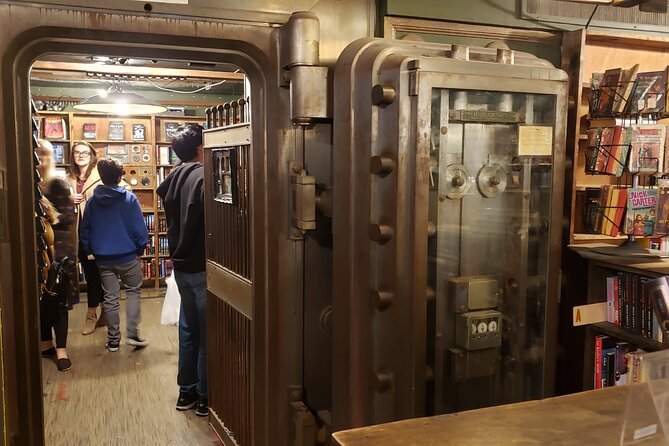
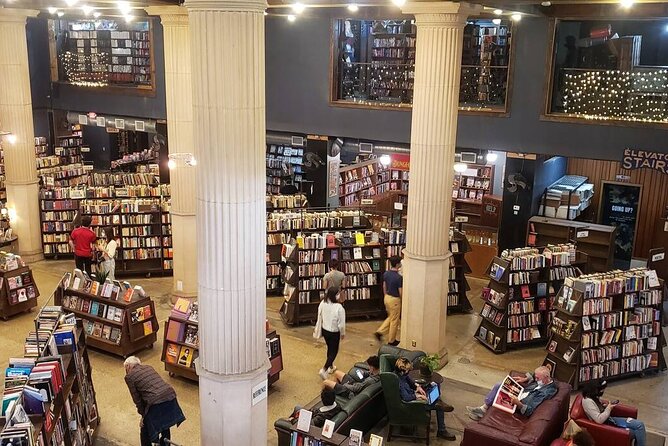
The Last Bookstore is a welcome change of pace after so much civic and commercial history. You go inside this former bank building and learn about its original use, including the secrets of the old vault.
The bookstore is also a practical stop for photographs and browsing. The schedule allows about 10 minutes, so you will not have unlimited time to explore every shelf. Still, it gives you a look at one of Downtown’s most popular independent spaces and shows how an old financial building found a new purpose.
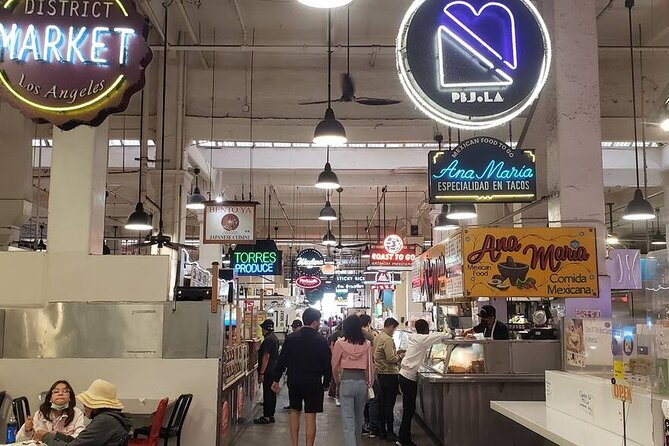
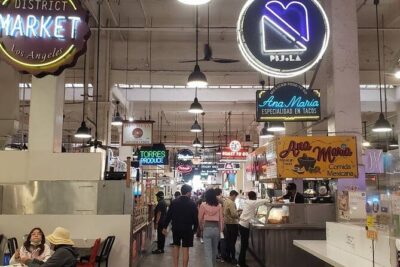
The final stop is Grand Central Market, which has operated for more than 100 years. It remains a useful place to finish because it brings the tour back to food, local business, and everyday city life.
The market is not presented as a formal included meal. Instead, you receive an introduction to a historic food hall with plenty of possible choices for lunch or a later visit. Ask Chris for food suggestions before you leave. Food recommendations are one of the practical benefits of having a local guide who knows the area.
Since the tour returns to its starting point, you can also use Grand Central Market as a launch point for more Downtown exploring. Keep your schedule flexible if you want to stay for a meal.
What the guide adds to the experience
Chris is repeatedly praised for more than factual recall. The strongest impression is his energy and personal connection to Los Angeles. He uses stories, architectural details, images, and conversation to make the buildings easier to understand.
That matters because Downtown architecture can otherwise become a parade of names. A good guide explains why a structure was built, who used it, what changed around it, and why it still matters. Chris also appears comfortable adjusting to the group. One couple who already knew Little Tokyo well received more attention elsewhere instead.
The pacing is another strength. The route covers a lot of ground, but the tour is designed to last about three hours rather than rushing through a full day. Bring a hat, especially in warm weather. The route is outdoors for much of the time, and one review specifically praised the guide for looking for shade and keeping the pace comfortable.
You should expect walking on city streets with stops to listen. Wear comfortable shoes and consider water, even though those items are not listed as inclusions. Most people can participate, service animals are allowed, and the activity runs near public transportation.
The route’s main limitation
The clearest gap is the limited attention to Los Angeles’s Mexican and Spanish founding history. Olvera Street is not part of the route, and the itinerary instead favors Bunker Hill, the Civic Center, Little Tokyo, Broadway, and the Historic Core.
That is a reasonable choice for a three-hour loop, especially since adding Olvera Street would make the route longer and harder to bring back to the starting point. Still, if your main interest is the city’s early Spanish and Mexican history, this is not the best single tour for you.
For a first look at Downtown’s architecture, Japanese American history, civic buildings, theaters, and food culture, the route has a clear focus. I would simply pair it with a separate visit to Olvera Street if that part of Los Angeles matters to you.
Who should book this tour?
I would choose this walk if you want more than Hollywood, beaches, and celebrity addresses. It suits first-time visitors who want a strong Downtown orientation, locals who know the city but have never studied its buildings, and architecture fans who like seeing several styles within a compact route.
It is also a good fit for solo visitors and couples who prefer conversation over a large bus tour. The small group limit makes it easier to ask questions, while the mobile ticket and central meeting point keep the practical side simple.
You may want another option if you dislike city walking, need extensive time inside museums, or want a food tour with a full meal. The food element is a mochi sample and a visit to Grand Central Market, not a long series of tastings.
The cancellation policy is flexible if you act early: cancel at least 24 hours before the start for a full refund. Cancellations inside 24 hours are not refunded. Poor weather or failure to meet the minimum group size can lead to a new date, another experience, or a full refund.
Should you book it?
Book this tour if you want Downtown Los Angeles explained rather than simply photographed. The included Angels Flight ride, Fugetsu-Do mochi, Frank Gehry’s concert hall, old movie palaces, the Bradbury Building, and Grand Central Market give you a varied three-hour route.
I would book it early, since the experience is often reserved about 18 days ahead. Choose it for architecture, civic history, Little Tokyo, and Chris’s lively local storytelling. Skip it only if Olvera Street, a full museum visit, or a substantial food crawl is your main goal.
FAQ
How much does the Downtown Los Angeles tour cost?
The price is $39.20 per person. The fee includes the Angels Flight ride and a mochi sample at Fugetsu-Do.
How long does the tour last?
The tour lasts approximately three hours.
Where does the tour begin and end?
It begins at 341 South Hill Street, Los Angeles, California 90013, and ends back at the same meeting point.
What language is the tour offered in?
The tour is offered in English and uses a mobile ticket.
How large is the tour group?
The experience has a maximum of 15 travelers.
Can I cancel for a full refund?
Yes. You can cancel at least 24 hours before the start time for a full refund. Cancellations or changes made less than 24 hours before the start time are not refunded or accepted. If poor weather or an insufficient number of bookings cancels the tour, you can receive a different date or experience, or a full refund.
Just added in the USA
- Wilmington History and Architecture Tour★ 4.8 · 18 reviews
- New Orleans : Garden District Architecture Walking tour★ 4.8 · 5 reviews
- Washington DC: Dupont Circle & Embassy Row Architecture Tour★ 5.0 · 6 reviews
- Washington, DC: Georgetown Architecture Walking Tour★ 5.0 · 8 reviews
- Private Colonial Williamsburg Architectural Tour★ 5.0 · 5 reviews
- Tulsa: Art Deco Walking Tour of Tulsa★ 5.0 · 8 reviews
- Monuments and Memorials Architectural Walking Tour★ 5.0 · 17 reviews
- Castle to Capitol: Museums of the National Mall Architecture Tour★ 4.5 · 9 reviews
Los Angeles Architecture Tours, compared.
Downtown Los Angeles History and Architecture Walking Tour
Read our review →
The History and Architecture of Downtown Los Angeles
Read our review →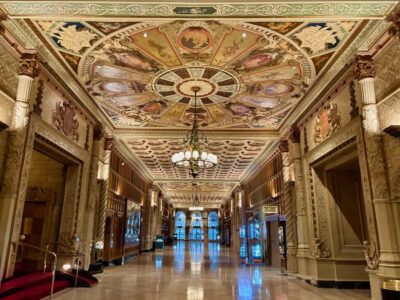
LA’s Art Deco & Beaux Art Architecture: Private Walking Tour
Read our review →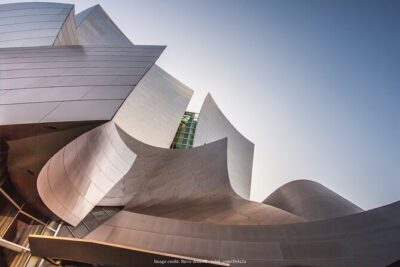
Downtown LA’s History & Architecture: Private Walking Tour
Read our review →Browse the lists this tour appears in