
REVIEW · NEW YORK CITY ARCHITECTURE TOURS
Midtown North NYC Architecture Walking Tour
Look up, and Midtown changes completely. This two-hour walk links Grand Central Terminal, the Seagram Building, Rockefeller Center, St. Patrick’s Cathedral, and newer towers in one compact introduction to New York’s architecture. I especially like the small group size, capped at 15, and the personal headsets, which help you hear the guide above Manhattan traffic.
I also like the range of buildings. You move from Art Deco icons to modern glass towers, with stops connected to major architects, planning rules, business history, and design ideas. The main consideration is the content level: guides such as Ivan Shumkov and William can go well beyond basic sightseeing, so some explanations may feel technical if architecture is not your main interest.
The essential details at a glance
- A compact architecture survey: See major buildings from Grand Central Terminal and the Chrysler Building to Central Park Tower, completed in 2023.
- Small-group format: The tour accepts no more than 15 people, giving you a better chance to ask questions.
- Personal audio headsets: Each person receives a professional headset, useful beside busy avenues and large groups.
- Strong guide-led interpretation: Ivan Shumkov and William are praised for explaining how buildings were designed, built, and shaped by city rules.
- No admission fees during the walk: The listed stops are viewed and discussed without separate entry charges.
- A useful Midtown finish: The walk ends at Apple Fifth Avenue, near Central Park and several major subway connections.
Why Midtown works so well for an architecture walk
Midtown can feel like a wall of stone, glass, and traffic when you first arrive. A good guide gives that wall a sequence. You begin to see different eras, materials, setbacks, structural ideas, and design choices instead of one giant cluster of tall buildings.
This route is especially useful because it does not focus on one period. Grand Central and the Chrysler Building bring in the early twentieth century. The Seagram Building and Lever House show the clean lines of postwar modernism. Rockefeller Center connects architecture with art, commerce, and planned urban space. The newest towers then show how Midtown continues to change.
The tour is also a practical first-day activity. It begins at 35 West 44th Street, at the Harvard Club of New York City, and ends at Apple Fifth Avenue, 767 Fifth Avenue. Since travel time is included in the two-hour duration, you should expect a brisk city walk with frequent pauses rather than two hours spent inside buildings.
The route covers streets around Fifth Avenue, Madison Avenue, Park Avenue, and Vanderbilt Avenue. Wear comfortable shoes, and check the weather before you go. The experience requires good weather, and poor conditions can lead to a different date or a full refund.
More walking tours in New York City:
- Tribeca Architecture And History Walking Tour
★ 5.0 · 141 reviews - TriBeCa Architecture & History Walking Tour
★ 5.0 · 37 reviews - Midtown Manhattan Art and Architecture Walking Tour
★ 5.0 · 32 reviews
Starting at the Harvard Club on West 44th Street
The Harvard Club is an unusual meeting point for a public sightseeing walk. It gives the outing a more distinctive start than a generic street corner, though the tour information does not promise interior access to the club. You should arrive with your mobile ticket ready and confirm the exact meeting instructions before setting out.
The group is limited to 15 people, which matters in Midtown. You are less likely to be stranded at the back of a crowd, and it is easier to ask why a building looks the way it does. Guides can speak in English, Spanish, or Italian, and each person receives an individual headset.
That headset is one of the most useful features here. Midtown traffic, buses, construction, and crowds can swallow a guide’s voice. With the audio system, you can keep looking at the building instead of pressing close to the guide.
Grand Central Terminal and the city beneath your feet
Grand Central Terminal is the first major stop, with about 10 minutes set aside for it. Even a short visit can raise big questions about transportation, civic ambition, and the way New York built for crowds.
The guide’s value here is not simply naming the terminal. You can ask how its design relates to movement through the city, why its scale matters, and how a transportation building became one of New York’s best-known public interiors. The tour does not list a separate admission ticket, so this stop is part of the walking experience rather than a paid museum visit.
Because the stop is brief, do not expect an exhaustive exploration of every hall or detail. Think of Grand Central as the opening chapter, a way to establish how architecture responds to urban life.
The Seagram Building and the logic of modernism
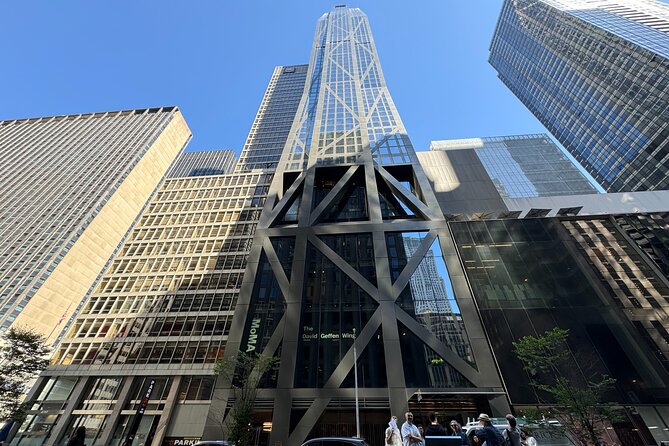
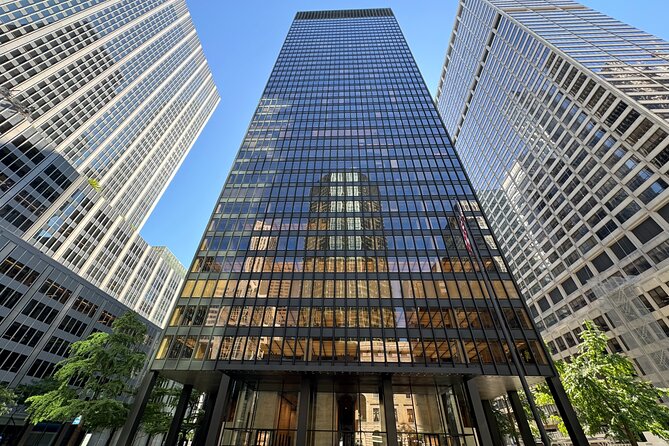
The Seagram Building receives another 10-minute visit. Designed by Mies van der Rohe with Philip Johnson, it is one of the clearest examples of the disciplined glass-and-metal office tower associated with postwar modernism.
This is where the tour can become more than a list of famous names. A guide can point out the building’s relationship to the plaza, its restraint, and the way the open space in front changes how the tower is seen from Park Avenue. You may also hear how design decisions, ownership, and city planning affect the public experience of a private office building.
If you are new to architecture, listen for the basic visual ideas rather than trying to memorize every term. The building is a useful lesson in proportion, repetition, and the power of leaving space around a tower.
A few more architecture tours in New York City worth a look
- Manhattan Architecture Yacht Cruise
★ 5.0 · 1,395 reviews - NYC: Around Manhattan Official NYC Architecture Cruise
★ 4.8 · 402 reviews - Art Deco and Architecture Midtown Landmarks Tour
★ 5.0 · 142 reviews - 3 Hour Midtown Manhattan Architectural Tour
★ 5.0 · 81 reviews
JP Morgan Chase and the changing Park Avenue corridor
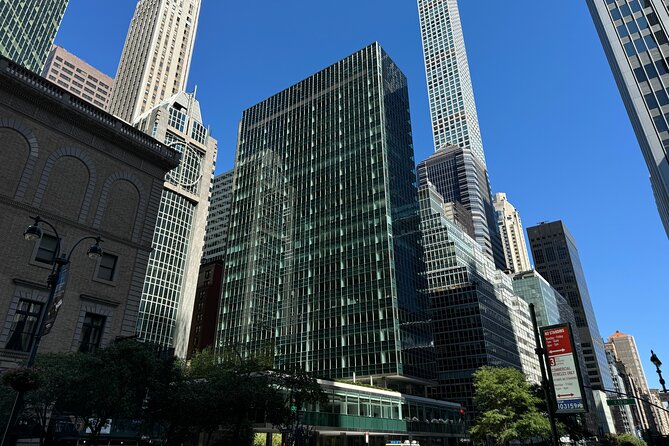
The route then pauses for about five minutes at the new JP Morgan Chase office tower between Vanderbilt and Park Avenue. This stop brings the story into the present and contrasts sharply with the older buildings nearby.
The value here is comparison. Midtown is not a preserved museum district. New office construction changes views, sidewalks, transportation patterns, and the relationship between old and new towers. A guide can help you consider how a large contemporary headquarters fits into a street already defined by Grand Central, historic office buildings, and landmarks.
Five minutes is enough for an introduction, not a full case study. You will get the most from this stop if you ask about the tower’s place in the changing district.
Harvard Club, Chrysler Building, and St. Patrick’s Cathedral
The Harvard Club receives a 10-minute visit on the route, followed by shorter stops at the Chrysler Building and St. Patrick’s Cathedral. Since the tour starts at the club, the itinerary’s separate visit may provide a closer look at the building or a fuller discussion of its architecture. The information does not promise entry, so plan on an exterior-focused experience unless your guide tells you otherwise.
The Chrysler Building gets about five minutes. William Van Alen’s 1930 tower is one of Midtown’s essential Art Deco sights, known for its dramatic crown and expressive details. The short stop works well as a focused look at how decoration, engineering, and corporate ambition came together during the skyscraper era.
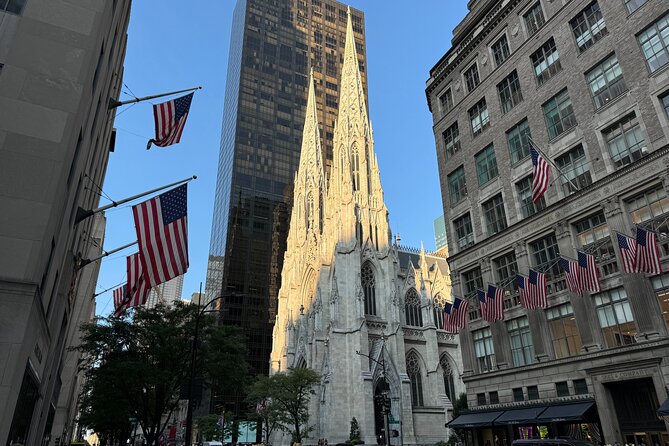
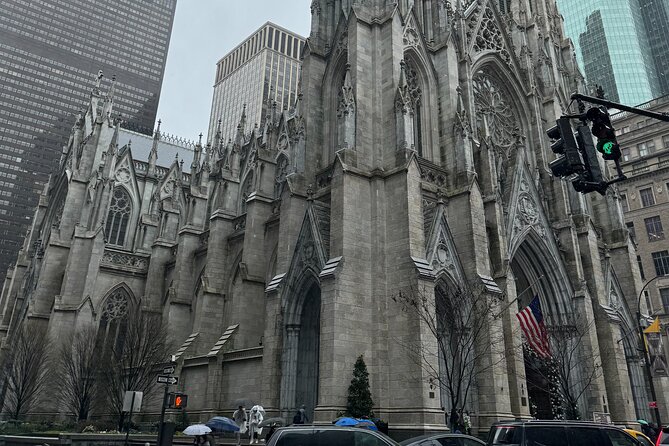
St. Patrick’s Cathedral receives another five minutes. Its Gothic Revival design offers a sharp change from the steel-and-glass offices. The point is not just that the cathedral looks old beside modern towers. It shows how different ideas about height, ornament, religion, and public identity can occupy the same avenue.
The short timing at both locations means you should not expect an interior tour or a long architectural lecture. You will see the buildings, hear the main interpretation, and keep moving.
Lever House and the MetLife Building

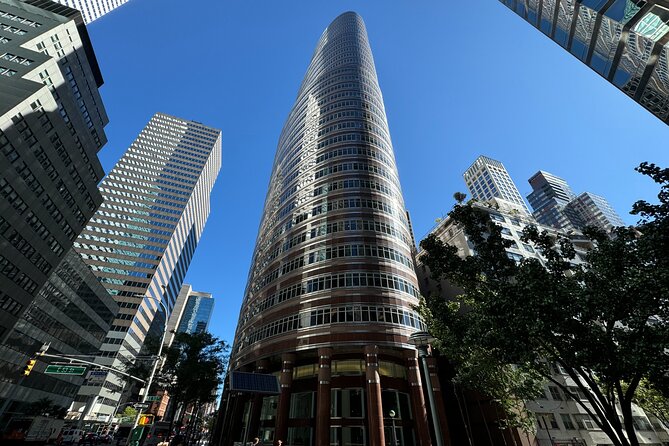
Lever House, designed by Skidmore, Owings and Merrill in 1953, gets about five minutes. It is a key modernist building and a useful contrast with the Seagram Building. Both favor clean lines, but placing them side by side lets you think about differences in materials, open space, and the treatment of the office tower.
The MetLife Building, designed by The Architects Collaborative in 1962, also receives about five minutes. Its size and position near Grand Central make it a strong example of the large corporate buildings that reshaped Midtown after the Second World War.
These are quick stops, but that is not necessarily a weakness. The route gives you a broad architectural vocabulary in a short time. The tradeoff is that you need to stay engaged and remember that this is a survey, not a detailed seminar at every address.
MoMA from the outside, then Rockefeller Center
The Museum of Modern Art is viewed and discussed from the outside for about 10 minutes. This distinction matters. Your tour fee does not include museum admission, and the experience does not present itself as a gallery visit.
An exterior discussion can still be worthwhile because MoMA’s building has changed over time and its setting connects art, architecture, and Midtown development. If you want to see the collections, plan a separate visit and buy museum admission independently.
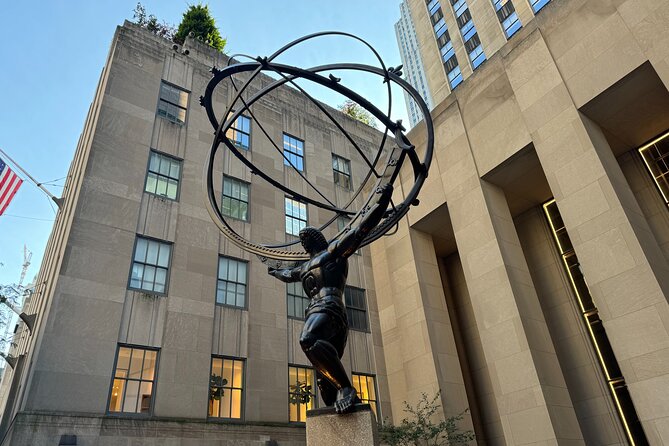
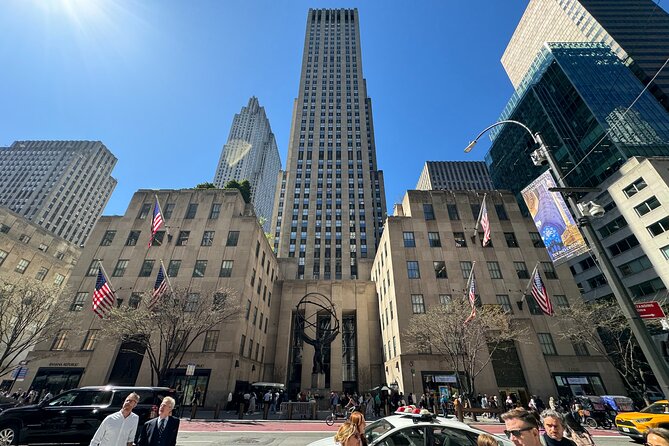
Rockefeller Center receives about 10 minutes and is one of the route’s strongest stops. Here, architecture is tied to a larger plan rather than a single tower. You can look at the arrangement of buildings, public spaces, artwork, and commercial uses as parts of one urban project.
This is also a good place for questions. One distinctive review described the guide answering a question about the stern expression of the Atlas statue. That small exchange captures the tone of the experience: serious architectural discussion, but with room for the odd detail that makes a city walk memorable.
Steinway Hall, Central Park Tower, and the modern skyline
The route passes Steinway Hall and Steinway Tower, designed by SHoP Architects and completed in 2022. It is not listed as a timed stop, so expect a passing view and a short explanation rather than a full presentation.
Central Park Tower receives about five minutes. Designed by Adrian Smith and Gordon Gill Architecture and completed in 2023, it brings the walk right up to the newest phase of Midtown’s supertall construction.
Seeing the 2022 and 2023 buildings near older landmarks makes the route feel current. You are not only studying famous historic architecture. You are also considering what New York chooses to build now, how tall towers alter the skyline, and how new construction changes the experience of Fifth Avenue.
The tour ends at Apple Fifth Avenue. That is a practical finish, since you are close to Central Park, Fifth Avenue shops, and several other attractions. It also leaves you with a modern retail building as the final architectural reference point, rather than ending at a purely historic landmark.
Guide quality and how technical the discussion gets
The guides are the central reason to book this experience. Ivan Shumkov is described as an architect, urban planner, Columbia professor, Harvard graduate, and PhD in architecture. William is described as a retired architect and current city employee. Their backgrounds suggest a level of subject knowledge well above a standard sightseeing script.
The strongest feature is their ability to connect facts. You are not simply told an architect’s name and a completion date. The discussion can include the people behind a building, construction choices, artistic ideas, zoning rules, and urban planning decisions.
That depth has a downside. One account found parts of the discussion more technical than expected, especially for people without an architectural background. I would not choose this walk if you want only quick photo stops and entertaining anecdotes. You should book it if you enjoy asking why a building works, how it was made, and what city rules shaped it.
The guides also appear willing to adapt private tours to personal interests. Ivan has adjusted routes for a parent with a strong structural engineering background, a family birthday outing, and a couple interested in construction and art. The regular small-group format may have less flexibility than a private booking, but the emphasis on questions remains a real advantage.
Is $59 a fair price?
At $59 per person, this is not the cheapest way to see Midtown. You can walk past nearly all these buildings for free, and the itinerary does not include paid interior admission.
The price pays for interpretation, organization, audio equipment, and access to a small group rather than a giant crowd. The all-inclusive fee also covers taxes and other listed costs, with tips left out. For someone who wants architectural context, that is a fair exchange, especially if you would otherwise pass the buildings without understanding their design.
The value is highest for architecture students, design fans, urban-planning enthusiasts, history-minded visitors, and New Yorkers who want a fresh look at familiar streets. It is also a sensible gift for a parent or partner who already enjoys buildings and city design.
If your main goal is entering Grand Central, MoMA, St. Patrick’s Cathedral, or another interior, use the $59 for a separate admission-based visit instead. This experience is primarily about guided exterior interpretation and the connections between buildings.
Practical planning before you go
The walk lasts approximately two hours, and the listed stop times range from five to 10 minutes. Since movement between locations is part of the duration, expect a steady pace with regular pauses.
The tour is offered in English, Spanish, and Italian. The booking includes a mobile ticket, and confirmation arrives when you reserve. It is near public transportation, and most people can participate. Service animals are allowed.
This is an outdoor activity, so weather matters. The provider requires good conditions and offers another date or a full refund if poor weather cancels the tour. You can cancel for a full refund up to 24 hours before the start time. Cancellations or changes inside that window are not refunded or accepted.
Demand is not extreme, but the experience is booked on average 17 days ahead. If your New York dates are fixed, I would reserve before arrival, especially if you want a particular guide or day.
Who should book the Midtown North walk?
Book it if you want to understand Midtown rather than simply photograph it. The route gives you a well-chosen sequence of old, modern, religious, corporate, and very recent buildings, and the headsets make the explanations easier to follow.
I would especially recommend it to people who enjoy architecture but do not have the time for a full course. You get a concentrated look at major periods and ideas, with a guide available for questions. The small group also makes it more personal than a standard bus tour.
Skip it if you dislike technical explanations, need frequent indoor breaks, or want admission to museums and landmarks. The tour is also less suitable for someone seeking a relaxed stroll with no fixed pace, since the group must cover a substantial Midtown route in two hours.
For most architecture-minded visitors, the strongest reason to book is simple: the buildings are already there, but a skilled guide helps you notice what you would otherwise walk past.
FAQ
How long is the Midtown North NYC Architecture Walking Tour?
The tour lasts approximately two hours, including travel time between stops.
What is the price?
The price is $59 per person.
Where does the tour begin?
It begins at the Harvard Club of New York City, 35 W 44th Street, New York, NY 10036.
Where does the tour end?
The tour ends at Apple Fifth Avenue, 767 Fifth Avenue, New York, NY 10153.
What language is the tour offered in?
The tour is offered in English, Spanish, and Italian.
Is the tour limited to a certain group size?
Yes. The maximum group size is 15 people.
Are headsets provided?
Yes. Each person receives a professional individual headset.
Are admission tickets included?
The listed stops have no separate admission charge during the tour. MoMA is discussed from the outside, and the experience does not include museum admission.
Is the tour suitable in bad weather?
The experience requires good weather. If poor weather causes cancellation, you will be offered another date or a full refund.
What is the cancellation policy?
You can cancel at least 24 hours before the start time for a full refund. Cancellations and changes made less than 24 hours before the start time are not accepted, and the amount paid is not refunded.
Should you book it?
I would book this tour if buildings are part of the reason you came to New York. The route is efficient, the group is small, and the combination of Grand Central, Art Deco, modernism, Rockefeller Center, and new supertalls gives you a clear sense of how Midtown developed.
The best choice is for a curious visitor who wants more than names and dates. You will get the most from it by asking questions, looking closely, and accepting that a few explanations may be technical. At $59, it is a worthwhile purchase for serious architecture interest, but less useful if you mainly want interior access or a casual sightseeing walk.
Just added in New York City
- Race to the Sky: NYC Architecture Tour With SUMMIT One Ticket★ 5.0 · 3 reviews
- Chelsea and the High Line NYC Architecture Walking Tour★ 5.0 · 6 reviews
- Private Flatiron Food, History and Architecture Tour★ 5.0 · 8 reviews
- New York Soho and the Village Art and Architecture Tour★ 5.0 · 4 reviews
- New York Upper West Side Art and Architecture Tour★ 5.0 · 4 reviews
- New York Upper East Side Art and Architecture Tour★ 5.0 · 3 reviews
- New York Midtown South Art and Architecture Tour★ 5.0 · 2 reviews
- The Story Behind NY’s Evolving Skyline An Architectural Journey Through History★ 5.0 · 18 reviews
New York City Architecture Tours, compared.


Around Manhattan Official NYC Architecture Cruise
Read our review →
Art Deco and Architecture Midtown Landmarks Tour
Read our review →

New York City The Official Rockefeller Center Tour
Read our review →

Browse the lists this tour appears in