
REVIEW · SKYSCRAPER TOURS
Rotterdam: Wilhelminapier, High-rise & floating architecture
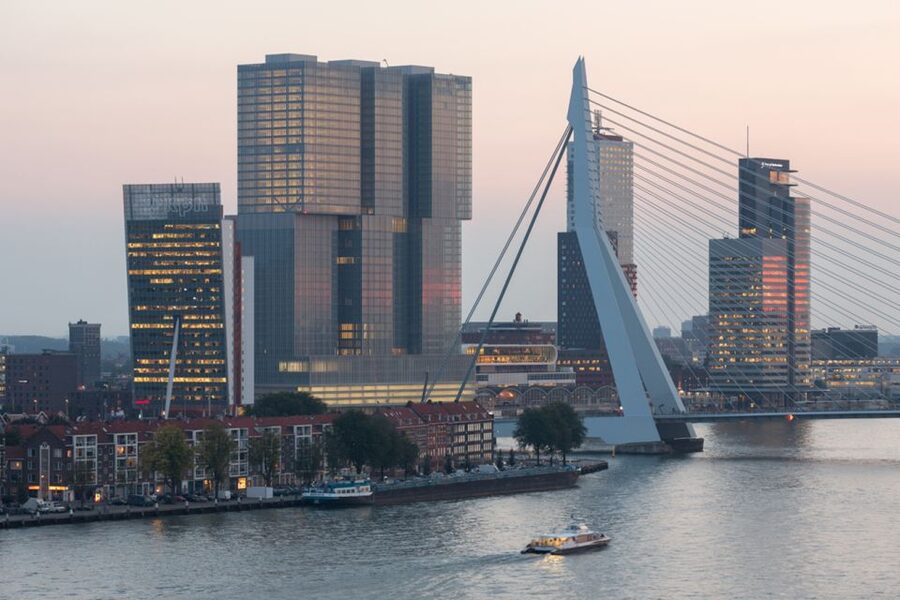
Rotterdam turns old docks into bold design. This one-hour private tour makes the Wilhelminapier easy to understand, combining the former Holland America Line district with striking towers, a rooftop visit at Pakhuismeesteren, and a look at floating hotels, offices, and parks. I especially like the small private-group format and the chance to see architecture from above rather than only from the street.
I also like the way the tour connects Rotterdam’s past with its new identity. You hear about the pier’s harbor role, the design of De Rotterdam, and the area’s modern transformation in one compact walk. The main consideration is time: one hour is short, so this is an introduction, not a slow architectural study.
Key points at a glance
- Rooftop view at Pakhuismeesteren: Reach the top of a former harbor warehouse for a clear look across Rotterdam’s skyline.
- Wilhelminapier’s transformation: Learn how the former Holland America Line area became one of the city’s most modern districts.
- De Rotterdam explained: Hear about the concept and design of the large high-rise complex from a live guide.
- Foodhallen stop: See how Pakhuismeesteren now combines a hotel with a food hall.
- Floating architecture: Walk along Rijnhaven and view floating projects including a hotel, park, and office.
- Private and accessible: The tour is for your group of up to six, with wheelchair access and guides in five languages.
Starting outside Het Nieuwe Luxor Theater
Your meeting point is outside Het Nieuwe Luxor Theater, the red building on the Wilhelminapier. This is a useful place to begin because you are already in the middle of the district rather than having to spend time traveling in from Rotterdam’s historic center.
Look for the guide outside the theater. The tour is private, so the pace should be shaped around your group rather than a large crowd. That matters on a walk built around buildings and views. You can ask why a tower was designed in a certain way, pause for photographs, or request more explanation about the harbor district.
The guide service is available in Dutch, English, German, Spanish, and French. That makes this a practical choice for mixed-language groups. The tour is also wheelchair accessible, an important advantage on an urban route where older harbor buildings and new public spaces meet.
The experience includes a Dutch treat and a postcard featuring Rotterdam architecture by photographer Ossip van Duivenbode. These are small additions, but they give the tour a pleasant local touch. The postcard is more useful than a generic souvenir because it connects directly with the subject of the walk.
More skyscraper tours in Netherlands:
- Chicago Premium Driving Tour with River Boat Cruise and Sky Deck
★ 4.5 · 165 reviews - Chicago Walking Tour: Art Deco Skyscrapers Loop
★ 5.0 · 138 reviews - Chicago Walking Tour: Art Deco Skyscrapers Riverfront
★ 5.0 · 53 reviews
From Holland America Line harbor to modern Rotterdam
The Wilhelminapier was once closely tied to the Holland America Line. The former shipping company carried people and goods from Rotterdam, and the pier was a working harbor area rather than a residential and cultural quarter.
This background gives the architecture tour its purpose. Without it, the high-rises can look like a collection of unrelated glass and concrete shapes. With the harbor story in place, you can see the area as a deliberate change from port infrastructure to a new city district.
I like this part of the experience because it gives you a way to read Rotterdam. The city is not simply showing off new buildings. It is using a former dockside setting to create a new urban center, while retaining traces of its maritime past.
The guide discusses the transformation of the Wilhelminapier and the former home of the Holland America Line. Expect the emphasis to be on the area’s concept, history, and design rather than on a long list of dates. That keeps the walk focused, though anyone wanting an exhaustive account of Rotterdam’s shipping history should allow time for another museum or tour.
De Rotterdam and the drama of vertical design
A major subject of the walk is De Rotterdam, one of the district’s most recognizable high-rise complexes. The guide explains its design and concept, helping you understand how the building works as part of the pier rather than as an isolated tower.
The name refers to the ship Rotterdam, which ties the building back to the Holland America Line story. The complex’s stacked, shifting forms give the skyline a strong sense of movement. From street level, you see broad blocks rising in layers. From the rooftop later in the tour, you can place De Rotterdam within the wider pattern of Rotterdam’s high-rise architecture.
This is where a live guide adds real value. A photograph can show you the building’s shape, but it cannot explain why its mass is arranged that way or how it fits the district’s redevelopment. You get the basic design story while standing close enough to notice the scale.
The limitation is that the tour lasts only an hour. The guide has to cover De Rotterdam, Pakhuismeesteren, Foodhallen, and the floating projects in a tight sequence. If you are especially interested in architecture, use the walk to identify buildings you want to revisit later.
Inside Pakhuismeesteren and its Foodhallen
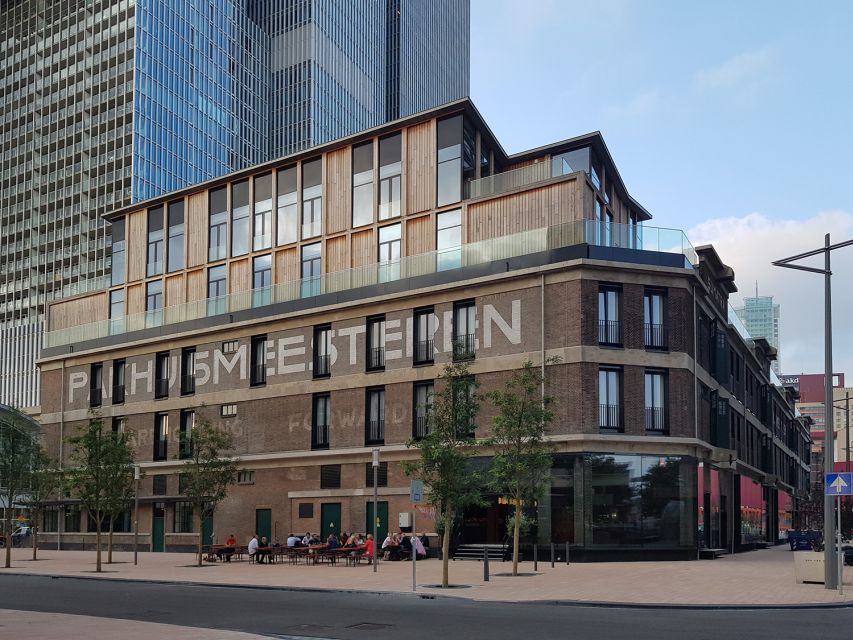
Pakhuismeesteren is one of the most appealing stops because it shows how Rotterdam reuses industrial buildings. It was formerly a harbor warehouse. Today, it houses a hotel and the Foodhallen, a food destination designed around multiple places to eat.
The building’s appeal comes from that contrast. You are not looking at a brand-new structure pretending to have a past. You are seeing an older warehouse given a new public role. The tour helps you understand the building from the inside, which is one of the features I value most here.
The Foodhallen is especially useful if you are hungry or planning the rest of your day. The tour does not promise a full meal, and the one-hour schedule is not designed as a food tour. Still, the stop gives you a look at how food, lodging, and architecture now share the same building.
You should think of Foodhallen as an added architectural stop rather than the main purpose of the experience. Food lovers will probably want to return with more time. The tour gives you the introduction, then the rooftop provides the bigger visual payoff.
A few more architecture tours in Netherlands worth a look
- Rotterdam: Architectural Highlights Guided Walking Tour
★ 4.8 · 215 reviews - Rotterdam: Highlights, Gems, Architecture & History Walk
★ 5.0 · 191 reviews - Rotterdam Walk: Hilights, Gems, Architecture & WWII | 2 or 3hrs
★ 5.0 · 149 reviews - Rotterdam Architecture Highlights Walking Tour
★ 5.0 · 66 reviews
The Pakhuismeesteren rooftop view
The rooftop visit is included in the tour price, and it is the clearest reason to choose this experience over a simple street walk. From above, you can take in Rotterdam’s skyline and see how the Wilhelminapier relates to the surrounding city.
The view also makes the earlier explanations easier to grasp. Buildings that seemed separate from the pavement begin to form a coherent urban picture. You can look across the city’s modern architecture and see the relationship between towers, harbor water, and the converted pier.
I would plan to have your camera ready here. The rooftop is not just a bonus lookout. It is the place where the tour’s main ideas come together: old port land, new construction, ambitious design, and Rotterdam’s willingness to build vertically.
Keep your expectations measured. This is a guided rooftop entrance, not a long rooftop stay. The tour description does not promise a restaurant, a drink, or an extended break at the top. Its value is the access and the view, especially for anyone who wants a compact introduction to Rotterdam’s architecture.
Walking along Rijnhaven to see floating projects
After the building-focused stops, the route continues along Rijnhaven. Here you look at floating innovation projects, including a floating hotel, floating park, and floating office.
These projects give the tour a second theme. The Wilhelminapier shows how a former port can be rebuilt on land. Rijnhaven adds the question of how parts of a city can function on water. That makes the walk more than a parade of tall buildings.
The floating hotel, park, and office are best understood as concepts in urban design. They show how Rotterdam uses its waterways as active city space rather than treating the harbor as scenery alone. The guide can explain the ideas behind these projects and place them within the city’s wider approach to development.
This part may appeal most to visitors interested in sustainability, engineering, or future-focused city planning. The information provided does not promise entry into each floating project, so expect to view the concepts from the walking route rather than tour their interiors.
The Rijnhaven walk also changes the rhythm of the experience. After looking up at towers and examining a converted warehouse, you get open water and a broader view. It is a smart way to finish the main architectural discussion.
Ending near the Fenix migration museum
The tour ends near Fenix, Rotterdam’s newest icon and migration museum. The museum itself is not listed as an included visit, so you should not expect an admission or an interior tour as part of this experience.
Still, the ending is practical. You finish near another important cultural building, with the option to continue exploring the area on your own. If you want to visit Fenix, check its opening hours and admission separately before booking the tour.
Ending here also reinforces the theme of movement. The Wilhelminapier is tied to people leaving and arriving by ship, while Fenix focuses on migration. The tour does not promise a full museum visit, but its location gives you a useful next stop.
What the one-hour format really means
One hour is enough to get the main story and see several strong highlights. It is not enough for a leisurely stroll with long pauses at every building. You will move from the theater to the pier, into Pakhuismeesteren, up to the rooftop, and along Rijnhaven in a compact sequence.
That short format suits you if you want a focused introduction before exploring Rotterdam independently. It also works well on a busy sightseeing day, since the tour does not take half a day.
The tradeoff is depth. You may leave with questions about individual architects, building materials, engineering, or the wider history of Rotterdam. That is not a flaw so much as a limit of the format. I would treat the experience as a well-organized orientation walk, then return to the buildings that catch your attention.
The private format helps. A group of up to six can move more efficiently than a large party, and you can ask the guide to spend a little more time on the subjects your group cares about. The tour has received a consistent rating of 4 out of 5, with specific praise for learning about the buildings, seeing the interiors, and enjoying a pleasant walk with guide Willem. That points to the tour’s strongest qualities: personal guidance, useful background, and access to places you might otherwise pass without entering.
Is $286 good value for your group?
The price is $286 for a private group of up to six. For six people, that works out to about $47.67 per person. For two people, the cost is much higher per person, so the value depends heavily on your group size and interest in architecture.
You are paying for more than a basic walk. The price includes a professional guide, private-group attention, rooftop entrance, a Dutch treat, and the Ossip van Duivenbode postcard. The rooftop access is the clearest added value, since it gives you a view that a street-only tour cannot provide.
I think the price makes the most sense for a group of four to six people who want a private introduction to Rotterdam’s modern side. Families, friends, and small groups with mixed interests can also benefit from the short duration and wheelchair accessibility.
For a solo visitor or couple watching every euro, the cost may feel high for one hour. In that case, you should book only if the private format and rooftop access matter to you. If you mainly want to admire the skyline from public streets, you may prefer to explore the Wilhelminapier independently.
Flexible booking softens the decision. You can reserve now and pay later, and cancellation is free up to 24 hours in advance. Starting times depend on availability, so check the schedule before planning the rest of your day.
Who should book this Rotterdam walk?
I would recommend this tour to you if:
- You want a short, focused introduction to Rotterdam’s modern architecture.
- You enjoy hearing the story behind buildings rather than simply photographing them.
- You are traveling with up to six people and value a private guide.
- You want rooftop access at Pakhuismeesteren.
- You are curious about floating urban projects.
- You need a wheelchair-accessible experience.
- You want a tour available in Dutch, English, German, Spanish, or French.
I would be more cautious if you want a long architecture lecture, a full food tour, or extensive time inside each building. The Foodhallen is a stop, not a complete culinary experience. The floating projects are viewed along Rijnhaven, not presented as interior visits. And the one-hour schedule leaves little room for lingering.
Should you book the Wilhelminapier architecture tour?
Book it if you want Rotterdam’s high-rises to make sense. The combination of former Holland America Line history, De Rotterdam, Pakhuismeesteren, a rooftop view, Foodhallen, and floating projects gives you a clear picture of how this part of the city changed.
The strongest reasons to go are the rooftop access and private guide. The main drawback is the price for a small group of one or two, along with the limited time. For a group of six, the cost is easier to justify. For a couple, book only if modern architecture is a real interest rather than a passing curiosity.
FAQ
How long does the Rotterdam Wilhelminapier tour last?
The tour lasts one hour.
Where does the tour meet?
The meeting point is outside Het Nieuwe Luxor Theater, the red building on the Wilhelminapier.
Where does the tour end?
The tour ends near Fenix, Rotterdam’s newest icon and migration museum.
What languages are available?
The live guide can conduct the tour in Dutch, English, German, Spanish, or French.
Is this a private tour?
Yes. It is a private-group experience for up to six people.
Is the tour wheelchair accessible?
Yes, the tour is wheelchair accessible.
Is rooftop access included?
Yes. Entrance to the Pakhuismeesteren rooftop is included.
What else is included in the price?
The price includes a guided tour, a Dutch treat, and a postcard of Rotterdam architecture by photographer Ossip van Duivenbode.
Can I cancel the tour or pay later?
You can cancel up to 24 hours in advance for a full refund. You can also reserve now and pay later.
Just added in Netherlands
- Rotterdam Must Do Tour: Highlights, History, WW2 and Architecture★ 5.0 · 20 reviews
- Escape Room – l’Architecte★ 4.5 · 13 reviews
- Private Rotterdam Walking Tour – guided by Architects★ 5.0 · 2 reviews
- Rotterdam Architecture and Highlights Walking Tour (TOP RATED)★ 4.5 · 14 reviews
- Maastricht Highlights, Architecture & Heritage Tour★ 5.0 · 7 reviews
- Gouda Private Walking Tour: History, Architecture & Cheese★ 4.5 · 8 reviews
- Amsterdam Architecture Tour★ 5.0 · 4 reviews
- Amsterdam Walking Tour. All about History, Architecture, Traditions & Anecdotes.★ 5.0 · 2 reviews
Skyscraper Tours, compared.
Chicago Premium Driving Tour with River Boat Cruise and Sky Deck
Read our review →
Chicago Walking Tour: Art Deco Skyscrapers Loop
Read our review →
Chicago Walking Tour: Art Deco Skyscrapers Riverfront
Read our review →
The Story Behind NY’s Evolving Skyline An Architectural Journey Through History
Read our review →Browse the lists this tour appears in