

REVIEW · HISTORICAL TOURS
Oxford: 90 minute Architectural & Historical Highlights Tour
Oxford rewards a good guide. This 90-minute walk packs medieval gates, grand colleges, libraries, churches, and university legends into a compact route through the center. I especially like the small group limit of 15 people and the chance to enter a medieval college, rather than simply viewing Oxford through college gates. The listed price is $0, which makes the value remarkable if that rate is available when you book.
I also like the personal touch. Guide Sophie brings in food, coffee, literature, science, religion, and local recommendations, and she can lead in English and French. The main thing to consider is pace: 17 stops in an hour and a half means many visits are short, often just three to five minutes. This is an excellent orientation walk, but not a slow inspection of every college interior.
Key points to know before you go
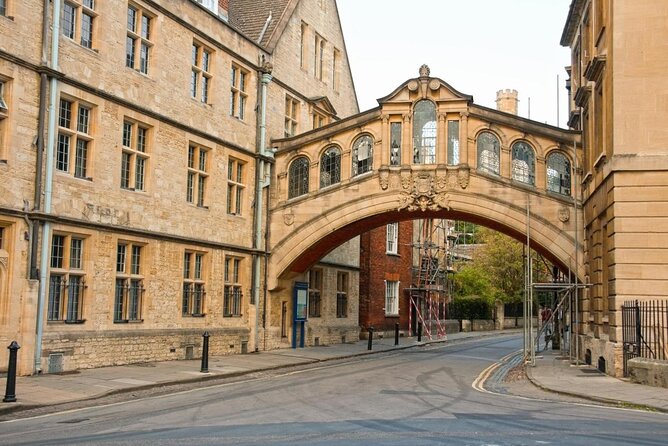
- Oxford in 90 minutes: The route links 17 landmarks from the Weston Library to the Golden Cross.
- Medieval college access: Entry to a medieval college is included, though the exact college open to the group may depend on the day.
- A strong local guide: Sophie is praised for clear explanations, humor, attentiveness, and her ability to guide in English and French.
- Big stories in short stops: You’ll hear about Protestant martyrs, Harry Potter filming locations, Oxford science, famous alumni, and college traditions.
- Useful follow-up help: A complimentary map and guidebook, plus suggestions for places to eat and drink, help you continue on your own.
- Weather matters: The tour requires good weather, and poor conditions can lead to a new date or a full refund.
Why this Oxford walk works so well
Oxford can feel confusing at first. Its colleges line narrow streets, but many hide behind stone walls and heavy wooden gates. The university is not one enclosed campus. It is a collection of colleges, libraries, churches, courtyards, bridges, and academic buildings spread through the city center.
This walk gives you a clear framework. You start on Broad Street at the Weston Library and finish near the Golden Cross, close to the center of Oxford. Along the way, you move from the city’s medieval religious roots to its modern university life.
I like the way the route mixes famous sights with smaller details. You’ll see the Radcliffe Camera and Bodleian Library, but you’ll also hear about Frank Cooper’s marmalade, Oxford’s first coffee house, and the tortoise race at Corpus Christi College. Those side stories help Oxford feel like a lived-in city, not only a line-up of old buildings.
The 4.9 rating from 23 published ratings, with 100 percent recommending the experience, fits the strongest pattern in the feedback: Sophie’s explanations and personal attention are the heart of the tour. One family found that she kept children, parents, and grandparents interested, even while switching between English and French. Another group appreciated that she responded to requests about particular parts of Oxford.
More history tours in the world:
- Chicago in a Day: Food, History & Architecture Walking Tour
★ 5.0 · 1,153 reviews - Charleston’s Best Highlights: History, Culture & Architecture
★ 5.0 · 422 reviews - Palm Springs Modernism Architecture & History Bike Tour
★ 5.0 · 359 reviews
Martyrs’ Memorial and St Michael’s medieval gate
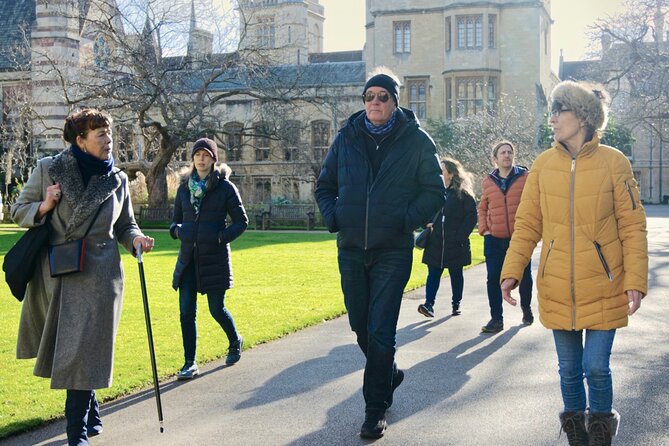
The first stop is the Martyrs’ Memorial, a Victorian monument to the Protestant martyrs of the 16th century. It is a quick introduction to one of Oxford’s most difficult chapters. The monument is free to see, and the stop takes about three minutes.
You then reach St Michael at the North Gate. Its Anglo-Saxon tower formed part of the medieval city gate and is likely the oldest surviving building in Oxford. In a short stop, Sophie can show how the university and city once met at a defensive entrance, rather than existing as separate worlds.
These opening stops are brief, but they set the tone. Oxford’s story is not only about scholars and grand ceremonies. It is also about religious conflict, city walls, old roads, and the people who lived here long before the university became a global name.
Exeter, Lincoln, and the University Church
Exeter College is your first close look at the collegiate world. Its chapel was influenced by the Oxford Movement and modeled on Sainte-Chapelle in Paris. The college also connects Oxford to modern literature through graduates such as J.R.R. Tolkien, Philip Pullman, and Alan Bennett.
The stop at Exeter lasts about four minutes, so expect an introduction rather than a full architectural study. Sophie’s role is to point out what matters and give you a reason to return if you want more time inside.
At Lincoln College, the original front on Turn Street tells a story about the university’s beginnings and its relationship with Oxford itself. The college is linked to Prime Minister Rishi Sunak and the Wesley brothers, John and Charles, who were central figures in the Methodist movement.
The University Church of St. Mary the Virgin gives the route more religious and academic context. It was the university’s first building and is recorded in the Domesday Book. You’ll admire its stained glass and hear about its connection to C.S. Lewis. The church’s spire can be climbed, though that climb is not part of this 90-minute visit.
This is one place where you may want to return later. The church offers more detail than a seven-minute stop can cover, especially if you care about religious architecture, stained glass, or Oxford’s early academic life.
Oriel, Corpus Christi, and Merton College
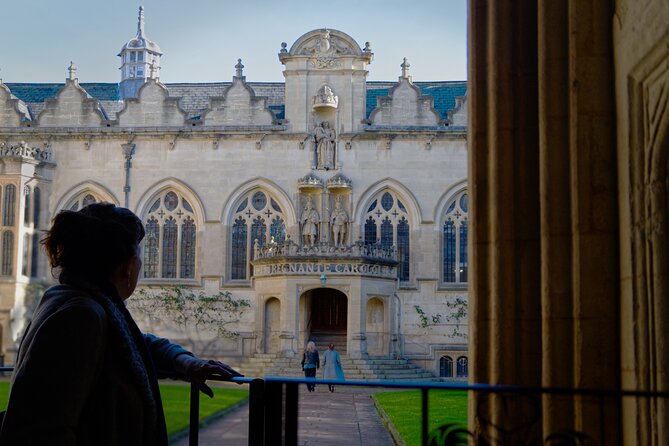
Oriel College is among the university’s oldest colleges. Its front quad is known for its distinctive Oriel windows, and the college has a present-day connection to rowing. Nearby Corpus Christi is famous for its annual tortoise race, a wonderfully odd Oxford tradition that brings a little humor to the route.
At Corpus Christi, look for the early 16th-century architectural details and the carved animal figures, including a pious pelican. The college sits along a cobbled street listed as a national treasure. This is a good example of how the tour works best: Sophie gives you a small detail that you might otherwise walk past, then links it to a broader story.
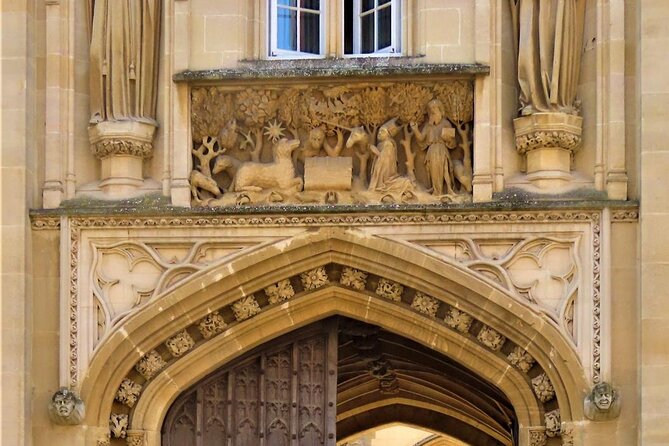
Merton College is Oxford’s third college. Its 15th-century frieze above the gatehouse is one of the most striking details on the route. It tells the story of how colleges were founded in the university’s earlier years.
Merton also has a strong library connection. Thomas Bodley, who founded the Bodleian Library, studied here, and Merton’s library is the oldest continuously surviving library in Oxford. You’ll also see the chapel’s decorated flying buttresses.
The Merton stop lasts about five minutes. That is enough to understand why the college matters, but not enough to explore its library or chapel at leisure. I would note the details you want to revisit and use the supplied map for a later walk.
A few more architecture tours in the world worth a look
- Chicago Architecture River Cruise
★ 5.0 · 15,756 reviews - Chicago River 90-Minute Architecture Tour
★ 4.5 · 9,629 reviews - Chicago River: 1.5-Hour Guided Architecture Cruise
★ 4.8 · 8,046 reviews - Chicago Architecture Center River Cruise aboard First Lady
★ 5.0 · 5,536 reviews
Examination Schools and Queen’s College
The Examination Schools show Oxford’s transition into a more organized modern university. Oxford held its first written exam in the early 19th century, and this Victorian building followed in the 1870s.
Its Jacobean and Tudor design was considered highly modern at the time. The building also reflects an effort to make education more widely available. In other words, this stop is not just about stone decoration. It shows how academic life changed from medieval traditions to written tests and broader access.
Queen’s College adds both architecture and personality. It was founded for poor scholars from northern England. One former student later became wealthy enough to fund an 18th-century rebuilding, with designs associated with Christopher Wren and Nicholas Hawksmoor.
The college’s celebrity connection is Rowan Atkinson, known for Mr. Bean and Blackadder. Sophie also uses the High Street to explain how Oxford changed over time. The road once led toward London, and it later became associated with Frank Cooper’s marmalade, first made here.
The High Street also has a coffee-house story. England’s first coffee house was founded here after Jewish people were welcomed back into the country following their earlier banishment. This is exactly the kind of urban detail that helps you see the street as a place shaped by commerce, religion, travel, and university life.
New College and the Bridge of Sighs
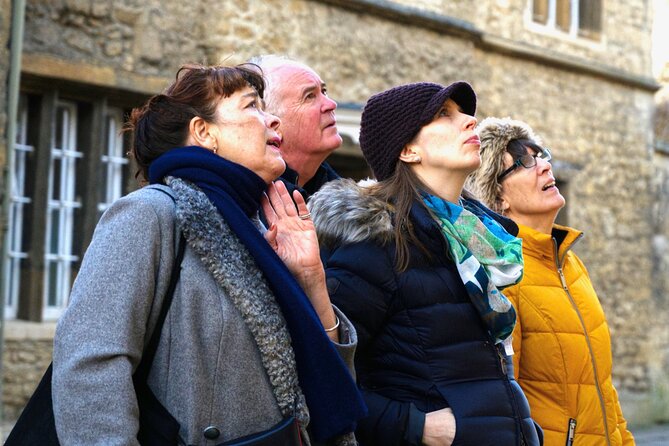
New College’s gatehouse tells the story of its foundation after the 14th-century plagues. The college is also known for its attractive setting, which has appeared in several films.
The route then reaches Oxford’s famous Bridge of Sighs, part of Hertford College. It looks Venetian, but it was built in the 20th century. That small correction is useful because Oxford encourages romantic assumptions. Not every old-looking structure is old.
The bridge is also near the house associated with Edmund Halley, the astronomer whose name was given to Halley’s Comet. This short stop connects architecture with science and gives you another reason to look beyond the postcard view.
Because both stops last only about three minutes, take in the overall setting rather than expecting an interior visit. The route is designed to keep moving through Oxford’s center.
The Sheldonian Theatre and Oxford’s great libraries
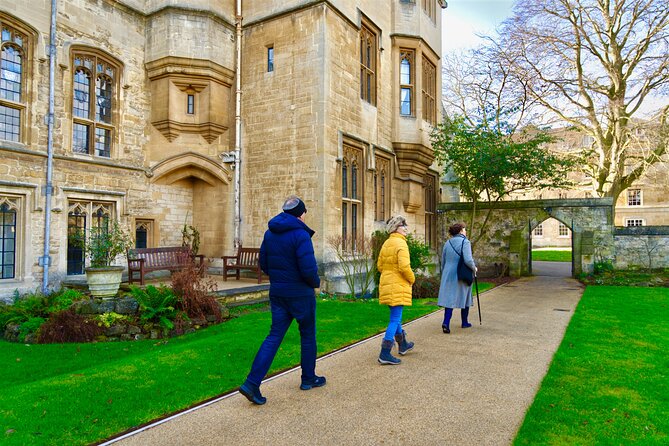
The Sheldonian Theatre is one of the tour’s major architectural sights. Built in the 17th century, it remains the setting for Oxford University ceremonies and is believed to be Christopher Wren’s first building.
Wren is best known as the architect of St. Paul’s Cathedral in London. At Oxford, he was also connected with astronomy. The supplied description calls him Astronomer of Photography, though the intended link is clearly to his scientific and university work. Either way, this stop gives you a useful reminder that Oxford’s story crosses architecture, ceremony, and science.
Next comes Oxford Central Library, built above the medieval Divinity School and Duke Humfrey’s Library. The Divinity School is a fine example of Perpendicular Gothic architecture. Duke Humfrey’s Library was built in the 15th century to hold a gift of more than 200 books from the king’s brother.
Both rooms were used for Harry Potter scenes. If you are interested in film locations, this is one of the most useful parts of the walk. The Harry Potter link is not the whole point, though. The real appeal is seeing how spaces first made for medieval scholarship later became familiar to a worldwide film audience.
The Bodleian Library follows. Today it holds more than 13 million books, and the tour explains how the library began and how it still functions. You’ll admire the 17th-century buildings from outside and learn why the Bodleian remains central to Oxford’s academic life.
Radcliffe Camera and Balliol College
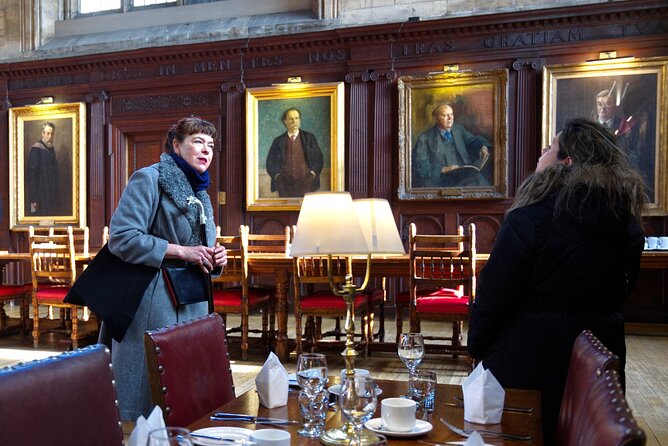
The Radcliffe Camera is Oxford’s first science library and one of the city’s most recognizable buildings. Sophie explains the role of Sir John Radcliffe, a royal physician and one of Oxford’s most eccentric and generous benefactors.
This stop is about more than taking the standard photograph. Look at the building as a statement of confidence in scientific learning, then connect it to the people whose money and influence shaped Oxford’s institutions.
The final stop is Balliol College. It is tied to the point at which undergraduates began to gain access to the university and its colleges. The stop lasts about 15 minutes, longer than most of the others, so it gives the tour a more substantial finish.
Admission to Balliol is not included, unlike the included medieval college entry noted in the tour highlights. That distinction matters. You should expect access arrangements to vary, and you should not assume every college on the route will open its gates.
What the 90-minute format really means
Seventeen stops in 90 minutes is ambitious. Several stops last only three or four minutes, and the route covers a lot of ground. I would treat this as a well-packed introduction, not a full college tour.
That format suits you if you are visiting Oxford for a day, coming from London, or trying to decide which colleges and libraries deserve a longer return visit. It also works well for families because the subjects change often: martyrs, books, film locations, marmalade, rowing, science, architecture, and famous names.
The pace may feel quick if you want time for photographs, interior details, or long questions at every stop. One useful feature is the personal approach. Sophie is described as attentive to specific requests and able to adjust the emphasis toward art, architecture, history, or particular sights.
The walking route is near public transport, begins at the Weston Library on Broad Street, and ends at the Golden Cross. Pickup is offered, but the supplied details do not specify the exact pickup area or time, so confirm that when booking.
Price, group size, and practical value
The listed price is $0 per person. At that rate, the tour offers exceptional value: a 90-minute guided route, entry to a medieval college, a map and guidebook, and personal advice about places to eat and drink.
The group limit is 15 people. That is small enough for questions and easier listening than a large city walk, while still allowing the guide to keep a steady pace. The published ratings are strong, and the praise focuses on Sophie’s clear explanations, humor, energy, and care with different ages and interests.
The tour requires good weather. If poor weather causes cancellation, you are offered another date or a full refund. If you cancel or request a change yourself, the experience is non-refundable and cannot be amended, even though the listed price is currently zero.
Most people can participate, and the activity is near public transportation. Wear shoes suited to city walking and allow time after the tour if you want to enter a library, church, or college in more detail. The complimentary map and guidebook are especially useful for that follow-up.
Who should book this Oxford tour?
I would choose this walk if you want a fast, intelligent introduction to Oxford and prefer a guide who connects buildings to people and ideas. It is particularly useful for first-time visitors, day-trippers from London, families, and anyone who wants help choosing what to see next.
It also suits you if English is your main language but you would appreciate French support. Sophie has guided families in both languages, and her personal interest in French culture adds another layer for bilingual groups.
I would look elsewhere if your main goal is a long college interior visit, a leisurely photography walk, or a detailed examination of one building. The route covers too much ground for that. Book this one for orientation, context, and lively local stories, then use the map and recommendations to build your own second look at Oxford.
FAQ
How long does the Oxford tour last?
The tour lasts approximately 90 minutes.
Where does the tour begin?
It begins at the Weston Library on Broad Street, Oxford OX1 3BG.
Where does the tour end?
The tour ends at the Golden Cross, Oxford OX1 3EU.
Is entry to a college included?
Yes. The tour highlights include entry to a medieval college. Admission to Balliol College is specifically listed as not included.
How many people can join the tour?
The group has a maximum of 15 participants.
What language is the tour offered in?
The tour is offered in English. The guide has also led tours in both English and French.
What happens if bad weather cancels the tour?
If poor weather causes cancellation, you are offered a different date or a full refund.
Just added in the world
- Wilmington History and Architecture Tour★ 4.8 · 18 reviews
- New Orleans : Garden District Architecture Walking tour★ 4.8 · 5 reviews
- Washington DC: Dupont Circle & Embassy Row Architecture Tour★ 5.0 · 6 reviews
- Washington, DC: Georgetown Architecture Walking Tour★ 5.0 · 8 reviews
- Walk & Discover KL’s Architectural and Heritage Gems★ 5.0 · 7 reviews
- Vicenza: Palladian Architecture Private Walking Tour★ 3.3 · 3 reviews
- Private Colonial Williamsburg Architectural Tour★ 5.0 · 5 reviews
- Unveiling Brno: History, Culture & Architectural Delights★ 5.0 · 2 reviews
Historical Tours, compared.
Chicago in a Day: Food, History & Architecture Walking Tour
Read our review →
Charleston’s Best Highlights: History, Culture & Architecture
Read our review →
Palm Springs Modernism Architecture & History Bike Tour
Read our review →
Historic Georgetown: History, Gossip, & Architecture Walking Tour
Read our review →
Charleston History, Homes, and Architecture Guided Walking Tour
Read our review →

Historical and Architectural Chicago Fireboat River & Lake Cruise
Read our review →Browse the lists this tour appears in