
REVIEW · HISTORICAL TOURS
Buda Castle Tour: History and Architecture
History is under your feet here. This 3.5-hour walk through Budapest’s Castle District connects royal ruins, medieval streets, Jewish heritage, and grand historic buildings in a way a quick photo stop cannot. I especially like the small maximum group of 12 and the focus on archaeology rather than only famous landmarks. I also like the guide’s use of historical images on an iPad to show how lost buildings may have looked.
The main drawback is simple: this is not an inside tour of Buda Castle. You will not enter the Royal Palace, Matthias Church, or the upper terrace of Fisherman’s Bastion unless you pay separately. The route also requires a good level of mobility, and three and a half hours on foot can feel long in cold or wet weather.
Key points to know before booking
- This is a walking history tour, not a palace interior visit: The emphasis is on streets, ruins, façades, and archaeology.
- The route covers 16 historic stops: You move from the Royal Palace area through medieval lanes, the old Jewish quarter, and the northern Castle District.
- The small group matters: With no more than 12 people, it is easier to hear the guide and ask questions.
- The medieval Jewish prayer house is included: This is one of the few paid interior visits built into the tour, but it is closed on Saturdays and Mondays.
- You finish beside Matthias Church: That gives you a useful chance to visit the church independently after the walk.
- The price is $43.25 per person: That is fair for a licensed English-speaking guide and a long, specialist-led route, but extra admission fees can add up.
What this Buda Castle walk is really about
Buda Castle can look like one grand palace complex from across the Danube. Up close, it is a patchwork of medieval foundations, Ottoman damage, Baroque rebuilding, 19th and 20th-century reconstruction, and modern arguments about preservation.
That layered story is the real subject here. You spend only about 20 minutes at the Royal Palace itself, then move into the streets where ordinary merchants, noble families, religious communities, printers, and soldiers shaped Buda.
I like this approach. It keeps the walk from becoming a parade of famous names. You learn to read the district as an old town, not just as a royal postcard.
The pace is steady, with short stops ranging from three to 20 minutes. The route includes cobblestones, uneven ground, stairs or slopes may be encountered, and long periods of standing. Wear supportive shoes. Children under 10 are not permitted, and the experience is not suitable for people with limited mobility.
More history tours in the world:
- Chicago in a Day: Food, History & Architecture Walking Tour
★ 5.0 · 1,153 reviews - Charleston’s Best Highlights: History, Culture & Architecture
★ 5.0 · 422 reviews - Palm Springs Modernism Architecture & History Bike Tour
★ 5.0 · 359 reviews
Starting at Prince Eugene and meeting the Royal Palace
The tour begins at the Statue of Prince Eugene of Savoy in the Buda Castle area. From there, the guide introduces the Royal Palace, a building complex that has been built, destroyed, altered, and rebuilt many times.
You will hear how a medieval stronghold became a royal residence and how Gothic, Baroque, and Neoclassical tastes left their marks. The palace is less a single piece of architecture than a record of Hungary’s political changes.
Do not expect a lengthy palace interior visit. Admission is not included, and the tour treats the exterior and surrounding archaeology as the main attraction. If you want museum rooms or royal interiors, plan to return on your own after the walk.
The remains of the medieval Sigismund Church receive only a brief stop, about three minutes. That may sound minor, but the foundations matter. They belong to a Gothic royal chapel built during King Sigismund’s expansion of the palace in the early 15th century.
This is a good example of the tour’s method. A few stones can open a larger discussion about how Buda was being reshaped into an imperial residence.
Tárnok Street and the practical life of medieval Buda
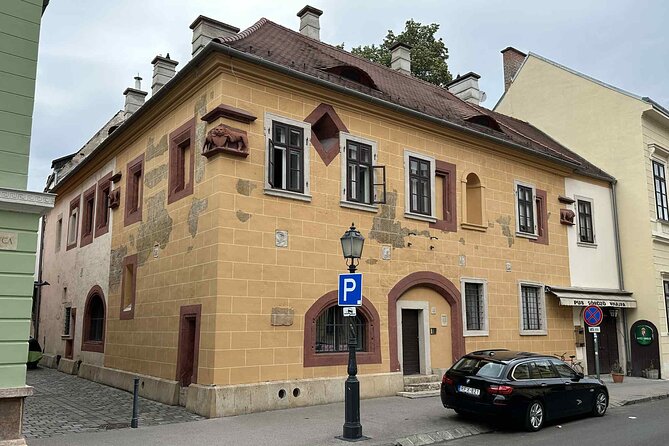
Tárnok Street is one of the most useful stops for understanding how the Castle District worked. It was the main commercial street of the medieval burgher town below the royal court.
Here, you look at preserved merchant houses built on original medieval foundations. The guide explains how goods were stored, traded, and displayed, bringing attention to the business of daily life rather than only kings and battles.
The stop lasts about 15 minutes, enough to examine several buildings without turning into a long architecture lecture. I find this part especially valuable because the façades and street plan help you picture Buda as a working town.
Úri Street changes the mood. This was the noble residential quarter, lined with aristocratic homes and grand townhouses. You look for thick stone walls, old gateways, and traces of buildings from the 14th and 15th centuries.
The gateways are the visual prize. They reveal how status was expressed before you even entered a house. The route also explains how noble homes developed over time, often retaining older foundations beneath later additions.
A ruined parish church and an Italian merchant quarter
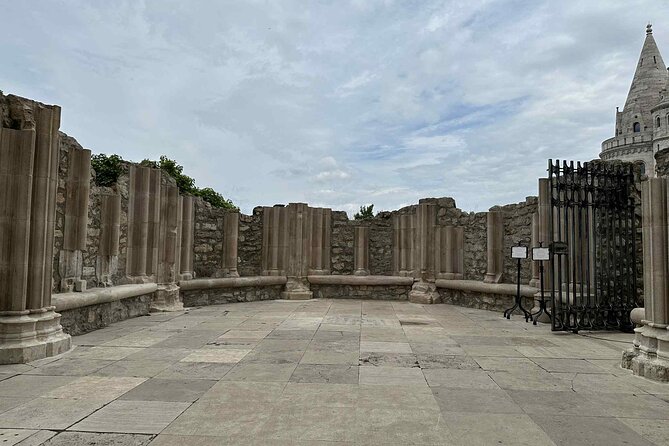
The Church of Saint Mary Magdalene has a sad and revealing story. Its foundations reach back to the 13th century, and the church served the Hungarian-speaking parish of the area once known as Szombathely.
The building suffered during the 1686 siege of Buda and was later demolished under Hungary’s communist government in the 1950s. Only the medieval tower survived through the efforts of archaeologists and preservationists.
The stop lasts around eight minutes and does not include admission. The tower is not simply an old monument. It shows how political decisions can erase parts of a city, and how careful preservation can save at least one visible piece.
Országház Street, once called Italian Street, brings another side of medieval Buda into view. Italian merchants lived and worked here, helping connect the town with wider European trade and culture.
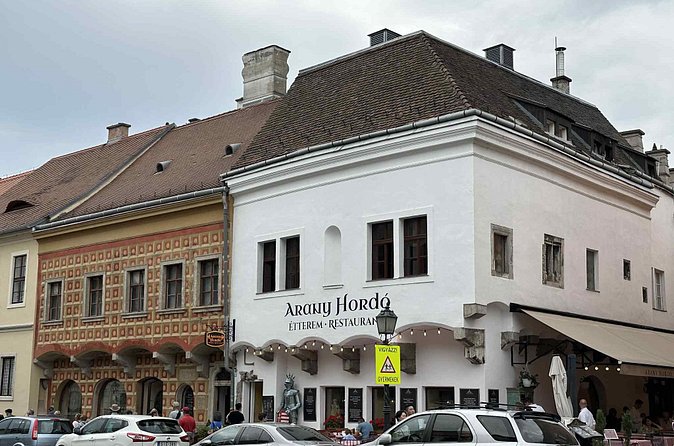
Look for the Castle District’s only surviving 16th-century sgraffito decoration. This Renaissance surface design is easy to miss if you are walking alone. The guide places it within the larger story of merchants, diplomacy, and foreign communities in Buda.
A few more architecture tours in the world worth a look
- Chicago Architecture River Cruise
★ 5.0 · 15,756 reviews - Chicago River 90-Minute Architecture Tour
★ 4.5 · 9,629 reviews - Chicago River: 1.5-Hour Guided Architecture Cruise
★ 4.8 · 8,046 reviews - Chicago Architecture Center River Cruise aboard First Lady
★ 5.0 · 5,536 reviews
A reconstructed ministry and the church most people misname
The former Royal Hungarian Ministry of Finance is one of the route’s clearest examples of modern reconstruction. Its Neo-Gothic building was created in the early 20th century, partly at the cost of medieval structures that were demolished for the project.
World War II caused major damage. Afterward, the ornate façade was simplified. In the past five years, much of the original appearance has been reconstructed, though the work has caused debate because part of an original wing was demolished.
This stop gives you a useful warning: old-looking does not always mean medieval, and restoration is not always a simple act of repair.
Matthias Church comes later, but the tour pauses there for only about five minutes. Its official name is the Church of the Assumption of the Buda Castle. The common name, Matthias Church, is widely used but technically incorrect.
The church originally served Buda’s German-speaking community. Its interior admission is not included, so you will need to return independently if you want to see the painted decoration and interior architecture.
The tour ends nearby at Szentháromság Square, making this a practical place to continue exploring. You can visit the church after the walk rather than trying to squeeze it into the group schedule.
Fortuna Street and Hungary’s first printed book
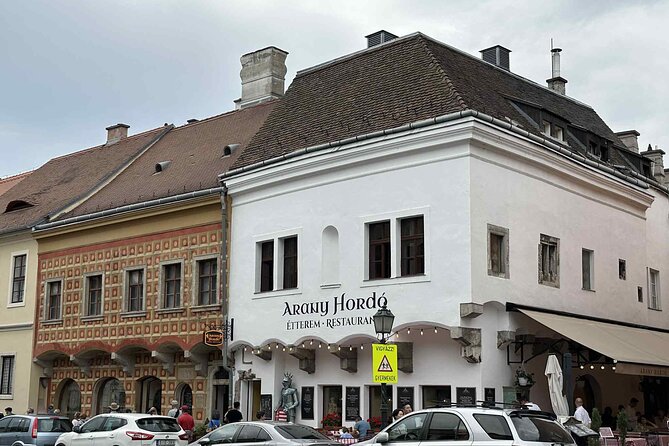
Fortuna Street is quieter today, with restaurants and a polished historic appearance. In the Middle Ages, it held aristocratic homes and important townhouses.
The street also connects Buda with the early history of printing. In the 1470s, Andreas Hess, a German-born printer, produced the Chronica Hungarorum here, considered Hungary’s first printed book.
The nearby Red Hedgehog Inn was another long-standing meeting place for merchants, intellectuals, and people passing through the district. The contrast is enjoyable: where printing presses once marked a new age of information, restaurant tables now fill the street.
You spend about 15 minutes here. It is a good stop for anyone interested in books, trade, and the less obvious ways a city becomes important.
Bécsi Kapu and the National Archives
Bécsi Kapu Square once functioned as a marketplace and one of medieval Buda’s main entrances. The square brought Hungarian townspeople and members of the Jewish community together for trade, conversation, and worship.
The stop is brief, about five minutes, but it helps you imagine the district as a place of social contact. It was not only a royal enclosure. Different groups used the same streets for business and religious life.
The National Archives of Hungary is another short stop. Built in the early 20th century in a Neo-Romanesque style, it was designed to echo the medieval surroundings through heavy stonework, arches, and a fortress-like presence.
Inside are documents covering Hungary’s written past, though the tour does not include an interior visit. From outside, the building raises an interesting question: how should a modern nation represent an older past?
The 1686 siege and the medieval Jewish prayer house
Along the outer castle walls, the guide explains the Siege of Buda in 1686. This area marks where Christian allied forces first breached the walls. Nearby, the Ottoman Pasha of Buda, Arnavut Abdurrahman Abdi Pasha, died in battle.
A memorial honors the multinational Christian forces who fought and died in the siege. This section adds military history without letting it swallow the rest of the walk. You see how the walls shaped the city and why Buda’s destruction was so severe.
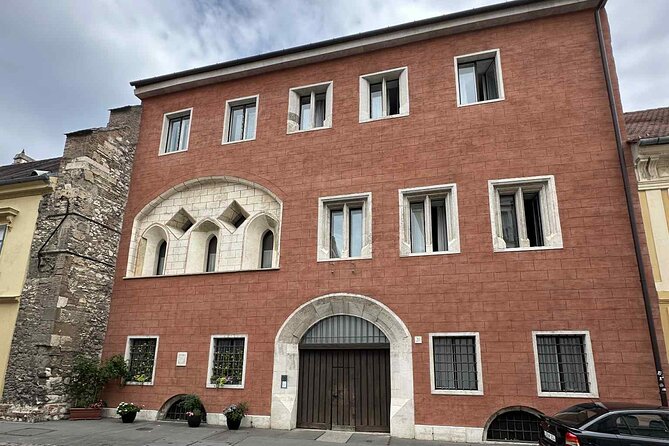
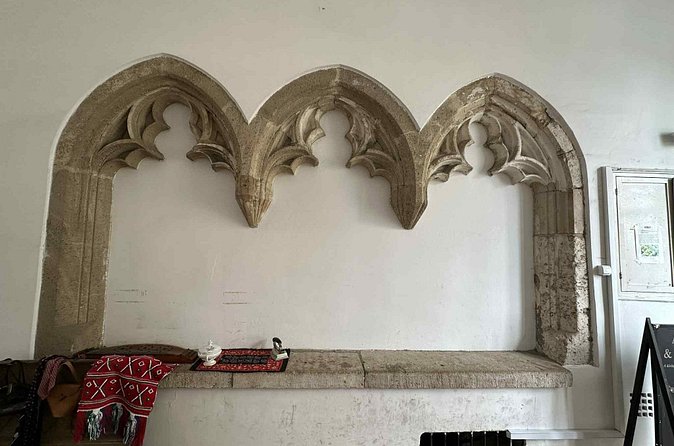
The medieval Jewish quarter is one of the strongest parts of the tour. You visit the excavated medieval Jewish prayer house, one of the rare surviving examples of medieval Jewish religious architecture in Hungary. Admission is included.
Nearby, the guide points out the former Gothic synagogue site. The building is gone, but the location helps restore a community that was once an important part of life inside the Castle walls.
The prayer house is closed on Saturdays and Mondays. Check the day before booking, since this is the one included interior visit and a major reason to choose this route. It is modest in size, but its importance is far greater than its scale.
Layered houses, Dominican ruins, and the Hilton debate
Táncsics Mihály Street shows how later residents reused medieval remains. Gothic walls and cellars were incorporated into Baroque and later homes instead of being removed completely.
That kind of reuse is common across old European towns, but it can be hard to notice without guidance. The street lets you see post-Ottoman Buda rebuilding itself on older foundations, both physically and politically.
The Dominican courtyard contains the remains of the monastery of Saint Nicholas. The Dominican order is linked with Friar Julianus, who traveled east in the 13th century in search of eastern Hungarian communities.
The ruins later became part of the Hilton Hotel project. The result combines medieval stonework with modern construction, a striking but controversial meeting of preservation and commercial development.
This stop is useful because it avoids a simplistic view of conservation. Keeping old walls does not always mean leaving a site untouched. Sometimes the result is awkward, creative, or disputed.
Fisherman’s Bastion and the end at Matthias Church
The final stop is Fisherman’s Bastion, one of Budapest’s most photographed landmarks. The route stays on the main level and does not include the upper lookout terrace, which requires a separate ticket.
You will see the monument and the equestrian statue of Saint Stephen, Hungary’s first Christian king. The stop lasts about six minutes, so this is more of a final orientation point than a long photo session.
That limitation is worth knowing before you book. If your main goal is panoramic views from the upper terrace, this tour will not replace a separate visit. Its value is the historical setting around the monument, not extended sightseeing from the top.
The walk finishes at Matthias Church on Szentháromság Square. You can continue into the church independently, explore the square, or arrange your next Castle District stop from there.
Guide quality, group size, and the value of $43.25
At $43.25 per person, this is not the cheapest way to see Buda Castle. It is still a reasonable price if you want a specialist-led walk rather than a quick orientation tour.
You receive an officially licensed English-speaking guide, a small group capped at 12, and admission to the medieval Jewish prayer house. The guide also provides a guest pass with lanyard, collected at the end.
The strongest praise centers on the guide’s command of history, architecture, and archaeology. Matthew and Máté are the names highlighted in the available feedback, and the descriptions emphasize clear explanations, humor, passion, and strong answers to questions.
One particularly useful feature is the iPad material showing earlier versions of buildings. Old Buda can be hard to understand from surviving walls alone. Seeing an image of a vanished church, altered façade, or former street arrangement can make the archaeological evidence much easier to follow.
The price becomes less attractive if you want every major interior. Matthias Church, the Royal Palace, and the upper Fisherman’s Bastion terrace all cost extra. Think of the fee as payment for interpretation and access to the prayer house, not as an all-inclusive castle pass.
Who should book this tour?
I would choose this tour if you care about medieval streets, architecture, archaeology, religious communities, and the political changes that shaped Buda. It suits adults and children aged 10 or older who can walk for several hours and enjoy listening at frequent outdoor stops.
It is also a good first or second-day activity in Budapest because it gives you a map of the Castle District’s major zones. Afterward, you will know which places deserve a separate interior visit.
I would skip it if you mainly want palace rooms, a long stop inside Matthias Church, or panoramic photography from Fisherman’s Bastion. You will get only short exterior visits to those landmarks.
Book at least 24 hours ahead if you may need to cancel, since that is the deadline for a full refund. The tour requires suitable weather and a minimum number of people. If poor weather or low enrollment cancels it, you are offered another date, another experience, or a full refund.
FAQ
How long does the Buda Castle Tour last?
The tour lasts approximately 3 hours and 30 minutes.
Where does the tour begin?
It begins at the Statue of Prince Eugene of Savoy in Budapest, 1013 Hungary.
Where does the tour end?
The walk ends at Szentháromság Square beside Matthias Church.
Is admission to the Royal Palace included?
No. The tour does not include admission to the Royal Palace interior.
Is admission to Matthias Church included?
No. You may visit the church interior independently after the tour.
Is the medieval Jewish prayer house open every day?
No. It is closed on Saturdays and Mondays. Admission is included when it is open.
Is the tour suitable for people with limited mobility?
No. A moderate level of physical fitness is required, and the tour is not suitable for people with limited mobility.
Should you book the Buda Castle Tour?
Book it if you want Buda explained rather than simply photographed. The route brings together royal power, merchant life, noble homes, Jewish heritage, religious ruins, war, reconstruction, and modern preservation debates.
The best value comes from the guide, the small group, and the unusual stops that independent visitors can easily miss. Just budget extra time and money for the palace, Matthias Church, or Fisherman’s Bastion interiors. If you accept that this is an outdoor history and architecture walk, not a full castle admission ticket, it is a strong choice for seeing the Castle District with much more meaning.
Just added in the world
- Wilmington History and Architecture Tour★ 4.8 · 18 reviews
- New Orleans : Garden District Architecture Walking tour★ 4.8 · 5 reviews
- Washington DC: Dupont Circle & Embassy Row Architecture Tour★ 5.0 · 6 reviews
- Washington, DC: Georgetown Architecture Walking Tour★ 5.0 · 8 reviews
- Vicenza: Palladian Architecture Private Walking Tour★ 3.3 · 3 reviews
- Walk & Discover KL’s Architectural and Heritage Gems★ 5.0 · 7 reviews
- Private Colonial Williamsburg Architectural Tour★ 5.0 · 5 reviews
- Unveiling Brno: History, Culture & Architectural Delights★ 5.0 · 2 reviews
Historical Tours, compared.
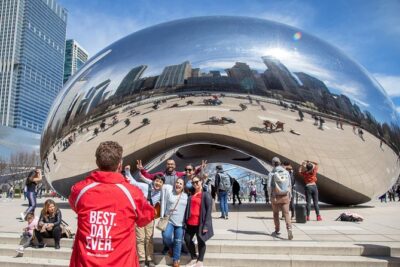
Chicago in a Day: Food, History & Architecture Walking Tour
Read our review →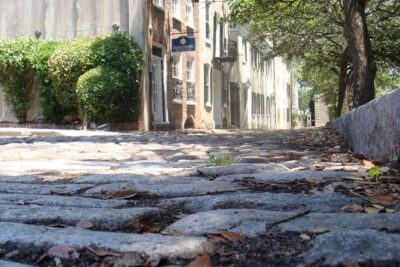
Charleston’s Best Highlights: History, Culture & Architecture
Read our review →
Palm Springs Modernism Architecture & History Bike Tour
Read our review →
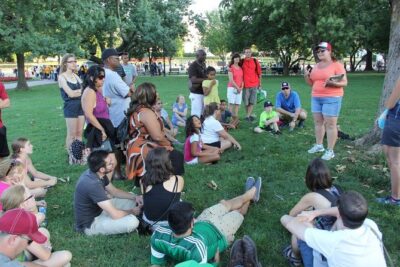
Historic Georgetown: History, Gossip, & Architecture Walking Tour
Read our review →
Charleston History, Homes, and Architecture Guided Walking Tour
Read our review →

Historical and Architectural Chicago Fireboat River & Lake Cruise
Read our review →Browse the lists this tour appears in