
REVIEW · HISTORICAL TOURS
Alhambra Surroundings: History, Architecture and Legends
The Alhambra reveals itself from the outside. This two-hour walking tour links its gates, gardens, churches, walls, Renaissance palace, and old workshops, giving you a useful introduction without requiring an Alhambra admission ticket. I like the focus on the architectural clues and defensive design, and I especially like that the route includes the Palace of Charles V, the Forest, and views from the Plaza de los Aljibes.
I also like the attention given to Hispano-Arabic gardens and Granada’s inlay craft, details that are easy to miss when you hurry toward the Nasrid Palaces. The main caution is the bilingual guiding: one German participant found the Spanish and English delivery tiring, while another reported that guide Robert spoke too quickly and that the tour ended earlier than expected. Ask at check-in about the day’s language setup and timing.
Key points at a glance
- No Alhambra admission ticket required: You see major exterior landmarks, gates, walls, gardens, and courtyards without entering the ticketed palace areas.
- The Palace of Charles V gets a long stop: Its Renaissance design provides a sharp contrast with the Nasrid buildings around it.
- The route includes the Justice Gate and Tower of the Seven Floors: These stops bring the Alhambra’s military side into view.
- The Alhambra Forest adds shade and context: You learn why gardens mattered so much in Hispano-Arabic architecture.
- The final views are a strong finish: The Plaza de los Aljibes looks toward Granada, and the tour ends at the Alberca Nazarí.
- English and Spanish are offered: The guide leads the walk, with Hector praised for clear and capable work in one recent experience.
Why this outdoor Alhambra tour makes sense
The Alhambra can be a difficult place to understand if you only follow the crowds toward the famous palaces. Its gates, walls, religious buildings, gardens, and later Christian additions tell a longer story. This walk helps arrange those pieces.
You pay $26 per person, which is a reasonable price if you want a guided introduction but do not have an Alhambra entry ticket. You are not buying access to the Nasrid Palaces, Generalife interiors, or other ticketed areas. Instead, you are paying for an official guide, historical explanation, exterior views, and several places that can be confusing without context.
I see this as a good choice for a first look, especially if your main Alhambra ticket is sold out. It can also work before a separate paid visit, since the guide explains the setting and defensive layout before you enter the complex on your own.
The meeting point is the Granavisión Welcome Visitor Centre at Paseo de la Sabika 28, beside the Guadalupe Hotel. Arrive at the front desk rather than waiting outside. Staff confirm your reservation, place you with the right group, and introduce you to the guide. The scheduled start is 10:30 am.
More history tours in Spain:
- Historical and Modernist Bike Tour Barcelona
★ 5.0 · 262 reviews - Bike Tour in Barcelona: History, Architecture and Culture
★ 3.5 · 29 reviews - Madrid Historic with an architect : Arabs, Austrias and Bourbons
★ 5.0 · 21 reviews
The Palace of Charles V and a sharp change in style
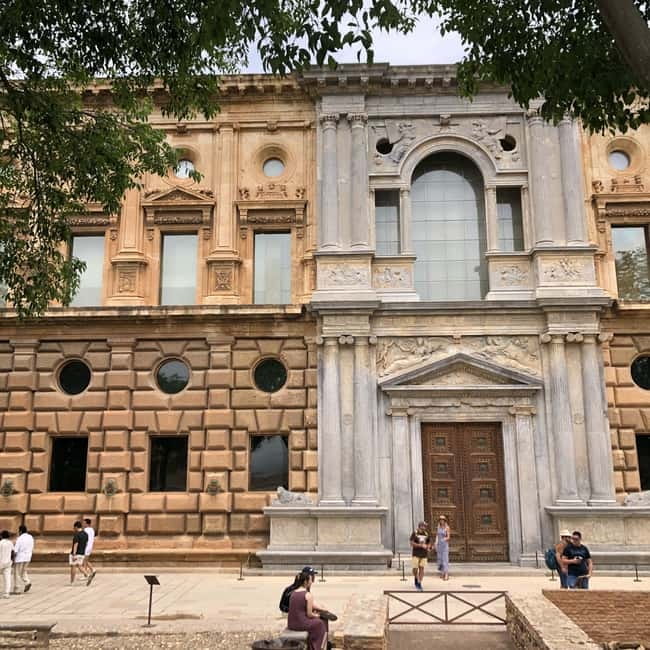
The Palace of Charles V is the biggest architectural surprise on this route. Built in the Renaissance period, it has a very different character from the Islamic buildings around it. Its severe exterior and circular inner courtyard show how the Christian rulers reshaped the Alhambra after the Muslim period.
The guided stop here is listed as 75 minutes, making it the longest part of the published route. That gives the guide time to explain the palace, its architecture, and its place within the wider Alhambra complex rather than treating it as a quick photo stop.
I like this part because it prevents a common mistake: thinking of the Alhambra as one single, untouched palace. You see layers of power and taste. The Nasrid rulers created a fortified courtly center, and later Christian rulers placed their own monumental statement inside it.
The palace is also useful for understanding scale. Delicate decoration often draws attention at the Alhambra, but Charles V’s building speaks in broad Renaissance forms. If you prefer one architectural style, this contrast may feel abrupt. If you enjoy seeing how monuments change under new rulers, it is one of the most valuable stops.
Santa Maria and San Francisco: Christian buildings inside the complex
The Church of Santa Maria and the Convent of San Francisco show what happened after Christian rule took hold. The church occupies an important position within the Alhambra grounds, while the convent reflects the religious changes that followed the end of the Nasrid era.
The scheduled visit to Santa Maria is 15 minutes, and the convent is included as part of the experience. These are short stops, so expect an explanation of their role rather than an exhaustive art-history lecture. Their value lies in the contrast they create with the earlier Islamic architecture.
This is also where the tour helps you read the Alhambra as a living site rather than a frozen monument. The complex was not abandoned after the Nasrid period. It was adapted, renamed, used for Christian worship, and reshaped according to later needs.
The old Taberna del Polinario is another unusual inclusion. It connects the site with Granada’s more recent cultural life. The supplied details do not specify how long you spend there, so treat it as a brief stop within the walk rather than a full meal or performance.
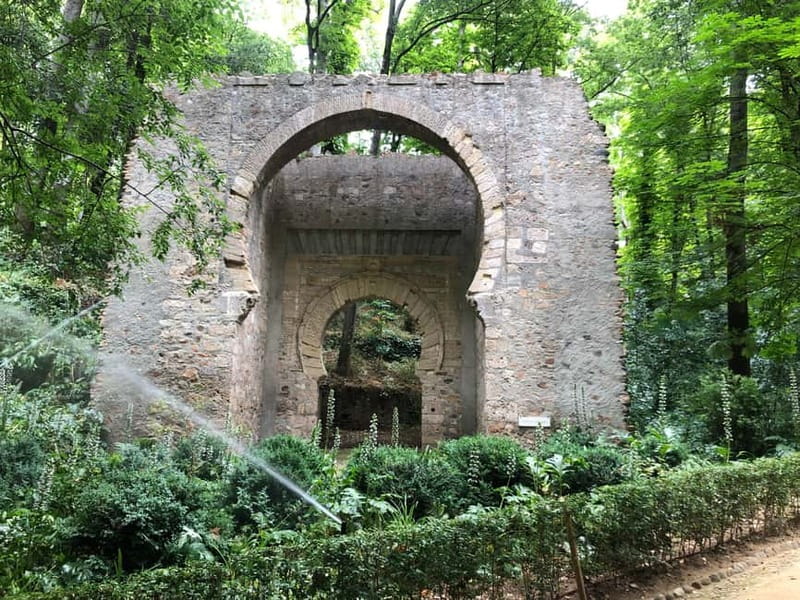
The Justice Gate and the Alhambra’s defensive face
The Puerta de la Justicia, or Justice Gate, is one of the Alhambra’s most famous entrances. The route reaches it early, after leaving the visitor centre, and gives you about 30 minutes of guided attention.
This gate helps you understand that the Alhambra was not simply a decorative palace. It was also a protected hilltop complex with controlled access. The gate’s structure, position, and relationship to the wall reveal how visitors and potential enemies were directed through the site.
I find this one of the most useful stops for people who know the Alhambra mainly from photographs. Photos often isolate arches and ornament. At the Justice Gate, you get a clearer sense of the practical work behind the beauty: entry points, walls, towers, and movement through the complex.
The guide also discusses architectural and defensive secrets here. Listen for how the site combines ceremony with security. A grand entrance can welcome an honored visitor while still forcing everyone through a controlled route.
A few more architecture tours in Spain worth a look
- Barcelona: Sant Pau Recinte Modernista Entry Ticket
★ 4.6 · 2,567 reviews - Barcelona: Sagrada Familia, Modernism, and Old Town Tour
★ 4.7 · 1,621 reviews - Ramblas, Old Town, Gothic and Gaudi Architecture Walking Tour
★ 5.0 · 723 reviews - Valencia: Art & Architecture Guided Tour with Monuments Tickets
★ 5.0 · 255 reviews
The Alhambra Forest and the role of gardens
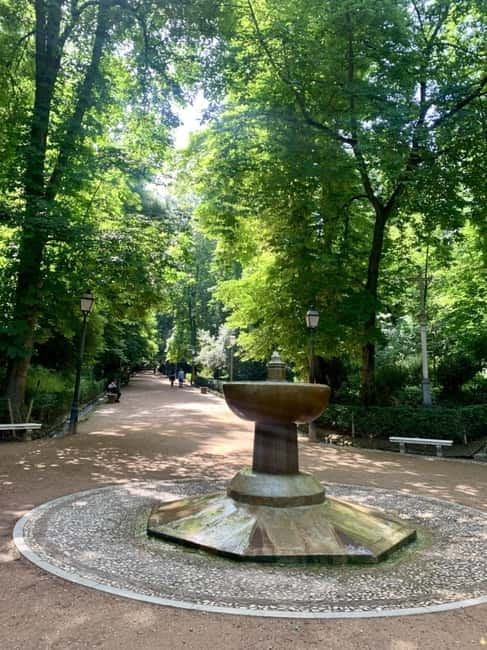
The route then moves around the outside of the Alhambra gardens and through the Alhambra Forest. The walk is not just a green break between monuments. It explains why gardens mattered so much in Hispano-Arabic architecture.
Water, shade, planting, and carefully framed views were part of how a palace was experienced. Gardens offered comfort, but they also shaped movement and mood. They connected architecture with the natural setting and made the approach to important buildings feel deliberate.
The forest is also practical. It gives you a chance to see the monumental complex from outside its busiest routes, while the trees provide a more relaxed setting for the guide’s explanation. You are still walking on an uphill historic site, so comfortable shoes are important.
The published timing creates one point worth checking. The overall experience is described as two hours, but the listed stop durations add up to three hours: 75 minutes at Charles V, 15 at Santa Maria, 30 at the Justice Gate, 45 in the Forest, and 15 at the Plaza de los Aljibes. Some of these times may overlap with walking or represent approximate guidance. Still, I would confirm the expected finish time at the welcome centre, particularly if you have another booking afterward.
Walls, the Tower of the Seven Floors, and Alhambra legends
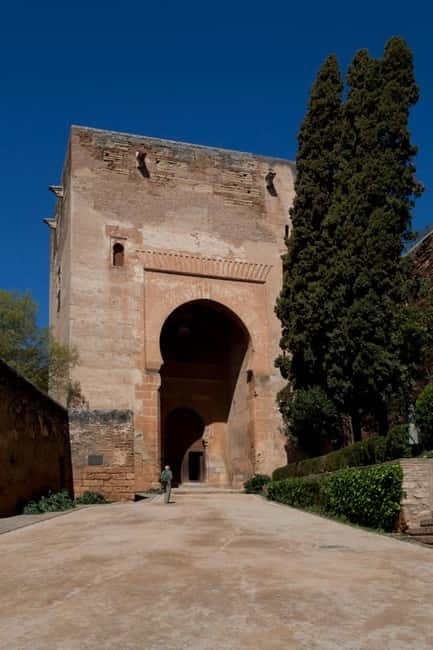
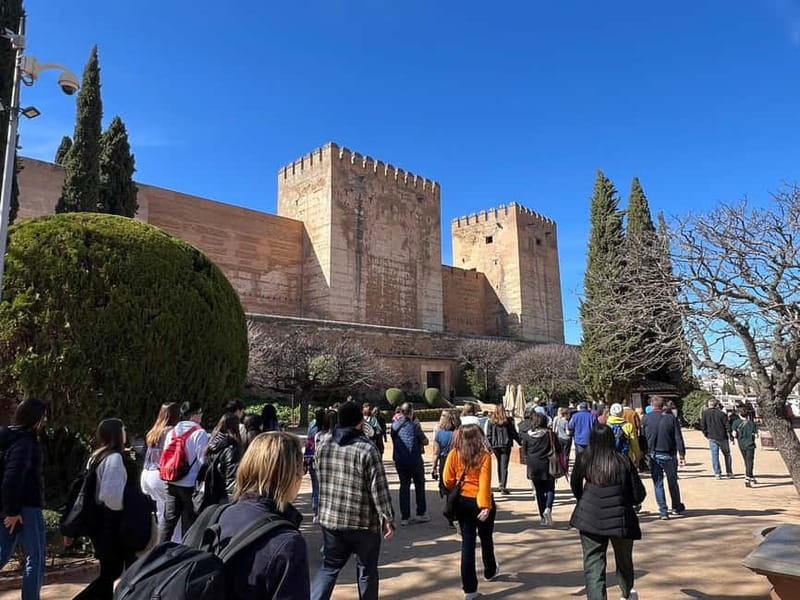
Walking along the wall gives the site a different scale. From ground level, the Alhambra can seem like a collection of buildings. Along the wall, you begin to see the relationship between towers, slopes, entrances, and open views.
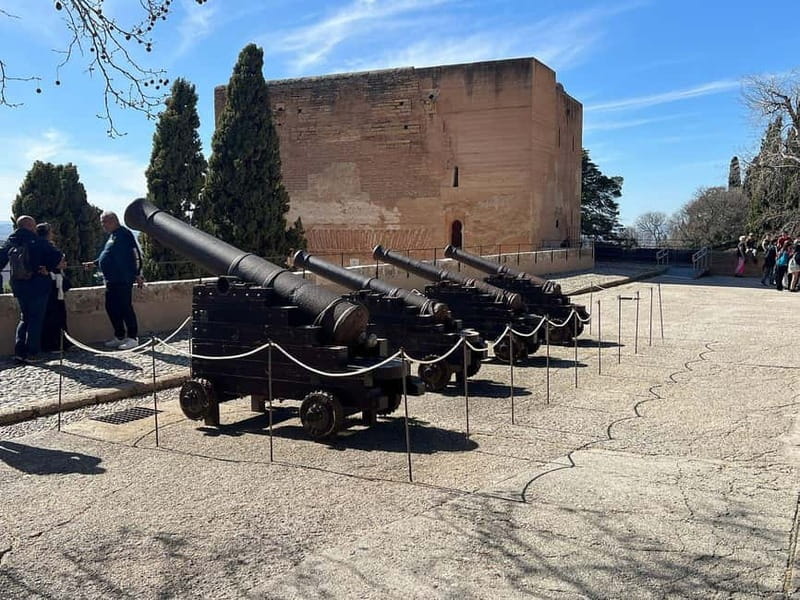
The Tower of the Seven Floors is tied to some of the Alhambra’s most intriguing legends. The tour uses this spot to discuss stories that have gathered around the complex, while also returning to the historical setting of the tower and wall.
I like the balance promised here. Legends make the site memorable, but the guide also places them within the evolution of the Alhambra from its Muslim era to the present. That keeps the stories entertaining without asking you to treat every tale as proven fact.
Expect uneven walking and some effort. The experience is a walking tour around a hilltop monument, not a flat city stroll. The supplied information does not give an exact group size or accessibility details, so ask the provider directly if those points affect your plans.
Plaza de los Aljibes and Granada from above
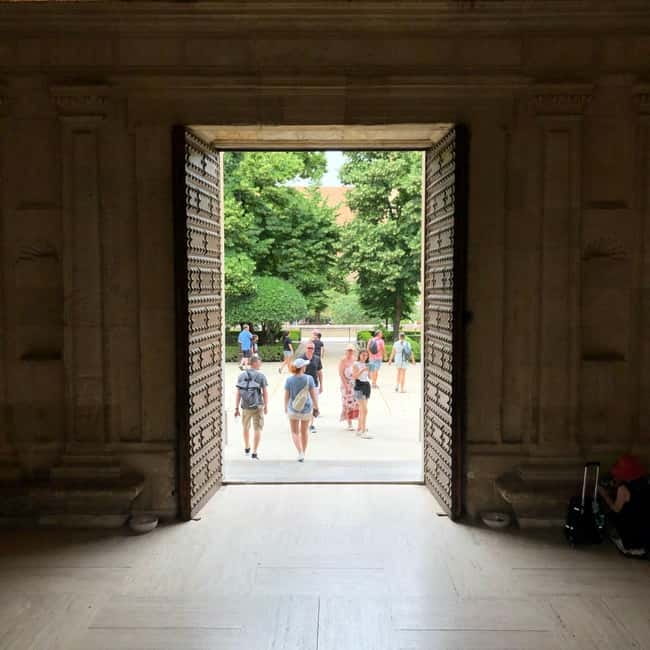
The route ends at the Plaza de los Aljibes, where you get broad views of Granada from the Alhambra complex. The plaza’s name refers to underground water storage, an important reminder that water management was part of life at a fortified palace.
This is a satisfying place to finish because the tour shifts your attention from individual buildings to the wider city. You can connect the Alhambra’s position on the hill with Granada below and better understand why the site mattered strategically.
The guide also introduces Granada’s inlay work in an artisan workshop within the grounds. This craft tradition gives the visit a hands-on cultural note, although the information provided does not say whether a demonstration or purchase is included. Expect an introduction to the craft rather than assume a full workshop session.
The final stop is the Alberca Nazarí, described as a symbol of Nasrid refinement. Its association with water, proportion, and palace design brings the themes of gardens and architecture together. Ending there gives the tour a clear visual and historical thread.
Guide style, languages, and the walking pace
The tour is available in English and Spanish. A live guide leads the group, and recent feedback gives a mixed but useful picture of the guiding style.
Hector received especially strong praise for his work. One French participant described the guide as highly interesting and compared the experience to a real history lesson. That matches the tour’s main strength: it is built around explanation, not just escorting you from one photo point to the next.
The language format deserves attention. A German participant found it tiring when the guide spoke in both Spanish and English, suggesting that frequent switching can make the talk feel constant. If you understand both languages, this may not trouble you. If you understand only one, ask how the guide normally handles bilingual groups.
There was also a complaint that Robert spoke too quickly and did not check whether everyone’s earphones worked. The same feedback said earphones were required to be purchased. Since the supplied activity details do not clearly state an earphone policy or price, confirm this before setting out. It is a small issue, but poor audio can weaken an otherwise good history tour.
What $26 gets you, and what it does not

At $26, the tour offers a practical way to see the Alhambra’s surroundings with an official guide. You receive guided access to Santa Maria, the convent of San Francisco, the exterior areas around the gardens, the wall and Tower of the Seven Floors, the Palace of Charles V, the old Taberna del Polinario, the Plaza de los Aljibes, and the Alberca Nazarí.
The strongest value comes from the interpretation. If you walk around the Alhambra alone, you can see the buildings, but you may miss why the gardens were designed as they were, how the entrances worked, or how the site changed from Muslim rule to later Christian use.
The limitation is just as clear: Alhambra admission is not included. You should not book this expecting to enter the ticketed Nasrid Palaces or receive a full interior visit. The experience is best understood as an exterior and surroundings tour.
Free cancellation up to 24 hours before the start and reserve-now, pay-later booking add flexibility. The tour is available only at the stated scheduled time, with the start listed as 10:30 am, so plan your morning around the meeting point and check the finish time.
Who should book this walk
I would choose this tour if you want the Alhambra explained in context, especially the gates, walls, gardens, Christian additions, and Renaissance architecture. It suits first-time visitors, people without an Alhambra entry ticket, and anyone who wants a historical orientation before exploring more of Granada.
It is also a good fit if legends and architecture interest you more than rushing through a checklist of rooms. The walk gives you a broader view of the complex and includes details such as inlay craft and the Taberna del Polinario.
I would be more cautious if you dislike bilingual guiding, need a precisely timed two-hour activity, or want access to the famous interior palaces. Ask about language delivery, audio equipment, and the actual end time before paying.
Should you book Alhambra Surroundings?
Book it if you want a guided, ticket-free look at the Alhambra’s gates, gardens, walls, Christian buildings, and views for $26. The Justice Gate, Palace of Charles V, Forest, Tower of the Seven Floors, and Plaza de los Aljibes give you a well-rounded sense of the site beyond its best-known rooms.
Skip it if your only goal is to enter the Nasrid Palaces, since no Alhambra ticket is included. If you do book, arrive early at the Granavisión Welcome Visitor Centre, wear sturdy shoes, and confirm the bilingual format and timing at check-in. That small bit of preparation should help you get the most from a tour that has strong historical content but may vary with guide pace and group language needs.
FAQ
Does the tour include an Alhambra admission ticket?
No. The price does not include an entrance ticket to the Alhambra.
How long does the experience last?
The activity is advertised as lasting two hours. The published stop timings add up to longer than two hours, so confirm the expected finish time at check-in.
What time does the tour start?
The tour starts at 10:30 am.
Where is the meeting point?
Meet at the Granavisión Welcome Visitor Centre, Paseo de la Sabika 28, next to the Guadalupe Hotel.
What should I do when I arrive?
Check in at the front desk inside the Welcome Visitor Centre. Staff confirm your reservation, assign you to a group, and introduce you to the guide.
Which languages are available?
The live tour is offered in Spanish and English.
Is a guide included?
Yes. An official live guide is included.
Does the tour visit Santa Maria Church?
Yes. A guided visit to Santa Maria Church is included.
Does the route include the Palace of Charles V?
Yes. The tour makes a guided stop at the Palace of Charles V.
What should I wear?
Wear comfortable shoes because the experience involves walking around the Alhambra surroundings, forest, walls, and historic areas.
Can I cancel for a full refund?
Yes. You can cancel up to 24 hours in advance for a full refund.
Just added in Spain
- Gaudí and Modernist Art: Guided Tour in Palma de Mallorca★ 4.5 · 3 reviews
- Self-Guided Audio Tour-The Surrealist Barcelona of Dalí and Gaudí★ 3.5 · 8 reviews
- Visit to the Modernist houses of the Americans★ 5.0 · 2 reviews
- Roman & Gotic & Gaudi in Barcelona: private walking tour★ 4.5 · 2 reviews
- Barcelona Gaudi Tour: Sagrada Familia, Casa Batllo & Casa Mila★ 5.0 · 4 reviews
- Barcelona Street Escape: Gaudi and the Hidden Treasure★ 5.0 · 17 reviews
- Sagrada Familia Private Tour – Unlock the mysteries of Gaudi★ 5.0 · 10 reviews
- Gaudi’s Casa Batlló and La Pedrera with Chocolate Tasting★ 5.0 · 5 reviews
Historical Tours, compared.

Chicago in a Day: Food, History & Architecture Walking Tour
Read our review →
Charleston’s Best Highlights: History, Culture & Architecture
Read our review →
Palm Springs Modernism Architecture & History Bike Tour
Read our review →
Historic Georgetown: History, Gossip, & Architecture Walking Tour
Read our review →
Charleston History, Homes, and Architecture Guided Walking Tour
Read our review →

Historical and Architectural Chicago Fireboat River & Lake Cruise
Read our review →Browse the lists this tour appears in