
REVIEW · MADRID ARCHITECTURE TOURS
Madrid Historic with an architect : Arabs, Austrias and Bourbons
Madrid’s oldest streets tell several stories. This private walking tour connects the city’s Arab beginnings with the Habsburg Austrias and the later Bourbon rulers, using buildings, plazas, church remains, and old city walls as its guide. I especially like the use of plans and historical photographs, and I like that the tour is led by a local architect rather than a general sightseeing guide.
The route covers a remarkable amount of central Madrid in about three to three and a half hours. The main consideration is that the tour gives as much weight to political and social history as it does to architectural style, so anyone expecting a purely technical study of facades may find the approach broader than expected.
Key points to know before booking
- A local architect leads the walk: Emilio, also referred to as Emiliano in one account, explains how Madrid changed through 12 centuries of building and city planning.
- The route covers 12 central stops: You see the Royal Palace, Arab Wall, Plaza de la Villa, Plaza Mayor, Puerta del Sol, and several lesser-known churches.
- Plans and old photographs add useful context: These materials help you picture streets and buildings that have changed or disappeared.
- The Royal Palace interior is not included: You study its facades and architects from outside.
- It is a private activity: Only your own group takes part, with group discounts available.
- The pace is substantial: The walk lasts three to three and a half hours, and one participant appreciated stopping for coffee during the longer outing.
Why this Madrid walk is different
Many central Madrid walks point out attractive buildings and move on. This one tries to explain why the city looks the way it does. That means connecting architecture to royal power, religion, urban planning, and the growth of Madrid from a fortified settlement into Spain’s capital.
I like that approach because Madrid is not a city you understand from one grand monument alone. Its story appears in fragments: a Mudéjar tower, a church ruin, a palace facade, a former city hall, and a market built from iron. The architect’s role is to join those fragments together.
The tour is also private, which matters at this price. At $65.89 per person, it is not the cheapest way to see Madrid’s center, but the cost becomes more reasonable if you are traveling as a small group and want a focused guide for several hours. You are paying for interpretation, not entrance tickets or a hurried checklist of sights.
The strongest praise centers on Emilio’s command of Madrid’s architecture and history, his humor, and his willingness to explain details at length. One person said the tour provided more understanding in a few hours than they might have gained in a week alone. That is a large claim, but it points to the tour’s main value: perspective.
More history tours in Spain:
- Historical and Modernist Bike Tour Barcelona
★ 5.0 · 262 reviews - Bike Tour in Barcelona: History, Architecture and Culture
★ 3.5 · 29 reviews - Bilbao: Historical and Architectural Walking Tour
★ 3.6 · 17 reviews
Starting at Teatro Real and Plaza de Oriente
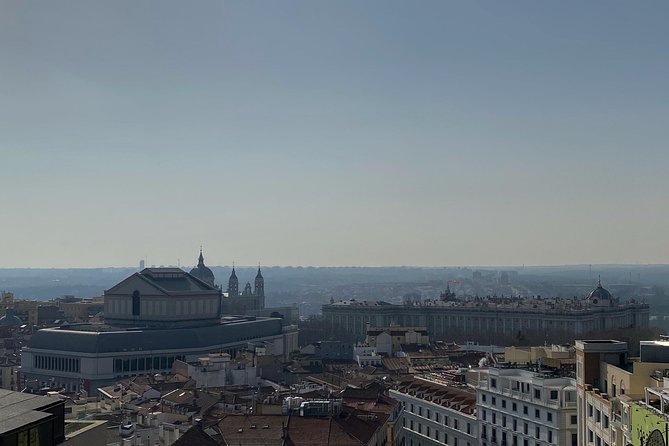
The meeting point is at Plaza de Isabel II, beside Teatro Real. The opera house is a useful opening because it introduces Madrid as a royal capital shaped by major public projects. You spend about ten minutes looking at the building and discussing its history.
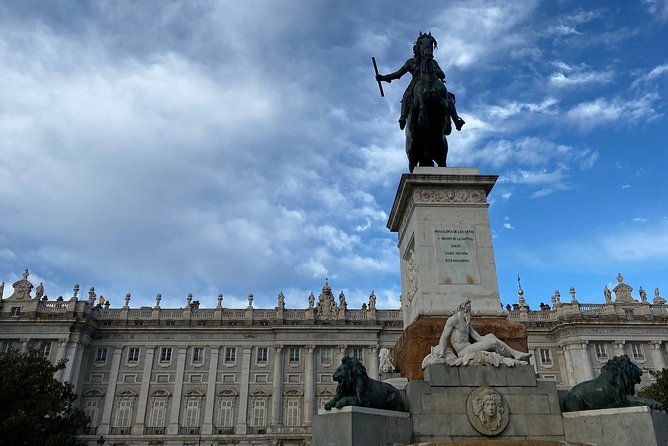
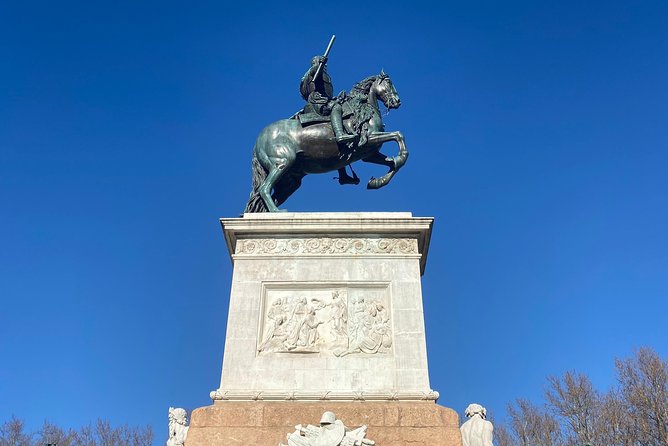
From there, the walk continues to Plaza de Oriente. The square gives the guide room to explain how the area developed from the Arab period to the present day. This is an important early stop because it sets up the tour’s central idea: public spaces change as rulers, military needs, transport, and civic ambitions change.
You should not expect a long interior visit at either opening stop. These are short orientation points, designed to help you read the city around you before the route turns toward the palace and older streets.
Reading the Royal Palace from the outside
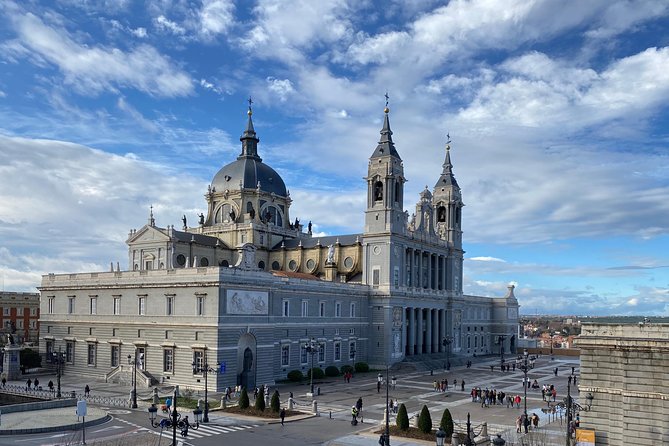
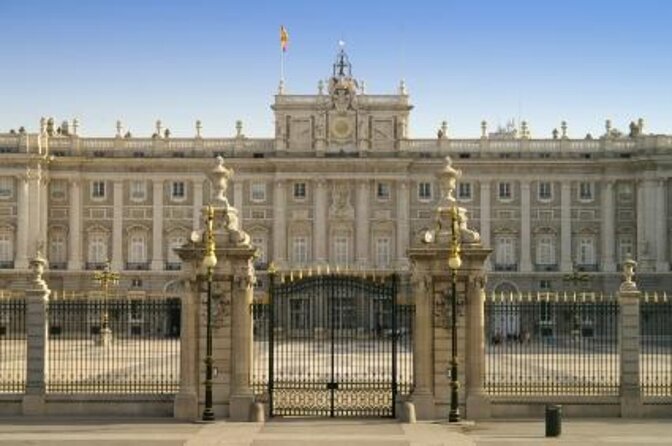
The Royal Palace of Madrid receives only about ten minutes on the schedule, but the stop is meant to cover every facade and the different architects and kings connected with the project. The interior is not included, and admission is not part of the tour.
That limitation is worth noting. If your priority is the palace’s rooms, paintings, and royal collections, you will need a separate visit. Here, the focus is on the building as part of Madrid’s urban design and royal history.
I like the outside-only format for this particular walk because it keeps the route moving. You can study the palace’s position in relation to Plaza de Oriente and the surrounding streets, then continue into smaller historic spaces. Still, ten minutes passes quickly, so anyone wanting a detailed architectural reading of every facade may want to ask questions as the guide goes.
Plaza de Ramales and Madrid’s church history
At Plaza de Ramales, the route turns toward a more intimate piece of Madrid. You see the remains of the Church of San Juan, where the painter Velázquez was buried, along with the Church of Santiago.
This is the sort of stop that can easily be missed without a guide. There is no grand monument demanding attention, yet the site connects Madrid’s religious buildings with one of Spain’s best-known painters. The physical remains also show how the city’s past can survive in partial form rather than as a complete building.
The nearby Real Iglesia Parroquial de Santiago y San Juan Bautista receives a shorter visit of about five minutes. It is dedicated to the apostle Santiago, and the stop adds another layer to the religious and civic story of this district.
The short timing suggests that these churches are viewed as part of the larger route rather than explored at museum length. If you prefer long interior visits, the schedule may feel brisk. If you like seeing several sites and learning why they matter, the variety works well.
A few more architecture tours in Spain worth a look
- Barcelona: Sant Pau Recinte Modernista Entry Ticket
★ 4.6 · 2,567 reviews - Barcelona: Sagrada Familia, Modernism, and Old Town Tour
★ 4.7 · 1,621 reviews - Ramblas, Old Town, Gothic and Gaudi Architecture Walking Tour
★ 5.0 · 723 reviews - Valencia: Art & Architecture Guided Tour with Monuments Tickets
★ 5.0 · 255 reviews
San Nicolás and the oldest church on the route
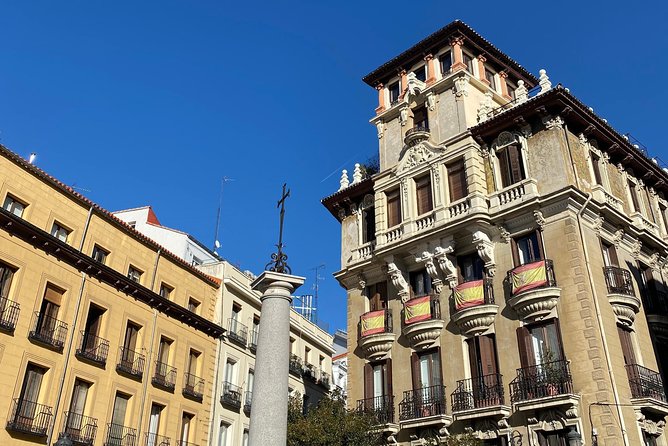
The Church of St. Nicholas of the Servitas is one of the most distinctive stops. The tour describes it as the oldest church in Madrid, with a Mudéjar tower marked by horseshoe arches.
That tower is a strong example of why an architect-led walk can help. The shape of an arch is not just decoration. It points toward the city’s Islamic and medieval building traditions, and it gives you a way to see Madrid as a place where different periods overlap.
The visit lasts about five minutes, so you should think of it as a focused look rather than a full church tour. The value comes from knowing what to notice: the tower, the arches, and the survival of an early form within the modern city.
La Almudena and the Arab Wall
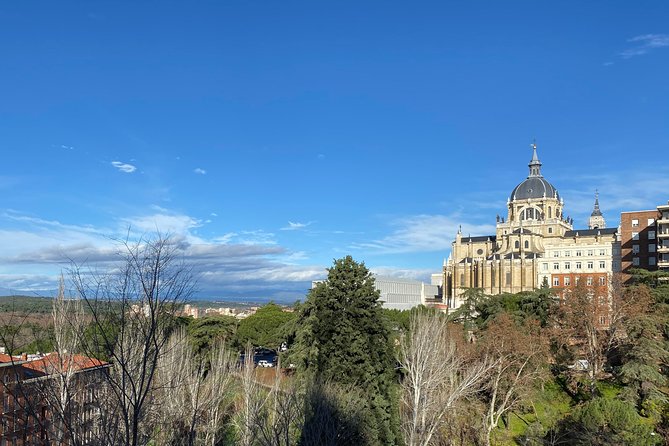
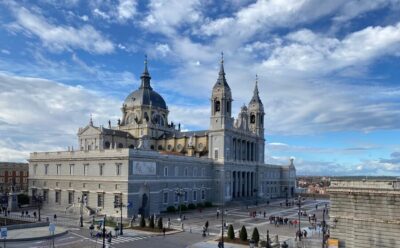
At the Museo de la Catedral de la Almudena, the guide explains the history of the Cathedral of La Almudena from a viewpoint. The stop lasts about five minutes and is mainly about context rather than entering the cathedral museum or completing an interior visit.
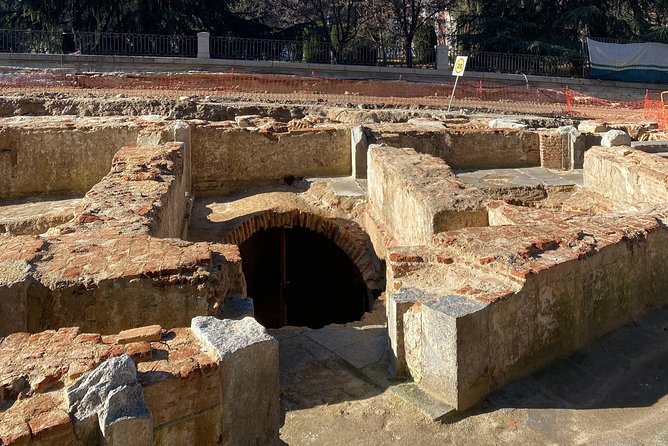
This part of the walk leads naturally to the Arab Wall, one of the most important surviving traces of early Madrid. The wall dates from the ninth century, and the tour uses the remains to explain the city’s origins under Muslim rule.
For me, this is one of the route’s most valuable sections because the Arab period can be easy to overlook in a city often associated with Habsburg and Bourbon monuments. The wall gives the early settlement a physical presence. It also makes the later growth of Madrid easier to understand.
The remains are limited, so do not expect a long fortress visit. Their importance lies in what they reveal about the scale and age of the original settlement. A guide who can place those stones within the city’s later expansion adds real value.
Plaza de la Villa and Madrid’s civic center
Plaza de la Villa is one of the route’s best stops for understanding civic Madrid. You see the old city hall and the buildings around the square, including Casa de Cisneros and Casa de los Lujanes.
The square brings several architectural periods into one compact space. Instead of seeing a palace or church in isolation, you can compare domestic, civic, and aristocratic buildings within the same historic setting.
This is also where the tour’s use of plans and historical photographs should be especially useful. Urban spaces are hard to read from the pavement alone. Old images can show how entrances, streets, and building functions changed over time.
The ten-minute stop is short, but it gives you a practical way to look at Madrid’s old center. Rather than simply admiring a picturesque square, you learn how government and private power occupied the same streets.
A pause at Mercado de San Miguel
Mercado de San Miguel provides a change of mood. The market is known for its iron structure, described here as the only market in Madrid with that type of construction. You have about ten minutes to stop, and you can buy a drink or tapas.
This is a useful point in a three-hour walk. A quick food or coffee break gives you time to rest and talk with the guide, especially since one participant enjoyed pausing for coffee and conversation midway through the longer tour.
Do keep expectations practical. Ten minutes is enough for a brief stop, not a full market meal. If you want to sample several tapas, you may need to return later. The market works best here as a living part of the city rather than simply another monument.
Plaza Mayor and Puerta del Sol
The final major historic space is Plaza Mayor, Madrid’s social and commercial center for roughly four centuries. The guide places it within the tradition of large Castilian squares, so you learn not only what surrounds the plaza but also how this kind of public space functioned.
Plaza Mayor is a fitting end to the architectural story. The route has moved from an early fortified settlement through royal projects, churches, civic buildings, and commercial life. Here, the city’s public identity becomes easy to see.
The listed route also includes Puerta del Sol and Kilometer 0, with a five-minute stop. Sol is one of Madrid’s key reference points and offers a clear connection between the historic center and the modern city.
There is a small practical point to confirm before you go. The tour information names Plaza Mayor as the ending point, while the stop sequence places Puerta del Sol after it. Ask the operator to confirm the exact final meeting location for your date, particularly if you have a reservation, taxi, or timed activity afterward.
How the timing feels on foot
The official duration is about three to three and a half hours. The individual stop times add up to less than the full duration, so the remaining time is used for walking, explanations, questions, and transitions between sites.
That makes this more than a string of five-minute photo stops. You should expect a sustained walk through central Madrid, with plenty of spoken interpretation between landmarks. Comfortable shoes are a sensible choice, though the supplied information does not specify the exact walking distance.
The pace can also be shaped by the private format. The guide can respond to your interests, and one account describes a coffee pause during a tour lasting more than three hours. At the same time, one participant left two and a half hours early because of cold weather, which is a reminder to dress for the conditions. Poor weather can also cause the experience to be canceled or moved.
Price, private format, and who gets the most value
At $65.89 per person, this tour makes the most sense for people who want a guide’s full attention and a clear historical framework. Since only your group participates, you are not joining a large public walk with a fixed audience and little room for questions.
The price does not include palace admission, interior visits, food, drinks, or tips. That keeps the tour focused, but you should budget separately if you want to visit the Royal Palace inside or stop for tapas at Mercado de San Miguel.
I would recommend it most strongly to:
- Architecture students and design-minded visitors
- First-time visitors who want Madrid’s historic center explained
- Small groups who enjoy asking questions
- People interested in how politics and religion shaped buildings
- Repeat visitors who have already seen the main sights and want more context
It may be less suitable if you want a fast highlights walk, a palace interior visit, or a tour focused only on building materials and styles. The guide’s method treats history, society, and architecture as connected subjects.
The experience is offered in English. Mobile tickets and group discounts are available. Confirmation normally arrives at booking, though reservations made within one day of departure are confirmed as soon as possible, depending on availability. Service animals are allowed, public transport is nearby, and the activity is described as suitable for most people.
My recommendation for Madrid visitors
I would book this walk if you want to understand how Madrid grew, not just photograph its famous squares. The Arab Wall, San Nicolás tower, Plaza de la Villa, and the palace facades give you a useful sequence of visual clues, while the plans and historical photographs help turn those clues into a coherent story.
The main choice is about style. You should book if you enjoy a patient guide, historical explanation, and architectural detail woven together. You should skip it if you want extensive time inside monuments or a short, light introduction.
The 4.9 rating from 21 published ratings and the 95 percent recommendation figure point to a strong record, especially for Emilio’s preparation, humor, and command of Madrid’s past. Just remember that the tour is serious about context. Bring comfortable shoes, allow the full three to three and a half hours, and confirm the final stop before setting your next appointment.
FAQ
How long does the Madrid historic architecture tour last?
The experience lasts approximately three to three and a half hours.
Where does the tour start?
It starts at Plaza de Isabel II, 4, in Madrid’s Centro district, near Teatro Real.
Where does the tour end?
The tour information names Plaza Mayor as the end point, while the route also includes a final stop at Puerta del Sol. Confirm the exact end point with the provider before departure.
Is admission to the Royal Palace included?
No. The tour examines the Royal Palace from the outside, and interior admission is not included.
Is this a private tour?
Yes. Only your own group participates.
What language is offered?
The tour is offered in English.
Can I cancel for a full refund?
Yes, if you cancel at least 24 hours before the experience start time. Cancellations made less than 24 hours in advance are not refunded. Poor weather or failure to meet the minimum number of participants may lead to a rescheduled experience or full refund.
Just added in Spain
- Gaudí and Modernist Art: Guided Tour in Palma de Mallorca★ 4.5 · 3 reviews
- Self-Guided Audio Tour-The Surrealist Barcelona of Dalí and Gaudí★ 3.5 · 8 reviews
- Visit to the Modernist houses of the Americans★ 5.0 · 2 reviews
- Roman & Gotic & Gaudi in Barcelona: private walking tour★ 4.5 · 2 reviews
- Barcelona Gaudi Tour: Sagrada Familia, Casa Batllo & Casa Mila★ 5.0 · 4 reviews
- Barcelona Street Escape: Gaudi and the Hidden Treasure★ 5.0 · 17 reviews
- Gaudí & Catalan Modernism Private Walking Tour★ 5.0 · 11 reviews
- Sagrada Familia Private Tour – Unlock the mysteries of Gaudi★ 5.0 · 10 reviews
Madrid Architecture Tours, compared.
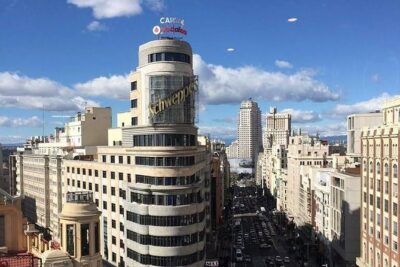
Architecture tour Gran Vía from its best rooftops 20thC
Read our review →
Architour through Lavapiés and Rastro with an architect
Read our review →
Browse the lists this tour appears in