
REVIEW · WALKING TOURS
Downtown Freedom Trail Walking Tour – History & Architecture
Boston’s past is under your feet. This compact walking tour links Faneuil Hall, the Old State House, and Boston Common while a guide explains how protest, religion, immigration, and architecture shaped the city. I like the clear downtown route and the chance to see many important sites in only 70 minutes. I also like the small-group limit of 20 people, which can make it easier to hear and ask questions. The main concern is that guide quality can vary, and some people have found the narration hard to hear.
The $45 price is fair if you want context instead of simply following the red brick line on your own. You will see more than famous buildings, including the Boston Massacre site, the Old Corner Bookstore, Boston Latin School’s original location, and the graves of Paul Revere, Samuel Adams, and John Hancock. Still, this is a brisk overview, not a full Freedom Trail tour, and it does not include interior admissions.
Key things to know before you book
- The route covers Faneuil Hall to Boston Common: You see a dense run of Boston landmarks without spending half a day on your feet.
- The tour joins history with architecture: Expect stories about revolution, religion, immigration, civic life, and the buildings that housed them.
- The group is limited to 20 people: This is a useful size for an outdoor walking tour, though hearing depends on the guide’s voice and the street noise.
- The Old State House is a major stop: Its balcony was the site of the first Boston reading of the Declaration of Independence.
- The finish is near Brewer Fountain: The tour ends at Boston Common, not back at the starting point.
- The guide style is not theatrical: You may get a funny, engaging history lesson, but guides do not necessarily wear period costumes or perform characters.
What this 70-minute Boston tour really covers
The Downtown Freedom Trail Walking Tour begins at 10:00 a.m. at State Street and Congress Street, a central spot near the early commercial and political heart of Boston. From there, the walk moves through the historic core toward Boston Common and the newer State House.
I see the route as a smart introduction for a first visit. Boston’s historic center is compact, but the sites can blur together when you encounter them on your own. A guide gives you a sequence: marketplace, protest, colonial government, religion, education, immigration, burial ground, and modern civic life.
The tour lasts about 1 hour and 10 minutes. That length is one of its strongest features. You get a useful orientation without committing to a long morning walk. The tradeoff is pace. You will stop for explanations and photographs, but this is mainly a street-level tour. It is not designed for long interior visits.
The route is offered in English, and mobile tickets make arrival simple. The maximum group size is 20. That is small enough to feel manageable, though you should stay close to the guide, especially in busy downtown areas.
More walking tours in the USA:
- The Official Art Deco Walking Tour by The Miami Design Preservation League
★ 5.0 · 1,580 reviews - Chicago in a Day: Food, History & Architecture Walking Tour
★ 5.0 · 1,153 reviews - Miami South Beach Art Deco Walking Tour
★ 5.0 · 1,039 reviews
Faneuil Hall and Quincy Market: Boston’s public stage
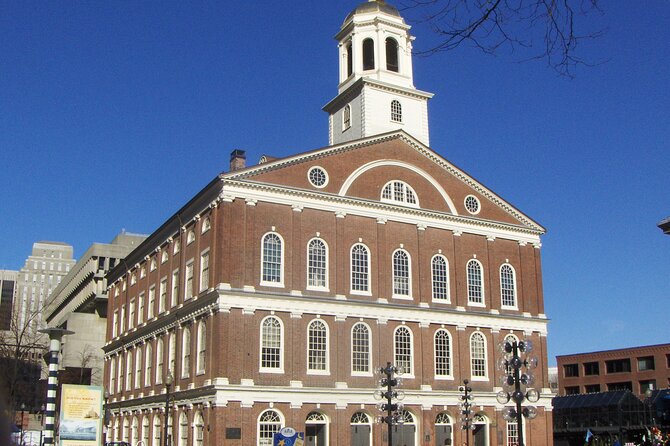
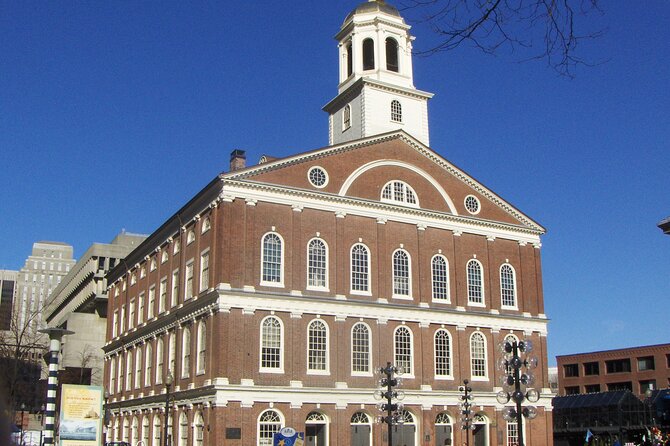
Faneuil Hall is the natural opening chapter. Often called the Cradle of Liberty, it hosted heated colonial protests that helped push Boston toward revolution. Your guide points out the grasshopper weathervane above the building, a detail easy to miss if you are focused on the pavement.
The value here is not just seeing an old meeting hall. Faneuil Hall shows how public space became political space. Merchants, residents, and political voices gathered in places like this to argue over taxes, British rule, and the future of the colonies.
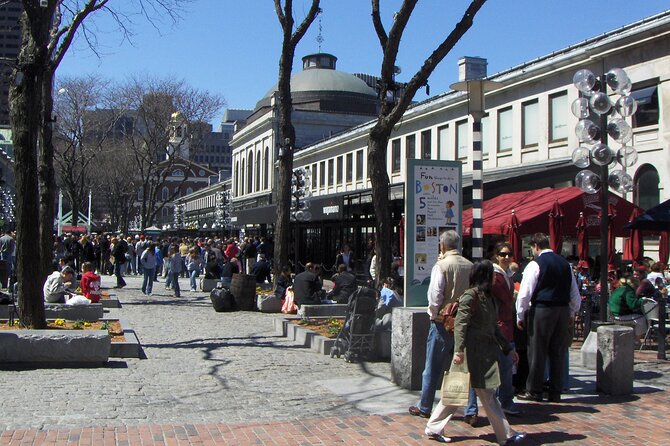
Quincy Market is nearby, adding a more everyday side to the area. It is a useful contrast with the formal civic buildings later in the walk. You see where commerce and public debate met in the same part of town.
The drawback is crowd noise. This area can be busy, and a guide without a microphone may be difficult to hear. Stay near the front of the group and ask the guide to repeat anything you miss.
The Old State House and Boston Massacre Site
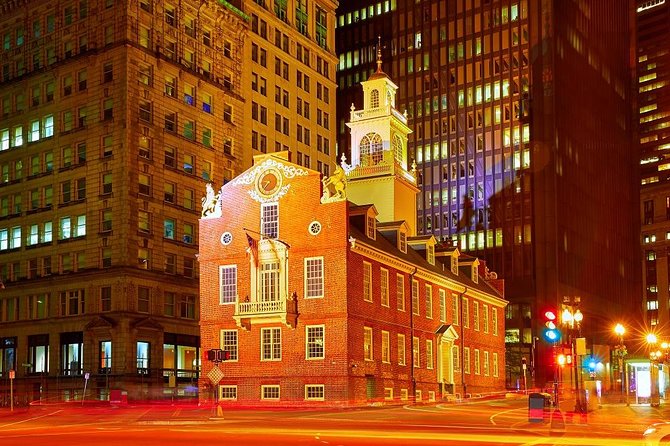
The Old State House, built in 1713, is one of the tour’s most important stops. It served as the center of British colonial government, and its balcony became the place where the Declaration of Independence was first read to Bostonians.
The building gives you a clear way to understand the political tensions of the period. British authority was not an abstract idea. It operated from this building, in the middle of a town where colonists were increasingly challenging that authority.
Just outside, a cobblestone ring marks the Boston Massacre site. In 1770, a confrontation between British soldiers and colonists ended with five colonists killed. The small marker can seem modest, but the event became a powerful piece of revolutionary propaganda and helped turn public anger against British rule.
This part of the walk is especially useful if you know the names from school but want to connect them to actual places. The guide can explain the sequence of events while you look at the streets and buildings where the conflict unfolded.
Old South Meeting House and the road to protest
The Old South Meeting House is a massive brick church with a major place in Boston’s revolutionary story. Signals connected with the Boston Tea Party were given here in 1773, making the building a key stop for anyone interested in the events leading to independence.
A good guide helps you see the meeting house as more than a church. It was a place where large crowds could gather, hear arguments, and make political decisions. That public role is central to understanding why Boston became such an important revolutionary city.
The tour also passes the Old Corner Bookstore at 283 Washington Street, at the corner of School Street. Built in 1718 as a residence and apothecary shop, it became a bookstore in 1828. Ralph Waldo Emerson, Charles Dickens, and other well-known authors gathered there.
The building is a fine reminder that Boston’s story did not end with the Revolution. Literature, publishing, religion, business, and politics all occupied the same tight downtown streets. You may not spend long at the site, but it adds welcome variety to the tour.
More history tours in the USA:
- Charleston’s Best Highlights: History, Culture & Architecture
★ 5.0 · 422 reviews - Palm Springs Modernism Architecture & History Bike Tour
★ 5.0 · 359 reviews - Charleston: History and Architecture Guided Walking Tour
★ 4.8 · 349 reviews - Historic Georgetown: History, Gossip, & Architecture Walking Tour
★ 5.0 · 321 reviews
Old City Hall, Boston Latin School, and the Irish Famine Memorial
Old City Hall at 45 School Street housed Boston’s city council from 1865 to 1969. Its French Second Empire design makes it one of the more distinctive architectural stops on the route.
This is where the architecture theme becomes especially useful. The tour is not only about colonial brick buildings and revolutionary events. You also see how Boston expressed civic pride in the 19th century, when the city was growing and its institutions were taking on a grander public image.
Nearby, a statue of Benjamin Franklin and a sidewalk mosaic mark the original location of Boston Latin School. Founded in 1635, it was the first public school in America. The Puritan founders created it to provide free classical education for boys.
For families, this can be one of the easiest stories to discuss with children. It connects a famous person, an old school, and the idea of public education to one ordinary-looking downtown sidewalk. The original school building is gone, so the site is marked rather than preserved as an interior attraction.
The Boston Irish Famine Memorial adds a later chapter. Its two groups of statues contrast an Irish family suffering during the Great Famine of 1845 to 1852 with a prosperous family that immigrated to America. It is a direct reminder that Boston’s identity was shaped by migration as much as by revolution.
King’s Chapel and the Omni Parker House
King’s Chapel brings you back to Boston’s religious and colonial past. Founded in 1686, the church has witnessed the American Revolution, the creation of the United States, and major changes in the city over more than three centuries.
Even if you do not enter, the stop helps explain the layered character of Boston. Churches here were places of worship, social order, political influence, and community memory. The building’s long life gives your guide plenty of ways to connect the colonial period with the modern city.
The route also passes the Omni Parker House, founded by Harvey D. Parker in 1855. It is the oldest continuously operating hotel in the United States, and it has hosted every U.S. president since Ulysses S. Grant, according to the tour information.
The hotel is also associated with Boston Cream Pie, Parker House Rolls, and the word scrod. Those food connections provide a welcome change after several political and religious stops. They are small details, but they help make the city’s past feel human rather than purely ceremonial.
Tremont Temple and Boston’s changing civic life
Tremont Temple began in 1839 as the Free Baptist Church. Its story is tied to Timothy Gilbert, who left Charles Street Baptist Church after the congregation objected to his inviting a Black family into his pew.
In 1843, Gilbert purchased the Tremont Theater, using $55,000 of his own money. The church offered open attendance without charge and became known as the first integrated church in America. Its halls also hosted public events, including an Egyptian mummy display in 1850 and speeches against slavery by figures such as Frederick Douglass and Sam Houston.
This is one of the tour’s most useful stops because it broadens the meaning of Boston history. The city’s past is not only Paul Revere, tea, and battles. It also includes debates over race, religion, public access, and abolition.
If your main goal is a strict account of the American Revolution, this stop may feel like a detour. I think it improves the tour by showing how Boston continued wrestling with national issues after independence.
Granary Cemetery and the final walk to Boston Common
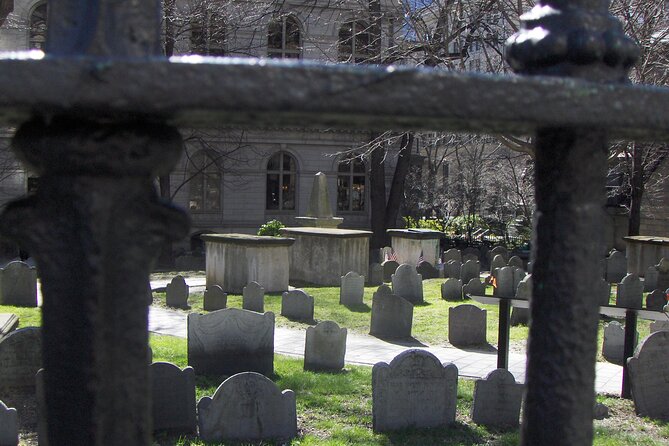
Old Granary Cemetery is the burial place of Paul Revere, Samuel Adams, and John Hancock. It is one of the most visited cemeteries in the country, and the names alone make it a central Freedom Trail stop.
The cemetery is more than a list of famous graves. It shows how the new nation created public memory. The people buried here became symbols of independence, and the cemetery helped later generations connect the Revolution to real individuals.
From here, the walk continues toward Park Street Church and Boston Common. Park Street Church is a large brick church associated with the signals that helped begin the Boston Tea Party in 1773. Its location near the Common makes it a strong bridge between revolutionary events and Boston’s public park.
Boston Common covers 50 acres and is the oldest city park in the United States. It is bounded by Tremont Street, Park Street, Beacon Street, Charles Street, and Boylston Street. The tour ends near Brewer Fountain, giving you a practical place to continue exploring.
The route’s finish is helpful for first-time visitors. From Boston Common, you can pause, rest, or continue toward other parts of central Boston. Just remember that the tour does not return to State Street.
The New State House and the architecture angle
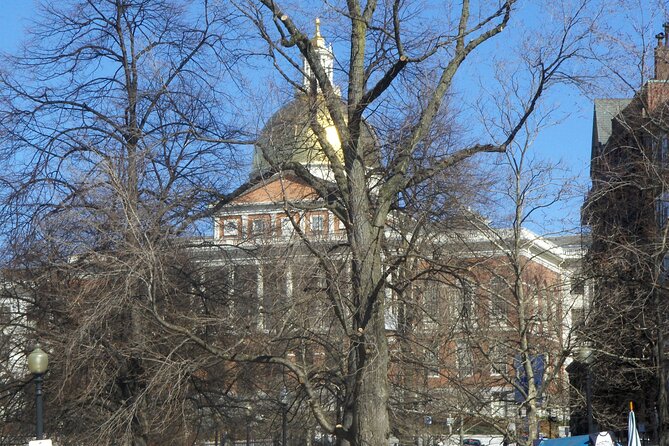
The New State House, built in 1798, is easy to recognize by its 23-karat gold dome. It overlooks Boston Common and remains the seat of Massachusetts government.
The building is called new only in relation to the Old State House. That contrast gives the tour a simple architectural timeline: colonial government in the Old State House, then the government of a new American state in the building near Beacon Hill.
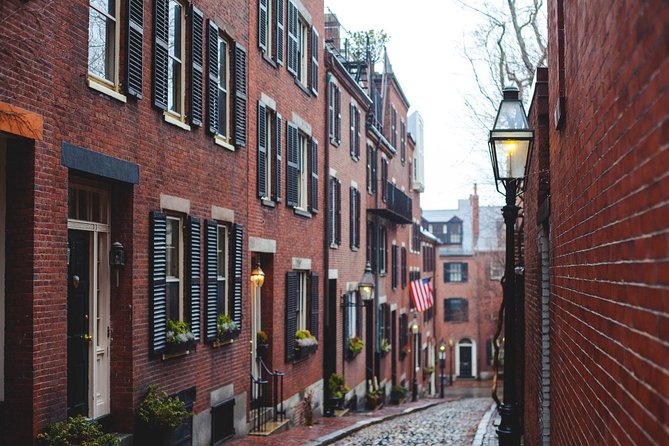
Architecture is a real part of this experience, not decoration added to a history walk. The route includes colonial structures, church buildings, a French Second Empire civic building, historic commercial buildings, a cemetery, and the state capitol. If you enjoy noticing materials, styles, and changing civic ambitions, you will get more from the tour than someone looking only for famous names.
Some people may want more detail about the buildings themselves, while others may prefer more stories about the people. The balance depends on the guide. Alan has been praised for combining history, architecture, humor, and modern context. Andrew has also earned strong praise for an educational and funny presentation. But guide delivery is not perfectly consistent, and one particularly poor experience involved a guide who spoke too softly and offered too little information.
Guide quality, group size, and the pace
The best guides on this tour make the facts easy to follow and bring children into the conversation. One guide adjusted well when a family got lost on the way to the meeting point. Another involved an 11-year-old in the discussion, which can make a long list of dates much easier for a family to handle.
The small-group limit matters. A group of up to 20 is more personal than a large city walk, and the guide can usually respond to questions. The downside is that the experience depends heavily on voice projection. Multiple comments point to difficulty hearing at times, especially without a microphone.
I would arrive early and stay close to the guide. If you are traveling with children, tell them before the tour that the guide may ask questions. That can be fun for an outgoing child, but a shy child may prefer simply to listen.
The tone is usually conversational rather than theatrical. You should not book this expecting a costumed performer. If you prefer clear explanations, jokes, and historical connections, that style may suit you better.
Is $45 a fair price?
At $45 per person, the tour is reasonably priced for a guided downtown orientation. You cover many major sites in 70 minutes, including Faneuil Hall, the Old State House, the Boston Massacre site, Old South Meeting House, King’s Chapel, Old Granary Cemetery, Park Street Church, the New State House, and Boston Common.
The value comes from interpretation. You can walk past these places for free, but it is harder to understand how they connect. The guide turns a line of landmarks into a story about power, protest, faith, education, immigration, and public memory.
The price is less attractive if you want interior access or a slow visit at each site. Admission tickets are not included, and the experience is primarily an outdoor walk. There has also been confusion for at least one person about an extra $15 charge for continuing beyond Boston Common on a longer tour. Confirm exactly which version you are booking before paying for any extension.
Weather, clothing, and practical planning
The tour starts at 10:00 a.m. and runs in English. It operates in all weather conditions, so wear suitable clothing and shoes. The cancellation terms also say that poor weather can lead to a cancellation, with a different date or full refund offered, so check for updates if conditions are severe.
The tour is near public transportation, and most people can participate. Children must be accompanied by an adult. There is no need to plan around a long-distance transfer, but you should allow time to find the State Street and Congress Street meeting point.
The route ends at Brewer Fountain on Boston Common. Plan your next activity from there rather than assuming you will return to the starting point.
Free cancellation is available up to 24 hours before the start time. Within 24 hours, the payment is not refunded, and changes are not accepted.
Who should book this Boston walk?
I would choose this tour if you are visiting Boston for the first time, want a fast orientation, or enjoy history with a side of architecture. It also works well for families who want a short activity with plenty of recognizable names and open-air stops.
History fans should enjoy the Old State House, Boston Massacre site, Old South Meeting House, Granary Cemetery, and Tremont Temple. Architecture fans will appreciate the range from colonial buildings to the French Second Empire Old City Hall and the gold-domed New State House.
I would hesitate if you need a very slow pace, a microphone, or a fully scripted presentation. I would also look elsewhere if you want the entire Freedom Trail in one booking. This walk covers the downtown section from Faneuil Hall to Boston Common, not every historic stop in Boston.
Should you book the Downtown Freedom Trail Walking Tour?
Book it if you want a compact, fairly priced introduction to Boston’s historic center and you value a guide’s stories over interior visits. The strongest guides, including Alan and Andrew, add humor, human detail, and useful links between architecture and events.
Skip it if you expect a costumed performance, a full-day history program, or guaranteed amplification. Arrive early, stay near the guide, dress for the weather, and treat the 70 minutes as an orientation. Afterward, you can return to the places that caught your attention and explore them at your own pace.
FAQ
Where does the tour begin?
The tour begins at State Street and Congress Street in Boston, Massachusetts.
What time does the tour start?
The scheduled start time is 10:00 a.m.
Where does the tour end?
It ends at Brewer Fountain on the Freedom Trail near Boston Common.
How long does the tour last?
The walking tour lasts approximately 1 hour and 10 minutes.
What language is the tour offered in?
The tour is offered in English.
What landmarks are included?
The route includes Faneuil Hall, Quincy Market, the Old State House, the Boston Massacre site, Old South Meeting House, Old Corner Bookstore, Old City Hall, Boston Latin School’s original site, King’s Chapel, Tremont Temple, Old Granary Cemetery, Park Street Church, the New State House, and Boston Common.
Is the tour suitable for children?
Yes. Most people can participate, but children must be accompanied by an adult.
What happens if I need to cancel?
You can cancel up to 24 hours before the start time for a full refund. Cancellations or changes made within 24 hours are not refunded or accepted. If the tour is canceled because of poor weather or too few bookings, you will be offered another date or a full refund.
Just added in the USA
- Wilmington History and Architecture Tour★ 4.8 · 18 reviews
- New Orleans : Garden District Architecture Walking tour★ 4.8 · 5 reviews
- Washington DC: Dupont Circle & Embassy Row Architecture Tour★ 5.0 · 6 reviews
- Washington, DC: Georgetown Architecture Walking Tour★ 5.0 · 8 reviews
- Private Colonial Williamsburg Architectural Tour★ 5.0 · 5 reviews
- Tulsa: Art Deco Walking Tour of Tulsa★ 5.0 · 8 reviews
- Monuments and Memorials Architectural Walking Tour★ 5.0 · 17 reviews
- Castle to Capitol: Museums of the National Mall Architecture Tour★ 4.5 · 9 reviews
Walking Tours, compared.

The Official Art Deco Walking Tour by The Miami Design Preservation League
Read our review →
Baroque Architecture and Underground Walking Tour
Read our review →
Chicago in a Day: Food, History & Architecture Walking Tour
Read our review →

Ramblas, Old Town, Gothic and Gaudi Architecture Walking Tour
Read our review →
Chicago’s Secret Interiors Architectural Walking Tour
Read our review →
Browse the lists this tour appears in