
REVIEW · WALKING TOURS
Downtown Austin Historical Architecture Walk
Austin’s past is written in stone. This 1-hour-45-minute walk links the Capitol, Victorian homes, Art Deco offices, a cathedral, and grand old theaters in one compact route. I like the clear architectural story, which moves from government buildings to homes and then to commercial Austin. I also like that you go inside the Driskill, rather than viewing every building from the sidewalk.
The walk is small enough for real conversation, with a maximum of 25 people. Guide Emily has earned praise for answering detailed questions and adding extra stops for people who want more. The main drawback is simple: you spend most of the time outdoors, and several buildings are viewed only from outside, so hot or rainy weather can affect the experience.
Key points at a glance
- Eight central Austin landmarks: The route covers the Driskill, Bremond Block, Travis County Courthouse, Governor’s Mansion, State Capitol, Saint Mary Cathedral, Capitol Complex Visitors Center, and Paramount Theatre.
- The Driskill is the indoor highlight: This is the one scheduled stop where you go inside and hear about the building’s changing architectural story.
- Bremond Block brings the city’s homes to life: You stroll past a well-preserved group of Victorian houses built after the Civil War.
- A useful mix of styles: Government architecture, Victorian design, pre-Depression Art Deco, theatrical ornament, and unusual state construction all appear within one walk.
- A good first-day activity: The guide also offers suggestions for local places to visit, which can help you shape the rest of your Austin stay.
- A short, focused morning: The 9:45 am start and return to 103 E 5th Street make this easy to fit around other plans.
Why this Austin walk works so well
I like tours that give a city a shape. This one does that by arranging Austin’s buildings in a loose historical progression. You begin near the center of state power, move through private homes, then finish among theaters and commercial buildings.
That sequence matters. Instead of seeing eight unrelated sights, you get a lesson in how downtown Austin changed. Government buildings from 1856 to 1933 show formal civic ambition. The Bremond Block reveals the city’s residential side. The final stops explain how commerce, entertainment, religion, and state administration shared a relatively compact center.
The tour costs $56, which is not the cheapest way to take a walk through downtown. But the value depends on how much you want from the buildings. If you simply want to photograph the Capitol, you can do that for free. If you want someone to explain why these buildings look the way they do, answer questions, and connect them to Austin’s growth, the price becomes easier to justify.
The group limit of 25 is also useful. That is large enough to keep the tour lively, but small enough for questions to be practical. One especially strong point is the guide’s teaching style. Emily has been praised for handling questions from a historic preservationist and an architect, then taking them to extra places because she knew they would appreciate them. That suggests a flexible approach rather than a rigid speech.
More walking tours in the USA:
- The Official Art Deco Walking Tour by The Miami Design Preservation League
★ 5.0 · 1,580 reviews - Chicago in a Day: Food, History & Architecture Walking Tour
★ 5.0 · 1,153 reviews - Miami South Beach Art Deco Walking Tour
★ 5.0 · 1,039 reviews
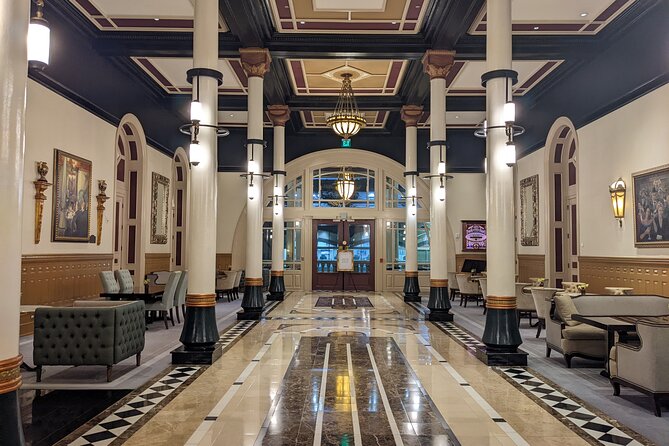
Starting at the Driskill on East Fifth Street
The meeting point is 103 E 5th St., and the tour begins at 9:45 am. The Driskill is the first major stop, and it is the only place on the route that you enter.
That choice is smart. A walk that only points at facades can feel thin, especially at $56. Going inside gives the tour a change of pace and lets you examine architectural details at close range. You spend about 20 minutes here, learning what inspired the building and how its design has changed through the years.
The Driskill also has the kind of unusual past that makes an opening stop work well. The supplied description calls its history wild, and the guide uses the building to show how architecture can carry several eras at once. You are not just looking at a hotel entrance. You are considering why its design was created, how it has aged, and what it says about Austin at different points in time.
Because this is the indoor portion, it can also provide a short break from the weather. Still, do not mistake the stop for a full interior tour. The planned time is about 20 minutes, and the experience remains a walking tour rather than a detailed examination of every room.
Bremond Block and Austin’s Victorian homes
From the Driskill, the route turns toward the Bremond Block. This is one of the best stops for people who want to see domestic architecture rather than public monuments.
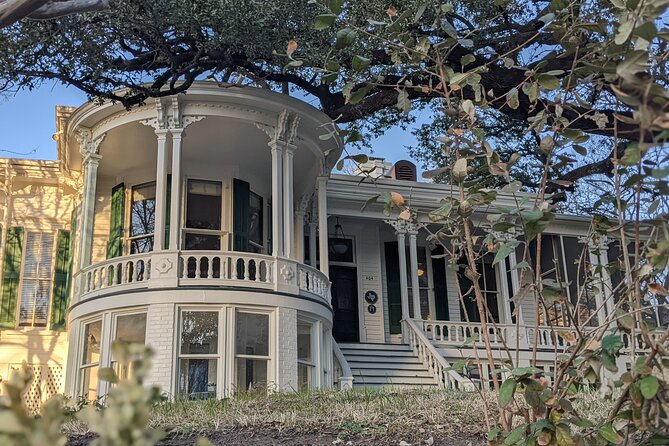
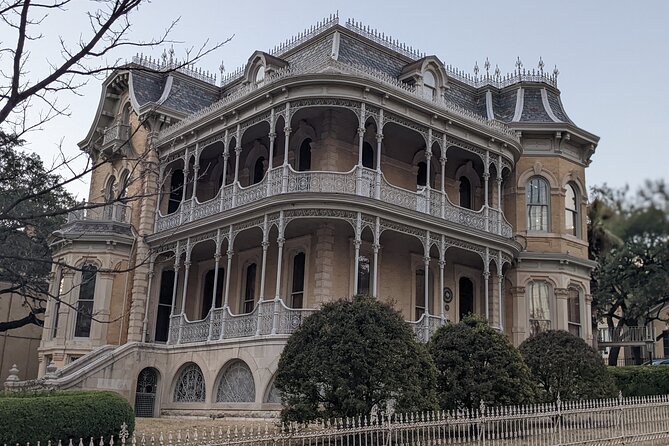
You take a stroll around a well-preserved block of Victorian homes and learn how their designs developed. The houses were built after the Civil War, and their scale and decoration offer a useful contrast to the government buildings nearby. Here, architecture is tied to private life, social position, and changing taste.
The Bremond Block may be the most memorable part of the route for anyone who enjoys old houses. You get time to look at the group as a whole instead of rushing past one facade. The tour spends about 20 minutes here, matching the Driskill as the longest stop.
I would pay close attention to the way the homes differ from one another. The point is not just that they are Victorian. The guide explains their architectural evolution, which helps you see Victorian design as a collection of choices rather than one fixed look.
This is also where the tour feels most connected to the ordinary shape of a city. The Capitol tells you how Texas presented itself officially. Bremond Block shows how people lived near that center of power. One reviewer even came close to spelling the name correctly as Bremen, so remember the proper name is Bremond Block.
The Travis County Courthouse and pre-Depression Art Deco
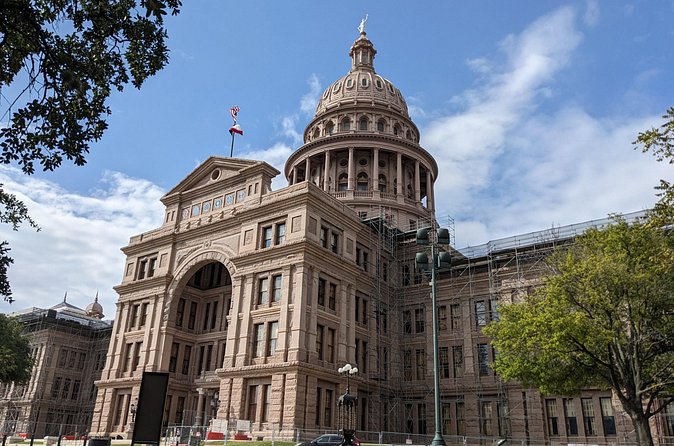
The Heman Marion Sweatt Travis County Courthouse is viewed from outside for about 10 minutes. The focus here is its pre-Depression Art Deco design.
That gives the walk a clear change in mood. Victorian houses tend to invite close attention to ornament and domestic scale. Art Deco brings a more formal, modern look. You can compare the courthouse with the earlier buildings and see how public architecture changed as the city moved into the twentieth century.
The limitation is that you do not go inside. If you want interior courtrooms or a longer discussion of civic functions, this stop will feel brief. Still, 10 minutes is enough for a focused exterior explanation, especially when the tour’s larger goal is to compare styles across downtown.
The courthouse also helps keep the route from becoming a parade of grand nineteenth-century buildings. Austin’s architectural story did not stop with Victorian homes. This stop shows a later period and prepares you for the mix of styles that follows.
More history tours in the USA:
- Charleston’s Best Highlights: History, Culture & Architecture
★ 5.0 · 422 reviews - Palm Springs Modernism Architecture & History Bike Tour
★ 5.0 · 359 reviews - Charleston: History and Architecture Guided Walking Tour
★ 4.8 · 349 reviews - Historic Georgetown: History, Gossip, & Architecture Walking Tour
★ 5.0 · 321 reviews
The Governor’s Mansion and a vanished residential district
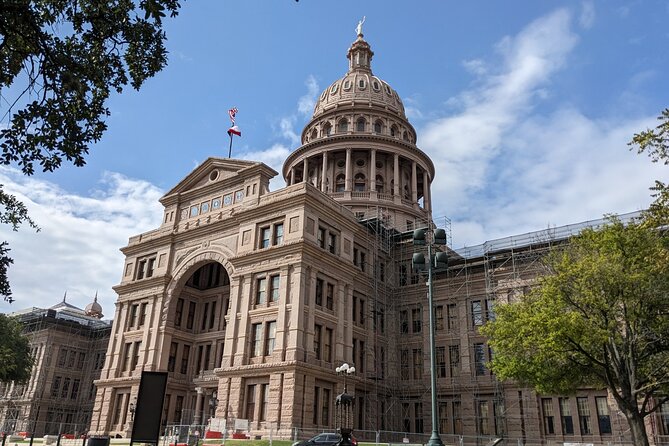
The Texas Governor’s Mansion may seem surprising in this part of downtown. It sits among commercial and government buildings, but the guide explains that the surrounding blocks were once covered with houses. Some were even larger than the mansion.
That context is the real reason to stop here. Without it, you might see the mansion as an isolated official residence. With it, you can picture a very different downtown, one where large homes occupied land now associated with offices, civic buildings, and businesses.
The exterior discussion lasts about 10 minutes. Again, you do not go inside, so this is primarily a lesson in setting and urban change. I like that the guide does not treat buildings as isolated objects. The surrounding blocks matter, and the tour uses the mansion to explain how Austin’s center shifted over time.
For you, this may be one of the most useful stops if you want to understand the city beyond individual landmarks. Architecture is not only about walls and windows. It is also about what replaced the buildings that once stood nearby.
The State Capitol from the south lawn
The Texas State Capitol gets another 10-minute stop, this time from the south lawn. The building is described as the largest state Capitol in the country, and there is clearly more to its architecture than can fit into a short walk.
You will hear only a few of its many stories, but that is probably the right approach. A full treatment would take much longer, and the tour has seven other locations to cover. From the south lawn, the guide can focus on the building’s overall presence and selected architectural details without turning the morning into a single-site visit.
The outdoor setting gives you room to appreciate the Capitol’s size. It also keeps the tour moving. You should not expect an interior Capitol visit or a detailed tour of every chamber. If that is your main goal, plan separate time for it.
Still, the stop has strong value because it anchors the whole walk. The earlier buildings make more sense when you see the scale of the state’s central symbol. The Capitol also ties together the tour’s opening focus on government buildings and its later look at Austin’s broader downtown mix.
Saint Mary Cathedral and unusual construction
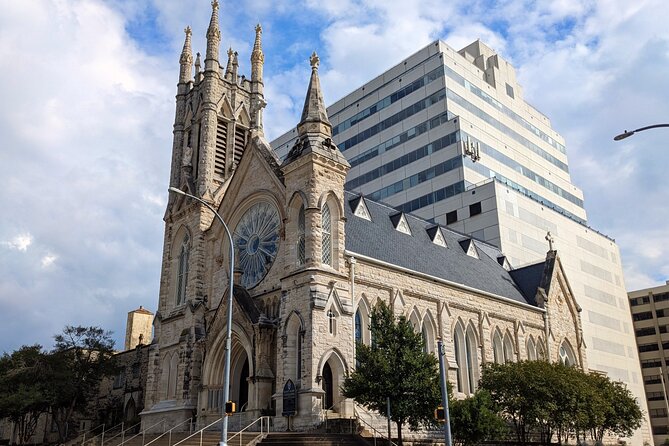
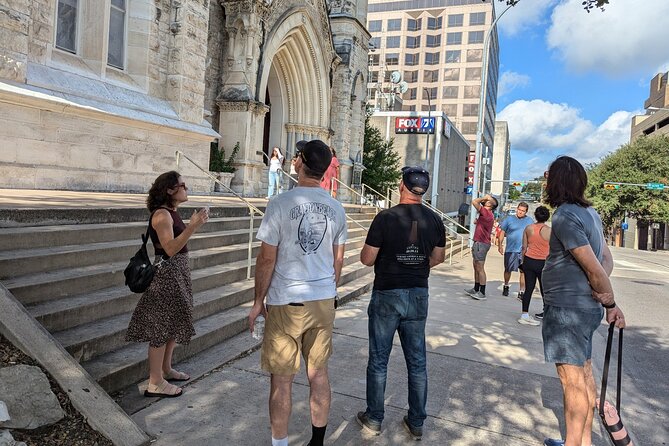
Saint Mary Cathedral is another exterior stop, lasting about 10 minutes. The guide covers the cathedral’s history and its distinctive construction.
The description does not specify the construction method or every feature, so you should expect an explanation rather than a technical building inspection. That restraint is useful. A short stop can introduce the cathedral’s design and place it within the city’s architectural story without pretending to provide a full religious or architectural lecture.
Its presence also broadens the tour. You have already seen government buildings, homes, a courthouse, and a mansion. The cathedral adds a major religious building to the comparison. Look for the ways it differs in purpose and visual language from the civic buildings around it.
As with the courthouse and Capitol, you view Saint Mary Cathedral from outside. If entering the cathedral is important to you, the tour itself does not promise that access.
The Capitol Complex Visitors Center’s unusual profile
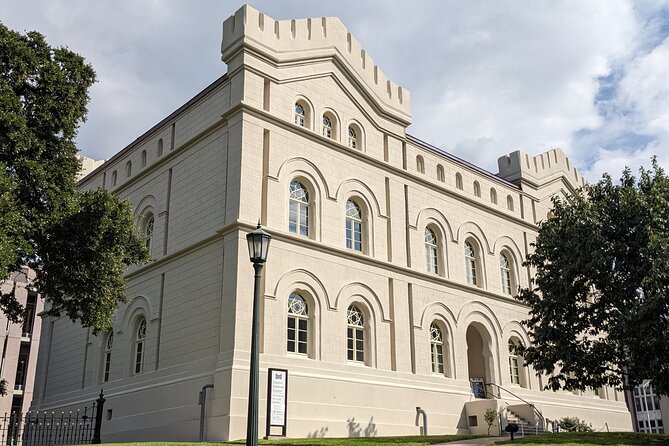
The Capitol Complex Visitors Center gets about 10 minutes from outside. The guide discusses why it does not fit neatly with its neighbors and describes it as the oldest and possibly strangest state building still standing in Austin.
That makes this a good stop for people who enjoy odd architectural details and buildings that resist easy classification. You are not being shown a polished row of matching structures. Instead, the guide points out a building that seems out of place and uses that mismatch as part of the story.
The word strange is doing useful work here. The building is not presented as a standard landmark with an obvious style. Its value lies in the questions it raises: why was it built this way, how did it survive, and why does it look different from nearby state buildings?
The stop is short, so expect a concentrated explanation. It may be less satisfying if you want to enter and inspect the building, but it adds variety to the route and keeps the tour from becoming predictable.
Finishing across from the Paramount Theatre
The final stop is the Paramount Theatre, viewed from across the street for about five minutes. The focus is the theatrical ornament used in its 1915 construction.
This is a fitting ending. After government buildings and homes, the tour finishes with architecture designed to attract attention and suggest entertainment. The Paramount’s ornament is meant to be seen, and the across-the-street position gives you a useful view of the facade.
Five minutes is brief, but the tour has already covered a lot of ground. Think of this as a final visual example rather than a full theater visit. There is no admission to the theater included, and the route does not take you inside.
The Paramount also brings the walk back toward the commercial district mentioned in the overall route. Austin’s architecture here is not only about official buildings or preserved residences. It is also about public amusement and the way businesses used elaborate design to draw people in.
Pace, group size, and physical effort
The full experience lasts about 1 hour and 45 minutes and returns to the starting point. That makes it easy to pair with other plans, though you should leave a little extra time around the scheduled finish if your next activity has a strict start.
You will be outside for most of the walk. The tour requires a moderate level of physical fitness, so expect ordinary urban walking rather than a seated presentation. Wear comfortable shoes, and plan for the weather. The activity requires good conditions and may be canceled if weather makes the walk unsuitable.
The group maximum is 25 people. That is worth noting because architecture tours depend on hearing the guide and being able to stop near a facade without losing the group. A smaller group would feel more intimate, but this limit should still allow questions and conversation.
The tour is near public transportation, which helps if you are staying outside central Austin. Service animals are allowed. Mobile ticketing also keeps the practical side simple.
Who will get the most from this walk
I would recommend this experience most strongly if you enjoy buildings but want more than a photo stop. It suits you if you like comparing styles, hearing how neighborhoods change, and asking questions as you go.
It is also a good fit for:
- First-time Austin visitors who want a quick orientation to downtown
- Architecture students and design fans
- People interested in historic preservation
- Couples or small groups looking for a guided morning activity
- Anyone who wants local suggestions for the rest of the visit
The tour appears able to handle serious questions. Emily was praised for working well with both a historic preservationist and an architect, while also making the experience enjoyable for people with less technical background. That combination is valuable. You can listen casually, or ask for more detail when a building catches your eye.
You may want to skip it if you need extensive interior access. Only the Driskill is specifically entered. The courthouse, mansion, Capitol, cathedral, visitors center, and Paramount Theatre are viewed from outside.
Is the $56 price fair?
At $56, this is a paid interpretation of a mostly free public route. That is not a criticism. The buildings themselves do not require admission during the walk, so the price pays for the guide’s time, structure, explanations, and local perspective.
I think the cost is fair if you would otherwise walk downtown without understanding what you are seeing. It is less compelling if you already know Austin’s architecture or prefer to explore at your own speed.
The strongest value comes from the connections between stops. A casual walk might show you the Capitol and the Driskill. This tour adds the Bremond Block, a courthouse, a mansion, a cathedral, an unusual state building, and the Paramount, then explains how they relate to changing tastes and city growth.
Free cancellation is available up to 24 hours before the 9:45 am start for a full refund. Within 24 hours, the payment is not refunded, and late changes are not accepted. Since the walk depends on good weather, a weather cancellation brings an alternate date or a full refund.
Should you book the Downtown Austin Historical Architecture Walk?
Book it if you want a focused introduction to Austin’s central buildings and prefer learning from a guide instead of reading plaques on your own. The route offers strong variety, the Driskill provides one useful indoor stop, and the Bremond Block gives the morning a more personal residential scale.
I would especially choose it near the start of your stay. The guide can suggest local places to visit afterward, and the walk gives you a better sense of how downtown fits together. Skip it if you want a long Capitol interior tour, a museum-style experience, or a completely weatherproof activity.
For architecture fans, history-minded visitors, and curious first-timers, the $56 price is reasonable. You get the most from it when you ask questions, watch for contrasts between styles, and treat the walk as an introduction to Austin rather than a complete study of every building.
FAQ
Where does the Downtown Austin Historical Architecture Walk begin?
It begins at 103 E 5th St., Austin, Texas 78701.
What time does the tour start?
The scheduled start time is 9:45 am.
How long does the tour last?
The walk lasts approximately 1 hour and 45 minutes.
Where does the tour end?
The activity ends back at the meeting point.
Which building do you enter during the tour?
The Driskill is the one listed stop where you go inside. The other scheduled landmarks are viewed from outside.
Is admission to the landmarks included?
The tour includes an English-speaking guide, and the listed stops have no separate admission ticket during the experience.
How many people can join the tour?
The maximum group size is 25 people.
Is the walk suitable for all fitness levels?
The activity calls for a moderate level of physical fitness.
What happens if the weather is poor?
The experience requires good weather. If it is canceled because of poor conditions, you will be offered a different date or a full refund.
Just added in the USA
- Wilmington History and Architecture Tour★ 4.8 · 18 reviews
- New Orleans : Garden District Architecture Walking tour★ 4.8 · 5 reviews
- Washington DC: Dupont Circle & Embassy Row Architecture Tour★ 5.0 · 6 reviews
- Washington, DC: Georgetown Architecture Walking Tour★ 5.0 · 8 reviews
- Private Colonial Williamsburg Architectural Tour★ 5.0 · 5 reviews
- Tulsa: Art Deco Walking Tour of Tulsa★ 5.0 · 8 reviews
- Monuments and Memorials Architectural Walking Tour★ 5.0 · 17 reviews
- Castle to Capitol: Museums of the National Mall Architecture Tour★ 4.5 · 9 reviews
Walking Tours, compared.

The Official Art Deco Walking Tour by The Miami Design Preservation League
Read our review →
Baroque Architecture and Underground Walking Tour
Read our review →
Chicago in a Day: Food, History & Architecture Walking Tour
Read our review →

Ramblas, Old Town, Gothic and Gaudi Architecture Walking Tour
Read our review →
Chicago’s Secret Interiors Architectural Walking Tour
Read our review →
Browse the lists this tour appears in