
REVIEW · GAUDí TOURS
Barcelona & Gaudi. Regular Tour
Gaudí’s Barcelona is stranger than it first appears. This three-hour walk follows the city’s Modernist spine with practicing architects, linking Gaudí’s Casa Milà, Casa Batlló, and Casa Calvet with work by Domènech i Montaner and Puig i Cadafalch. I like the serious architectural focus, and I like the small group limit of 20, which leaves more room for questions. The main trade-off is clear: you do not enter any buildings, so this is about reading façades, streets, ideas, and history from outside.
The walk also reaches beyond postcard beauty. You’ll hear how Barcelona’s social movements, bourgeois ambitions, anarchism, utopian socialism, the Spanish Civil War, and religious thought shaped its buildings. Guides such as Pia have earned praise for warmth, humor, and a lively way of explaining difficult ideas, though the subject can become dense if you want only a light sightseeing stroll.
Key points at a glance
- Practicing architects lead the walk: Expect attention to design, structure, materials, and the ideas behind Barcelona’s Modernist buildings.
- Gaudí is placed in context: Casa Batlló, Casa Milà, and Casa Calvet make more sense when compared with the work of his major rivals.
- The route centers on the Eixample: You’ll see the famous Manzana de la Discordia, the Antoni Tàpies Foundation, and selected courtyards.
- No interiors are included: The tour focuses on exterior architecture, urban planning, and historical interpretation.
- A 20-person maximum matters: The smaller format should make it easier to hear the guide and ask questions.
- The walk lasts about three hours: It begins at 10:30 a.m. and returns to the starting point.
Why this Barcelona architecture walk is different
Many Barcelona sightseeing walks treat Gaudí as a collection of instantly recognizable shapes: twisting balconies, bone-like windows, colorful tiles, and towers that seem to defy gravity. This experience takes a wider view. It asks why Gaudí worked the way he did, what Barcelona’s changing society demanded from architects, and how his spiritual ideas altered his buildings over time.
The central theme is Gaudí’s movement from social concerns toward religious devotion. That is a large subject for a three-hour walk, but the route gives it a useful physical shape. You move among the grand apartment blocks of the Eixample, where wealthy families commissioned eye-catching homes, then compare Gaudí’s work with other Modernist architects.
I like this approach because Barcelona’s architecture becomes less like a parade of odd façades and more like a debate. Each building reflects a different answer to the same question: how should a modern city look?
The guide’s professional background is important here. A practicing architect can point out choices that are easy to miss when you simply photograph a façade. The walk also brings in ideas such as eclecticism, positivist materialism, and the intellectual bourgeoisie. Those terms may sound academic, but they help explain why Barcelona’s wealthy families competed so fiercely for elaborate homes.
More Gaudi tours in Barcelona:
- Barcelona: Park Güell and Gaudí House Museum Entry Ticket
★ 4.5 · 6,326 reviews - Barcelona: Gaudí’s Park Güell Tour with Fast-Track Ticket
★ 4.8 · 4,512 reviews - Sagrada Familia & Gaudi Tour Private or Small Group with Tickets
★ 4.5 · 1,188 reviews
Starting at 10:30 a.m. near Plaça Catalunya
The meeting point is the Monument al Llibre on Gran Via de les Corts Catalanes, 634, in the Eixample. The walk begins at 10:30 a.m. and ends back at the same place, which keeps the logistics simple.
Because the route sits near public transportation, you can reach the starting point without arranging a private transfer. Your booking confirmation arrives at the time of reservation, and the tour is offered in English through a mobile ticket.
The morning schedule is practical. You still have much of the day left for a Sagrada Família visit, a museum, lunch, or another part of Barcelona. I would choose this walk early in your stay if you want the city’s architecture to make more sense during later independent sightseeing.
Plan for a city walk rather than a seated lecture. The subject is substantial, and the guide may cover political and religious themes as well as architecture. Comfortable shoes and attention to the weather are sensible choices. The experience requires good weather, so poor conditions can lead to a new date or a full refund.
Casa Milà, where Gaudí bends the apartment block
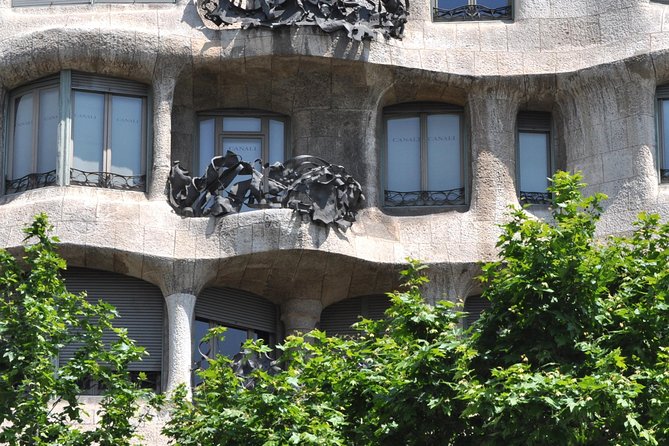
Casa Milà, also called La Pedrera, is one of the clearest places to see Gaudí refusing ordinary apartment design. Its stone exterior curves in broad waves, and its iron balconies add a restless, almost plant-like quality.
From the street, you can study the building’s mass and surface without entering. That limitation matters, since Casa Milà’s interiors and roof are famous in their own right, but the outside still offers plenty to discuss. A guide can help you notice how the façade avoids a flat, repetitive rhythm and how the building seems to flow from one section to the next.
This stop works well as an opening lesson in Gaudí’s mature style. You begin with a large urban building, not a small fantasy object. The guide can show how Gaudí made an apartment block feel sculptural while still fitting it into the Eixample street grid.
If your main aim is to visit the interior of La Pedrera, you will need a separate ticket and separate time. This walking tour does not include entry.
Casa Batlló and the theatrical side of Modernism
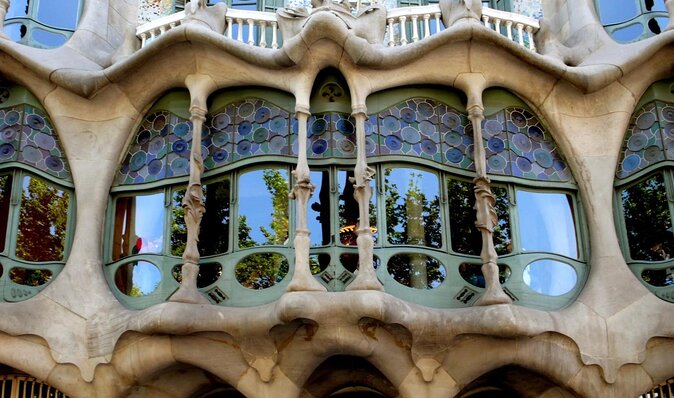
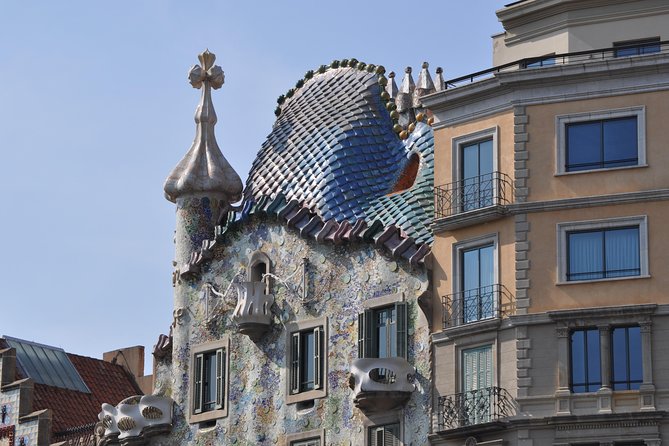
Casa Batlló brings a different mood. Its façade is famous for irregular shapes, unusual color, and a sense of movement that makes the building look almost alive. Gaudí transformed an existing structure rather than creating a plain new block, turning a standard urban residence into a visual performance.
The exterior is especially good for comparing detail and overall effect. Look at the balconies, window openings, surface treatment, and roofline. The design rewards close attention, but it also works from across the street, where the full composition becomes easier to read.
This is one of the places where a professional guide can add real value. A casual glance may leave you with the impression that Casa Batlló is simply whimsical. The architectural discussion connects its unusual forms with Gaudí’s working methods and with the taste of Barcelona’s early twentieth-century elite.
Again, you stay outside. That means you avoid spending time on interior admission during the walk, but you also miss the building’s rooms and immersive displays. If you want both, use this tour for context and return separately for an interior visit.
Same city, a different building to stand in front of:
- Barcelona: Sant Pau Recinte Modernista Entry Ticket
★ 4.6 · 2,567 reviews - Barcelona: Sagrada Familia, Modernism, and Old Town Tour
★ 4.7 · 1,621 reviews - Complete Gaudi Tour: Casa Batllo, Park Guell & Sagrada Familia
★ 5.0 · 1,152 reviews - Park Güell: Guided Tour with Optional Gaudí Experience Entry
★ 4.1 · 832 reviews
Casa Calvet and Gaudí’s more restrained face
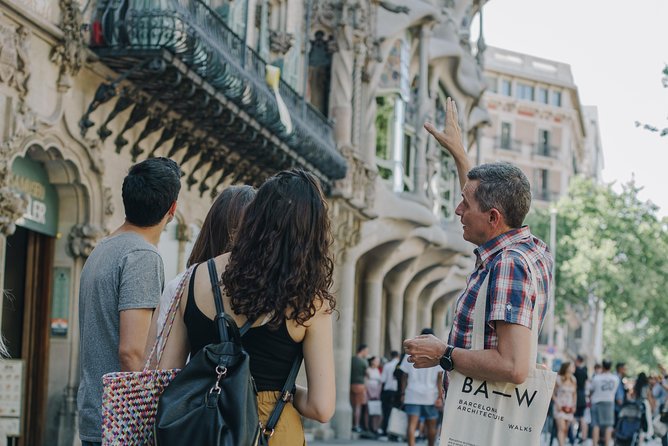
Casa Calvet is useful because it complicates the popular image of Gaudí. Compared with Casa Batlló and Casa Milà, it can appear more controlled and conventional. That does not make it less interesting. It shows how Gaudí adapted his design language to a different commission and a more formal setting.
This stop helps prevent the tour from becoming a simple list of Gaudí’s wildest creations. You can compare the building’s order, ornament, and proportions with the freer forms seen elsewhere on the route.
I appreciate that the itinerary includes Casa Calvet because it gives you a better sense of range. Gaudí was not always trying to shock. His work could respond to a client, a site, and a particular urban purpose.
The Manzana de la Discordia, Barcelona’s architectural contest
The Manzana de la Discordia, or Block of Discord, is one of the route’s best comparison points. Several major Modernist buildings sit close together, allowing you to read Barcelona’s architectural rivalry without crossing half the city.
Casa Batlló is the Gaudí landmark here, but the nearby Casa Amatller by Puig i Cadafalch and Casa Lleó Morera by Domènech i Montaner broaden the picture. Their proximity turns the street into an open-air argument among architects.
This is where the tour’s wider historical purpose becomes especially clear. Barcelona’s wealthy industrial and intellectual families wanted homes that expressed status, taste, and modern identity. The result was not one unified style, but a spirited mix of approaches.
You may find that this comparison makes Gaudí more interesting, not less. His buildings are easier to understand when you see what other architects were doing at the same time. Puig i Cadafalch and Domènech i Montaner were not background figures. They had their own ideas about ornament, national identity, craft, and modern life.
The Antoni Tàpies Foundation and Barcelona’s changing artistic identity
The Antoni Tàpies Foundation adds a later artistic layer to the route. Its building connects the Modernist period with Barcelona’s continuing interest in experimental design and visual culture.
The foundation is associated with Antoni Tàpies, one of Spain’s major modern artists. On this walk, you see the exterior as part of the city’s broader architectural story rather than visiting the collection inside.
That distinction is worth keeping in mind. The stop gives you another building to examine and another point of comparison, but it is not a museum visit. If you want to see Tàpies’s art, plan a separate visit.
Courtyards, urban planning, and what you miss from the sidewalk
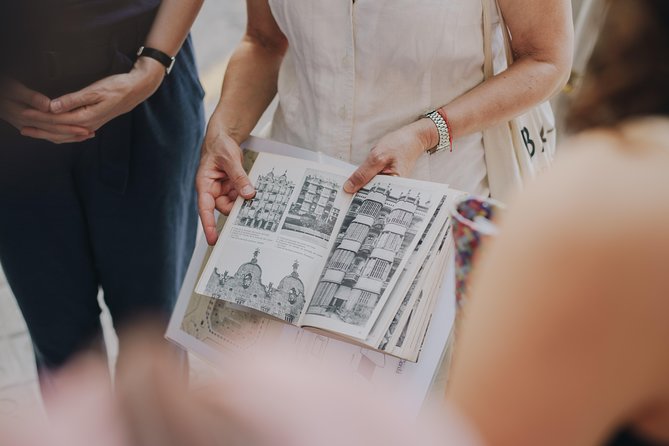
The route includes some less obvious Eixample courtyards. These spaces matter because Barcelona’s Modernist story is not only about decorated street façades. The Eixample was planned with a strong urban structure, and its blocks, open areas, and shared spaces help explain how the city expanded.
Courtyards can be easy to overlook when you are focused on balconies and rooflines. I like their inclusion because they shift your attention from individual buildings to the way the city works as a whole.
The exact courtyards are not specified, so you should not expect a fixed checklist of named sites. Think of them as part of the architectural reading of the Eixample, not as a separate attraction with guaranteed interior access.
The social and political story behind the façades
The most ambitious part of the walk is its historical range. You may hear about utopian socialism, positivist materialism, anarchism, the Spanish Civil War, religious devotion, and Gaudí’s path toward beatification.
That mix gives the buildings weight. Architecture is never only decoration, and Barcelona’s Modernist period was shaped by tensions between industry, wealth, religion, political unrest, and regional identity.
The material may feel dense at times. This is not a breezy photo walk built around a few fun facts. If you enjoy asking why a city looks the way it does, the context will make the tour more rewarding. If you prefer a simple list of filming locations and famous façades, you may find the historical discussion more than you need.
The guide’s personality can make a major difference. Pia is praised for combining detailed information with kindness, humor, and enthusiasm. That combination matters when the subject reaches from architectural theory to civil conflict. A guide who can explain serious ideas without making the walk feel like a classroom is a real advantage.
What a group of 20 feels like on city streets
The maximum group size is 20. That is not a private tour, but it is small enough to feel more personal than a large city walk.
A smaller group should make it easier to stay near the guide, hear explanations, and ask questions at busy façades. It also suits this subject, since you may want clarification about a design detail or historical term.
The trade-off is that the experience still takes place in central Barcelona. Street noise, passing pedestrians, and traffic can affect how easily you hear every word. Staying close to the guide is important, especially at popular stops.
The activity is listed as suitable for most people, and service animals are allowed. Since it is a walking tour lasting about three hours, consider your own comfort with standing and moving through city streets. No special fitness level is stated, but this is not a seated activity.
Is $54.44 a fair price?
At $54.44 per person, the value depends on what you want from Barcelona. You are not paying for building admission, transport, or a meal. You are paying for three hours of guided interpretation from an architect-led company, with a route that covers several major Modernist works and their social setting.
That is a fair proposition if you want to understand what you are seeing. Casa Batlló, Casa Milà, and the other buildings can be visited independently from the outside at no cost, but their meaning is harder to assemble on your own. The price also reflects the small group limit and the specialized subject.
It is less attractive if your priority is entering Gaudí buildings. Since no interiors are included, you may spend more later on separate admission tickets. I would treat this as a context-building walk, not as a substitute for interior visits.
The tour is often booked well ahead, with an average booking time of about 41 days. That suggests planning early is wise, especially if your Barcelona dates are fixed.
Who should book the walk?
I would choose this experience if you:
- Want Gaudí explained through architecture, not only celebrity and decoration
- Enjoy social, political, and religious context
- Prefer a small group to a large sightseeing crowd
- Want to compare Gaudí with Domènech i Montaner and Puig i Cadafalch
- Plan to visit Barcelona’s major buildings separately from the outside or inside
- Appreciate a guide who can mix serious material with humor
I would hesitate if you:
- Need interior admission included
- Want a short, casual photo stop rather than three hours of discussion
- Have little interest in architecture or Barcelona’s political history
- Need a fully weather-proof activity
The experience ends where it begins, which is convenient for fitting into a larger day. Free cancellation is available up to 24 hours before the start time. Cancellations made later are not refunded, and changes within that period are not accepted.
Should you book Barcelona and Gaudí?
Book it if you want Barcelona’s Modernist buildings to become easier to read. The strongest parts are the architect-led guidance, the comparison among several major designers, the smaller group, and the attention to social forces behind the façades.
Skip it if you mainly want to tour the interiors of Casa Batlló or La Pedrera, since entry is not included. For most architecture-minded visitors, though, this is a useful three-hour foundation. You’ll leave with more than a set of photographs. You’ll have a clearer sense of why Gaudí looked so far beyond ordinary apartment design, and why Barcelona’s Eixample became one of Europe’s great stages for architectural competition.
FAQ
How long does the Barcelona and Gaudí tour last?
The tour lasts approximately three hours.
What time does the tour begin?
It begins at 10:30 a.m.
Where does the tour start?
It starts at the Monument al Llibre on Gran Via de les Corts Catalanes, 634, in Barcelona’s Eixample district.
Where does the tour end?
The activity ends back at the original meeting point.
Are building interiors included?
No. The tour visits the buildings from the outside and does not include interior entry.
How many people can join the tour?
The group has a maximum of 20 participants.
Is free cancellation available?
Yes. You can cancel for a full refund up to 24 hours before the experience starts. If poor weather or an insufficient number of participants causes the tour to be canceled, you’ll be offered another date or a full refund.
Just added in Barcelona
- Visit to the Modernist houses of the Americans★ 5.0 · 2 reviews
- Roman & Gotic & Gaudi in Barcelona: private walking tour★ 4.5 · 2 reviews
- Self-Guided Audio Tour-The Surrealist Barcelona of Dalí and Gaudí★ 3.5 · 8 reviews
- Barcelona Gaudi Tour: Sagrada Familia, Casa Batllo & Casa Mila★ 5.0 · 4 reviews
- Barcelona Street Escape: Gaudi and the Hidden Treasure★ 5.0 · 17 reviews
- Sagrada Familia Private Tour – Unlock the mysteries of Gaudi★ 5.0 · 10 reviews
- Gaudi’s Casa Batlló and La Pedrera with Chocolate Tasting★ 5.0 · 5 reviews
- Gaudí & Catalan Modernism Private Walking Tour★ 5.0 · 11 reviews
Gaudí Tours, compared.
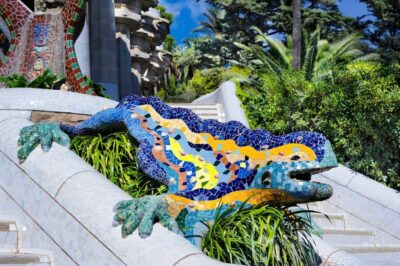
Park Güell and Gaudí House Museum Entry Ticket
Read our review →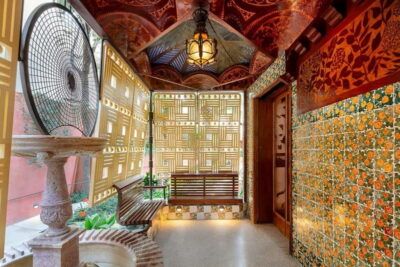
Gaudi’s Casa Vicens Skip-the-Line Entrance Ticket
Read our review →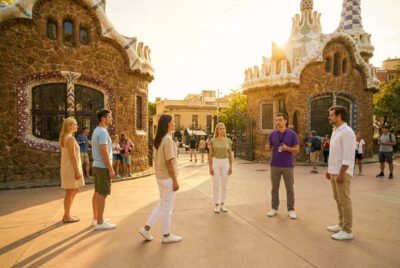
Gaudí’s Park Güell Tour with Fast-Track Ticket
Read our review →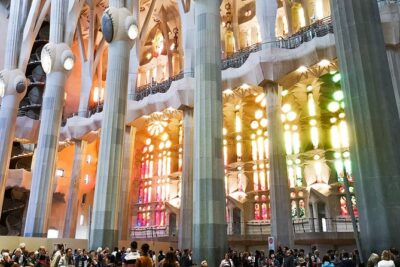
Sagrada Familia & Gaudi Tour Private or Small Group with Tickets
Read our review →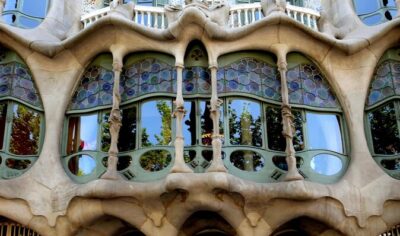
Complete Gaudi Tour: Casa Batllo, Park Guell & Sagrada Familia
Read our review →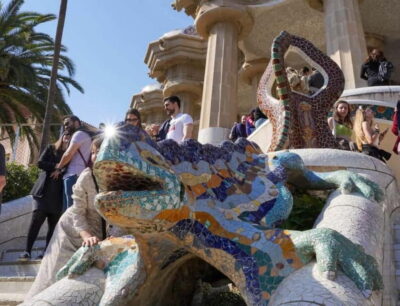
Park Güell: Guided Tour with Optional Gaudí Experience Entry
Read our review →
Barcelona e-Bike Tour: Gaudí & Old Town Small Group
Read our review →
Ramblas, Old Town, Gothic and Gaudi Architecture Walking Tour
Read our review →Browse the lists this tour appears in