
REVIEW · SELF-GUIDED AUDIO TOURS
Bastille’s Architecture & Artisans Self-Guided Walking Tour
Bastille rewards walkers who look past the square. This self-guided route takes you from revolutionary ground through old artisan streets, a historic passage, a local market, and the Coulée Verte René-Dumont. I like the freedom to start when your schedule allows, and I like that the audio commentary comes from a local historian, Juan. The main drawback is simple: you must bring your own phone and earphones, and the download process needs attention before you arrive.
At $17.88 per person, this is a sensible way to add context to a part of Paris that many visitors cross without exploring. The GPS map, offline listening, and small route make it easy to pause for photographs or a market snack. Still, one poor experience came from not finding the starting point, while another person never received the download link in time. I recommend checking your access before setting out.
Key points to know before walking
- Seven stops in about 45 minutes to one hour: The route is compact, but you can pause longer at the market, square, or passage.
- A local voice guides the walk: Juan explains the area’s revolutionary links, artisan past, architecture, and changing public spaces.
- Start at Place de la Bastille: The walk begins at the historic square and ends at 1 Coulée Verte René-Dumont.
- Built for independent exploring: GPS directions and offline audio let you walk without a scheduled group or live guide.
- The market is the best place to linger: Marché d’Aligre and Marché Beauvau bring food, brocantes, and local atmosphere into the route.
- Prepare your technology first: The mobile device and earphones are not included, and the audio access code must arrive before you begin.
Why Bastille makes a good walking subject
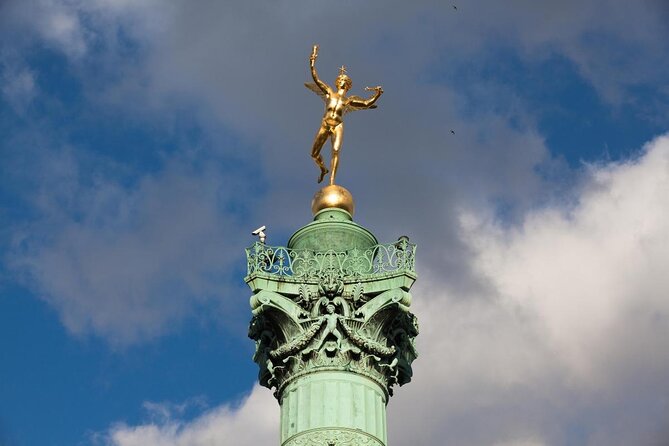
Bastille is more than the tall July Column in the middle of a traffic-heavy square. It is a useful Paris neighborhood for seeing how major political events, craft work, old housing, food markets, and modern public spaces sit close together.
The route gives you that story in manageable pieces. You do not spend hours marching between distant monuments. Instead, you move through a series of nearby locations where the character changes from grand public square to narrow artisan street, quiet passage, neighborhood green, market, and elevated park.
That scale is one of the tour’s strengths. You can finish in under an hour if you keep moving, but the format also gives you room to stop. I would allow extra time for the market, especially if you want to look through the brocantes or eat something along the way.
The published rating is 4.3 out of 5 from 18 ratings. The praise focuses on the useful historical context and the ability to stop whenever you want. The weaker experiences are tied less to the route itself than to access problems and uncertainty about where to begin.
More self-guided audio tours in the world:
Place de la Bastille: begin where the story broke open
The walk starts at Place de la Bastille, the natural place to introduce the French Revolution. You receive the first explanation here, where the former prison became a powerful symbol of political change.
This opening is valuable because the square can be hard to read at street level. Traffic circles around it, several streets meet here, and the modern city can distract from the event that gave the place its fame. An audio guide helps you connect the present-day setting with the political force of the Bastille.
Admission to the square is free, of course. You do not need a timed entry or a ticket for any of the outdoor stops. The practical challenge is orientation. One person found the start unclear and never got going, so I would open the app and confirm the GPS starting point before you leave your hotel or Métro stop.
The opening hours supplied for the experience are 7:00 a.m. to 10:00 p.m., Monday through Sunday. That gives you plenty of flexibility, although the market will have its own rhythm and may be more rewarding during daytime hours.
Rue du Faubourg Saint-Antoine: follow the artisan story
From the square, the route turns toward Rue du Faubourg Saint-Antoine. This street helps explain why Bastille was not only a political center. It was also linked to skilled trades and workshops, and those working communities shaped the neighborhood’s identity.
The audio commentary connects the area’s artisan roots with the French Revolution. That is the sort of context I find useful on a city walk. Instead of seeing a street as a line of shops and traffic, you begin to understand why this particular quarter mattered and how work, housing, and politics overlapped.
The stop is listed at about five minutes, but you should not feel tied to that timing. A self-guided route works best when you treat the times as suggestions. Pause if a doorway, street view, or old building catches your eye, then let the GPS guide you onward.
Rue du Faubourg Saint-Antoine is also where the tour begins to feel less like a monument checklist. You are looking at an ordinary Paris street with an unusual past. That is a good fit for visitors who prefer neighborhood texture to a string of famous photo stops.
Passage du Chantier: old architecture in a small space
Passage du Chantier offers a closer look at the architectural character of Faubourg Saint-Antoine. The route uses this short passage to explain how the neighborhood’s old building style relates to its working past.
The attraction here is scale. A passage can make the city feel more intimate than a broad avenue. You have a chance to slow down, listen, and notice how the architecture differs from the larger streets around it.
Juan’s commentary is especially important at this stop because the buildings may not explain themselves. Without context, you might simply see an attractive old-style passage. With the audio, you get a reason to care about its form and place in the district.
Do not expect a major museum or a formal architectural tour. This is a brief outdoor stop, listed at around five minutes. Its value comes from the connection between place and explanation, not from a long visit or a large collection.
More walking tours in the world:
- Lecce: Baroque Architecture and Underground Walking Tour
★ 4.6 · 1,248 reviews - Chicago in a Day: Food, History & Architecture Walking Tour
★ 5.0 · 1,153 reviews - Ramblas, Old Town, Gothic and Gaudi Architecture Walking Tour
★ 5.0 · 723 reviews - Chicago’s Secret Interiors Architectural Walking Tour
★ 5.0 · 635 reviews
Fontaine de Charonne and Square Trousseau: two quieter pauses
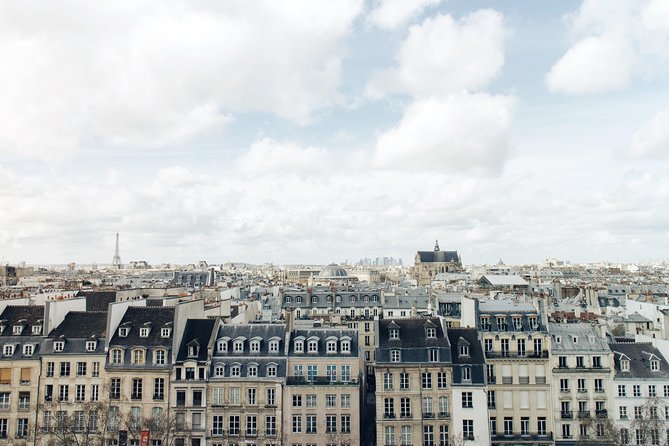
The Fontaine de Charonne brings the route to a point where older design meets present-day Paris. The stop focuses on the preservation of the fountain and the way an old feature remains part of modern neighborhood life.
That contrast gives the walk a welcome change of pace. You are no longer standing in the middle of a major square or following a busy commercial street. The fountain offers a short visual pause and a reminder that Paris often keeps fragments of earlier eras in everyday settings.
Next comes Square Trousseau, described as a green oasis and a place for a leisurely break. The five-minute audio segment explains the square’s past while giving you a chance to sit or walk at an easier pace.
This is one of the route’s better design choices. Bastille can feel energetic and crowded, so a small square gives you breathing room. I would not plan a long picnic around this stop because the supplied timing is brief, but it is a useful place to pause, check your phone, and reset before the market section.
Marché d’Aligre and Marché Beauvau: save time for the market
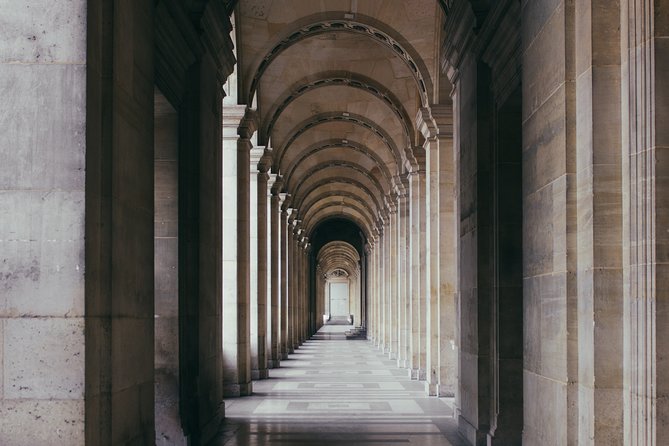
The market section is the most flexible and potentially the most rewarding part of the walk. It includes Marché d’Aligre and Marché Beauvau, with time to explore brocantes, sample local food, and take in the atmosphere Juan considers especially appealing.
The listed time is about ten minutes, but this is the one stop where I would willingly stretch the schedule. A market is not a monument that you can understand in one glance. You may want to browse the stalls, look for an inexpensive bite, or examine the secondhand goods sold through the brocante tradition.
The market also gives the route a more everyday feel. The earlier stops explain political and architectural history. Here, you see how the neighborhood functions as a place to shop, eat, and meet. That makes the walk more useful than a purely historical narration.
The tradeoff is that markets are active public spaces, not controlled attractions. Sound quality may be less consistent around people and stalls, and you may be tempted to stop for longer than the audio expects. That is not a serious problem. The tour is self-guided, so pause the recording and continue when you are ready.
If food is part of your Paris plans, this is the section to protect time for. The price of the tour does not include food, and admission is free, but the market may encourage you to spend a little extra on something to eat.
Coulée Verte René-Dumont: finish on a former rail line
The route ends at 1 Coulée Verte René-Dumont. The final commentary recounts the area’s past and its poetic present, giving the walk a softer ending than the opening at Place de la Bastille.
The Coulée Verte is a pleasant place to finish because it represents change. The route has moved from revolutionary memory and old trades toward a modern public space shaped by reuse. You finish with a sense of how Paris keeps adapting older structures for present-day life.
The end point is useful for planning your next move. You can treat the walk as a self-contained neighborhood outing, or use the Coulée Verte as the beginning of more independent exploring. The tour itself does not include transportation afterward, so check your next destination before you start.
The final stop is listed at about five minutes. Again, think of that as narration time, not a limit on your visit. If you enjoy parks and elevated paths, you may want to remain here longer after the audio ends.
What the $17.88 price actually buys you
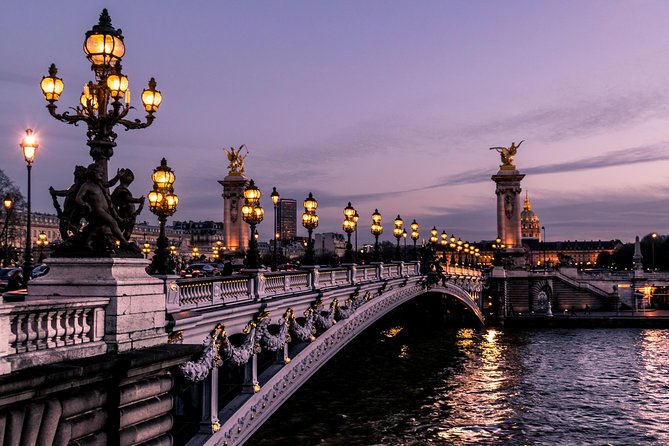
At $17.88 per person, the cost is reasonable for a short audio walk if you value interpretation more than a live guide. You are paying for the narration, route planning, GPS map, offline mode, and the convenience of having the story organized in a logical order.
The route covers seven stops in less than an hour, so the price is not a bargain if you measure value only by minutes. It becomes better value when you consider what the commentary adds to places that are free to enter. You do not pay admission at Place de la Bastille, the fountain, the square, the market, or the Coulée Verte. The fee pays for explanation and structure.
The experience works especially well for one or two people who want independence. A couple pays about $35.76 at the listed rate, which is still less than many private walking tours. However, a live guide would offer conversation, instant clarification, and help with orientation. This audio option gives you privacy and flexibility instead.
One published complaint refers to paying $32 for two people. That amount may reflect a different price at the time of purchase, so check the current total before booking rather than relying on an older figure.
The app, audio, and starting point require preparation
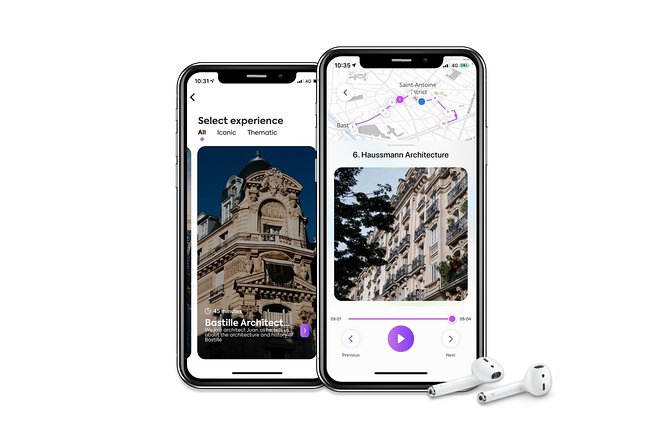
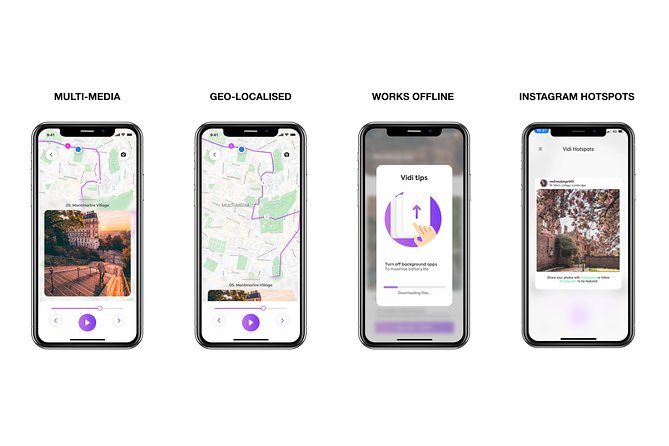
The tour is delivered through the Vidi Guides app. You receive a unique code to download the walk, and the audio can be saved for offline use. That is important in Paris, where you may not want to depend on a steady data connection while walking.
You need three things that are not supplied:
- Your own mobile device
- Your own earphones
- The download link or access code before arrival
The audio was recorded by a local or historian, with Juan named in the route commentary. That local perspective is one of the experience’s strongest features. You hear more than basic dates, and the route links Bastille’s events, crafts, buildings, markets, and public spaces.
Still, technology is the weak point. One person could not participate because the download email did not arrive in time. Another could not identify the starting point. I would download the tour before reaching Place de la Bastille, open the map, and test the first segment while you still have a reliable connection.
The tour can accommodate a maximum of 10 people, though its self-guided format means you are not dependent on a live group moving at one pace. You can stop the audio, take photographs, or linger over food without holding up a guide.
Who will enjoy this Bastille walk most
I recommend this experience for independent visitors who want history with a neighborhood feel. It suits you if you enjoy walking, prefer a flexible schedule, and like having background information without committing to a long guided group tour.
It is also a good choice for repeat visitors to Paris. If you have already seen the main monuments, Bastille offers a way to spend an hour with streets, markets, and architecture that receive less attention.
Families and mixed-age groups may appreciate the ability to pause. The route is short, and most people can participate according to the supplied information. Service animals are allowed, and the starting point is near public transportation.
I would think twice if you want a personal exchange with a guide or if you dislike using your phone while sightseeing. You should also skip it if you cannot confirm the app access before the day of your walk. The content may be worthwhile, but a self-guided tour cannot solve a missing download link once you are already at the meeting point.
Free cancellation is available if you cancel at least 24 hours before the scheduled start time. Cancellations or changes within 24 hours are not refunded or accepted.
Should you book Bastille’s Architecture & Artisans walk?
Book it if you want an affordable, short introduction to Bastille that goes beyond the famous square. The strongest parts are the local historical voice, the artisan connection along Rue du Faubourg Saint-Antoine, the market stop, and the freedom to pause whenever you like.
Do not book it expecting a live guide, museum entry, or a perfectly effortless start without preparation. Download the audio in advance, bring earphones, confirm the Place de la Bastille meeting point, and allow extra time at Marché d’Aligre and Marché Beauvau.
For independent walkers, the $17.88 fee is fair. It gives free public places a clear story and lets you explore at your own pace. That makes this a worthwhile pick for a compact Paris neighborhood walk, provided your phone setup is ready before you leave.
FAQ
Where does the walking tour start?
It starts at Place de la Bastille, Place de la Bastille, Paris, France.
Where does the tour end?
The route ends at 1 Coulée Verte René-Dumont, 75012 Paris, France.
How long does the tour take?
The walk takes approximately 45 minutes to one hour.
What language is the audio tour offered in?
The tour is offered in English.
Is the tour guided in person?
No. It is a self-guided audio tour accessed through the Vidi Guides app.
Do I need to bring my own phone and earphones?
Yes. A mobile device and earphones are not included.
Can I listen without WiFi?
Yes. You can download the tour in advance and use its offline mode.
How much does the tour cost?
The listed price is $17.88 per person.
Is cancellation available?
Yes. You can receive a full refund if you cancel at least 24 hours before the experience start time. Cancellations within 24 hours are not refunded.
More Self-Guided Tours in the world
- Woodlawn Cemetery: A Self-Guided Audio Tour of Gilded Age Art and Architecture
★ 5.0 · 2 reviews - Gaudi and La Sagrada Familia Exterior Self-Guided Audio Tour
★ 3.5 · 25 reviews - Palau Guell by Gaudi with Audio Guide in Barcelona
★ 4.5 · 13 reviews - Self-Guided Audio Tour-The Surrealist Barcelona of Dalí and Gaudí
★ 3.5 · 8 reviews
Just added in the world
- Wilmington History and Architecture Tour★ 4.8 · 18 reviews
- New Orleans : Garden District Architecture Walking tour★ 4.8 · 5 reviews
- Washington DC: Dupont Circle & Embassy Row Architecture Tour★ 5.0 · 6 reviews
- Washington, DC: Georgetown Architecture Walking Tour★ 5.0 · 8 reviews
- Vicenza: Palladian Architecture Private Walking Tour★ 3.3 · 3 reviews
- Walk & Discover KL’s Architectural and Heritage Gems★ 5.0 · 7 reviews
- Unveiling Brno: History, Culture & Architectural Delights★ 5.0 · 2 reviews
- Private Colonial Williamsburg Architectural Tour★ 5.0 · 5 reviews
Self-Guided Audio Tours, compared.
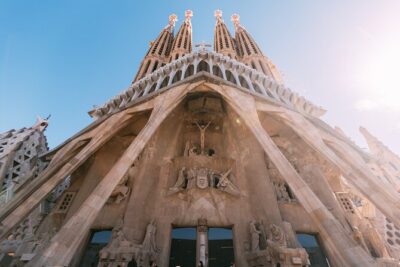
Gaudi and La Sagrada Familia Exterior Self-Guided Audio Tour
Read our review →
Self-Guided Tour of Ísafjörður: Art, History, and Architecture
Read our review →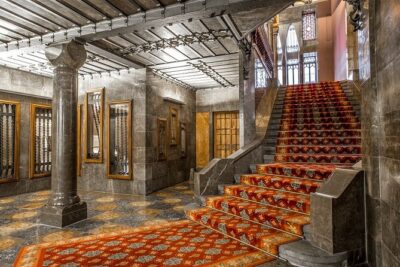
Palau Guell by Gaudi with Audio Guide in Barcelona
Read our review →
Self-Guided Audio Tour-The Surrealist Barcelona of Dalí and Gaudí
Read our review →
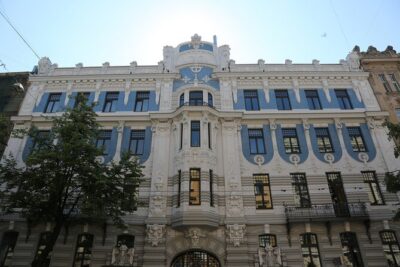
Riga’s Architecture: A self-guided audio tour of the city’s art nouveau history
Read our review →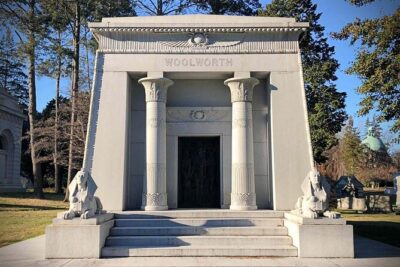
Woodlawn Cemetery: A Self-Guided Audio Tour of Gilded Age Art and Architecture
Read our review →
Philadelphia Architecture: Discover Every American Style on a GPS Audio Tour
Read our review →Browse the lists this tour appears in